


On this page
- Planning and insight
- Script and production
- Versions and localization
- Buying and bidding
- Analysis and the next brief
- Generative AI advertising disclosure: Platform rules and 2026 regulation
- Example: Division of work and sign-off for an app install campaign
- AI Studio and AI DASH across one campaign
- Frequently asked questions
In generative AI advertising, models write, draw, film, and voice ad content. The AI that ad platforms run inside campaigns also bids, moves budget, and makes new versions of uploaded assets. Across one campaign, generative AI in advertising touches five stages: planning and insight, script and production, versions and localization, buying and bidding, and analysis for the next brief.
WFA's September 2026 study of 54 senior respondents from 46 top brand owners found that 80% use AI for content creation and 72% for research and insights. Media buying and optimization came in at 54%, and strategy and planning at 48%. Most respondents use AI to make content; about half use it to plan or to buy media.
AI in advertising runs on two kinds of AI in every campaign. The team's tools produce output that is reviewed before upload. Platform AI bids, moves budget, and generates versions under the settings chosen at setup. Each kind needs its own owner: one for what enters the ad account, one for the platform settings that change it after upload.
Planning and insight
AI drafts the inputs to a brief: summaries of past results, audience hypotheses, competing messages in the category, and a first draft of the brief itself.
Trace each AI-produced insight to its data before the brief is approved: date range, accounts, and the number of ads or users behind it. An insight with no traceable source comes out of the brief. Competing messages get the same check against the live ads they came from.
Audience hypotheses enter the brief as test cells, each with one message and one metric. Any audience the ad platform cannot target comes out at this stage.
List the synthetic assets in the brief as well, such as an AI presenter, a cloned voice, or a generated product scene. Naming them at the brief moves the disclosure decision ahead of production.
Script and production
Models draft concepts and scripts, build storyboards, and render scenes, voices, and music from the brief and approved brand assets.
Settle synthetic people and voices at the script, before any scene renders. IAB's August 2026 disclosure framework lists photorealistic synthetic humans in primary roles among the uses that need a consumer-facing disclosure.
Review rendered scenes one at a time for product accuracy, claims, continuity, and rights. Generated footage meets the same claim standard as filmed work. Starti's guide to AI video ad production sets out the review gates from brief to final cut.
Versions and localization
Set platform creative enhancements asset by asset. Assets that passed legal review or carry talent and music clearances go in with enhancements off, and test assets go in with them on. New Demand Gen campaigns start with Google's video enhancements for vertical and shorter versions switched on, and with auto-generated video ads and image enhancements checked; each can be turned off. Google advises reviewing live previews of auto-generated video ads before publishing. Give each preview the same placement check as the team's own cuts.
For localization, IAB lists AI translation of approved text into multiple languages as not requiring disclosure. New York's synthetic performer law exempts AI used solely for the language translation of a human performer. Cloned voices are different. TikTok's ad policy counts AI voice cloning that makes the primary subject say what they did not say as a significant edit that needs a label. Every localized cut gets a native speaker's review before it runs.
Buying and bidding
In Performance Max, Smart Bidding bids in real-time auctions "based on your conversion probability," per Google's help page. The campaign funnels budget toward the highest performing inventory and placements. For Meta, Starti's Meta Andromeda guide explains how ads are retrieved and ranked and sets a starting ad set structure for creative.
Teams give the bidder its conversion event and value, the budget, the assets, and the creative enhancement settings. The conversion event weighs most: an install goal buys installs whether or not those users start a trial. Count the event closest to revenue that fires often enough for the bidder to learn from, and pass a value with it where revenue differs by plan. On Meta, the Andromeda guide works out that weekly volume and budget from the learning phase.
Analysis and the next brief
AI reads results across ad accounts, groups ads by creative attributes such as the opening, visual style, and call to action, and drafts findings and a next brief.
Open a sample of ads in each attribute group first and confirm the label matches what is on screen. Then read each finding with its evidence: number of ads, spend, comparison group, and counterexamples. A comparison group should share the placement and objective; a vertical video in Reels set against square images in feed measures placement as much as creative. A pattern from a handful of ads enters the next brief as a test.
Generative AI advertising disclosure: Platform rules and 2026 regulation
TikTok and Meta set AI label rules for all ads. TikTok requires its AIGC label or the advertiser's own clear disclaimer on AI-generated or significantly edited content. Meta adds "AI info" to ads made or significantly edited with its own generative AI tools and, when it detects them, to ads made with third-party tools.
Google Ads labels assets the advertiser designates through its AI label setting, with a visible overlay in campaigns targeting the EU, India, New York, California, South Korea, or Vietnam.
For election ads, Google's political content policy requires the "Altered or synthetic content" checkbox when content is synthetic or digitally altered. Meta's policy for social issue, election, and political ads requires disclosure of photorealistic images, video, or realistic-sounding audio created or edited with third-party generative AI tools. It covers real people shown saying or doing what they did not, and invented people or events.
Since August 2, 2026, the EU AI Act has required deployers of AI, advertisers among them, to disclose deep fakes. Starti's AI commercials guide lists the Meta, TikTok, and Google Ads label rules and New York's synthetic performer rule.
Example: Division of work and sign-off for an app install campaign
- Planning and insight: AI summarizes past results from the Meta, TikTok, and Google Ads accounts and drafts the brief. The growth lead sets goal, audience, offer, and success metric. Sign-off: every insight cites its date range and sample, and planned synthetic people, voices, and scenes are listed.
- Script and production: AI drafts concepts and scripts and renders scenes, voices, and music. The creative lead approves concept, script, and storyboard before rendering; legal, brand, and product marketing sign at the stages in Starti's approval checklist for AI generated ads. Sign-off: each scene passes review on its own.
- Versions and localization: AI reframes, shortens, translates, and dubs, and platform AI adds versions where enhancements are on. The creative lead approves each version at its running size, and a native speaker reviews each language. Sign-off: enhancement settings previewed or switched off, asset by asset.
- Buying and bidding: platform AI bids and moves budget toward the chosen event. The media lead sets the event, its value, the budget, and the enhancement settings. Sign-off: conversion action, enhancement settings, and Google's AI label setting checked before launch; served versions matched to the approved list each week, with any unreviewed generated version removed.
- Analysis and next brief: AI groups ads by attribute and drafts findings. The creative strategist accepts or rejects each finding on its sample and counterexamples. Sign-off: the next brief names one change, its finding, its success metric, and the read date.
- Disclosure and release: the final approver labels any asset where AI materially shapes content in ways that could mislead a reasonable consumer about authenticity, identity, or representation, IAB's disclosure threshold. Labels go on per platform: AIGC label or own disclaimer on TikTok, and AI label setting on Google Ads. A visible label goes inside the creative wherever the platform's own label cannot be relied on, CTV included. Sign-off: the decision is recorded with the file, and one named person releases each file.
AI Studio and AI DASH across one campaign
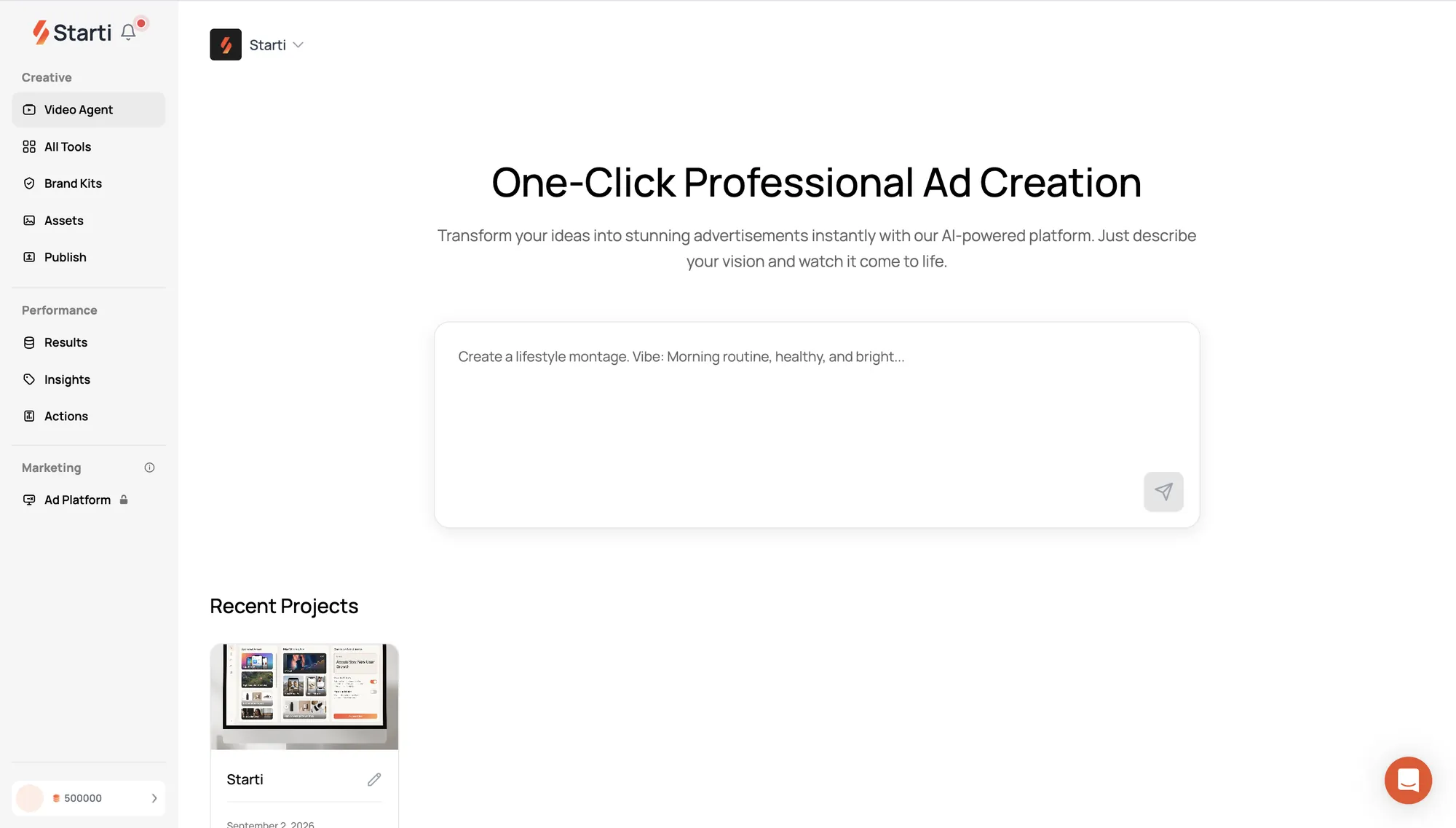
In AI Studio, Video Agent starts from the goal, audience, offer, and key message, turns the brief into concepts, scripts, and storyboards, and moves nothing forward without the team's approval. Finished videos can be reframed to 9:16, 16:9, 1:1, and 4:5, localized into ten languages, and, once approved, published to connected Meta, Google Ads, and TikTok ad accounts.
Brand kits in AI DAM hold the approved logo, colors, fonts, and brand description, and every concept and scene starts from the kit. Smart Insight compares nine creative attributes against CTR, completion, and other outcomes across connected Meta, TikTok, and Google Ads accounts. Each finding comes with its supporting ads and counterexamples.
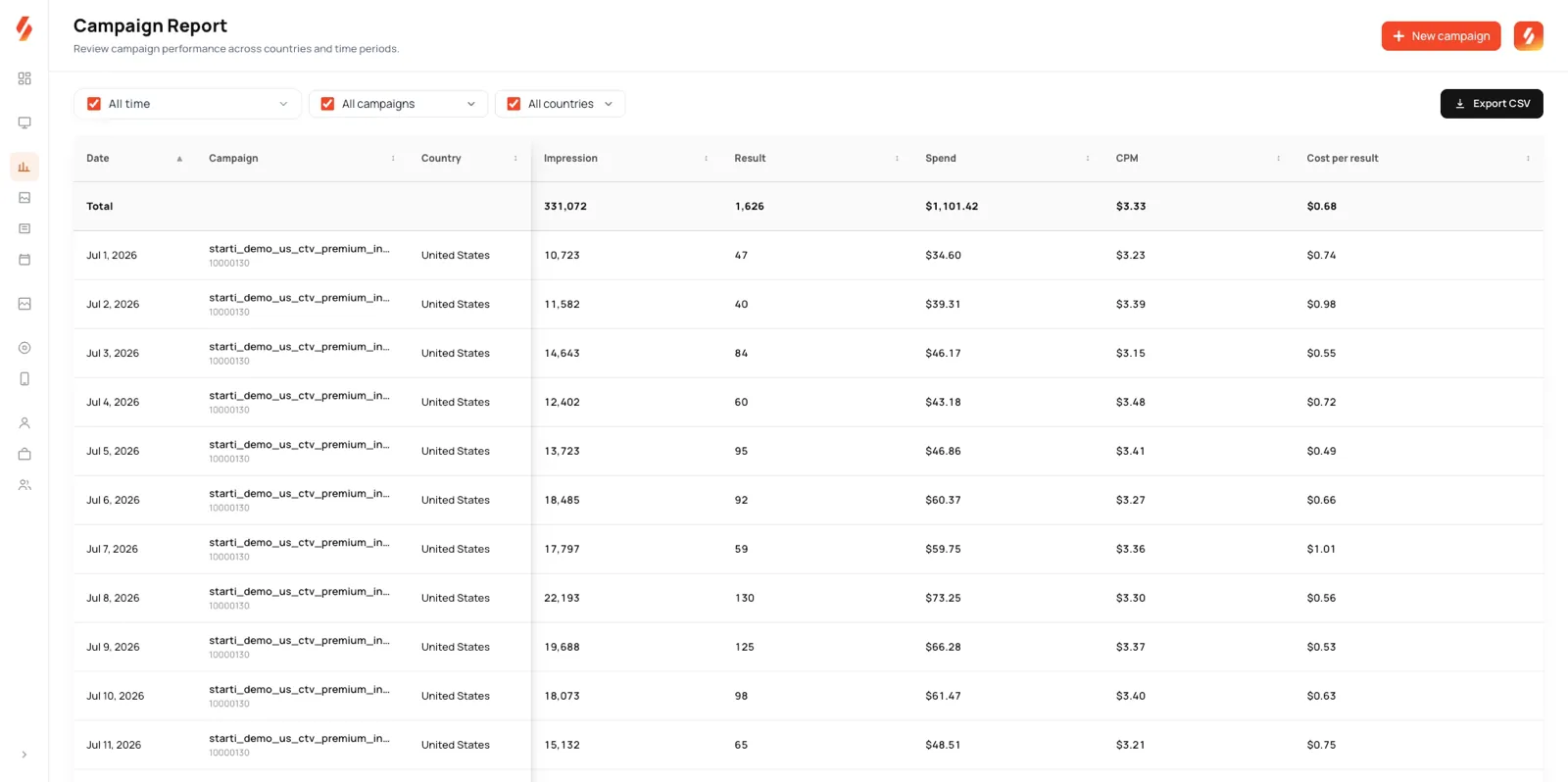
When the buy includes CTV, AI DASH, Starti's performance CTV platform, uses its Adaptive Performance Engine to adjust bids and budgets across creatives and media as performance changes. AI DASH also brings delivery, creative performance, media quality, and results into one reporting layer.
Explore AI Studio to follow a brief from first concept to final cut.
Frequently asked questions
What is generative AI advertising?
It covers ad content that AI models make or change: copy, images, video, voice, and music from a team's tools, plus the versions ad platforms generate inside a campaign. People set the goal, audience, offer, and claims, and approve the output before it runs.
Do AI-generated ads need to be labeled?
Yes on TikTok, where the advertiser adds the AIGC label or its own disclaimer to AI-generated or significantly edited content. Meta applies its "AI info" label itself, to ads made with its own tools and to ads it detects as made with other AI tools. The label sits next to Sponsored when an ad includes an AI-generated photorealistic human. Google Ads shows a label for assets the advertiser designates and requires disclosure on election ads with synthetic content.
Does EU law require labels on AI-generated ads?
Yes, for deep fakes. Article 50(4) of the EU AI Act requires a deployer of AI that generates or manipulates image, audio, or video content constituting a deep fake to disclose it. The Act defines a deep fake as content resembling existing persons, objects, places, entities, or events that would falsely appear authentic. Evidently artistic, creative, or fictional work carries a lighter duty: a disclosure that does not hamper enjoyment of the work.
Does platform AI change ads after upload?
In Performance Max, it does: Google's generative AI tools combine uploaded assets and creatives into new images and videos. Compare served versions with the approved list each week and remove any that skipped review.