On this page
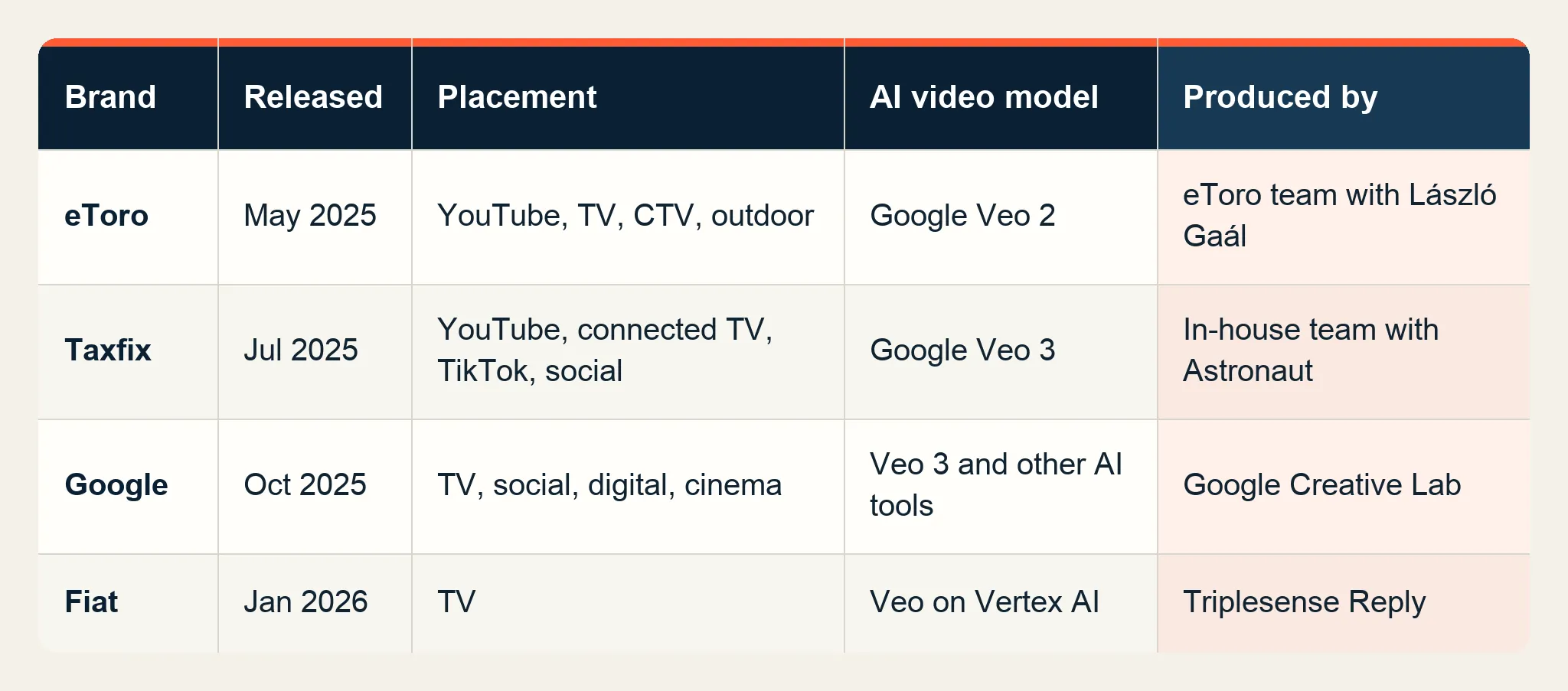
An AI commercial, or AI generated commercial, is a TV, streaming, or social ad in which generative video models produce most of the footage, and often the voice and music, from a written brief. People choose the idea, write and approve the script, select the shots, and handle the video editing. Since 2025, eToro, Taxfix, Google, and Fiat have used them in campaigns for television, connected TV, and cinema.
AI commercial examples, 2025 and 2026
eToro: Veo 2 brand campaign (May 2025)
Its brand campaign consisted of two 30-second videos created with Google DeepMind's Veo 2, running on YouTube, television, CTV, and outdoor channels, first in Italy. The work was led by eToro's marketing and creative team with AI video creator László Gaál, and Google was the technology partner.
Taxfix: Everything but Taxes (July 2025)
The German tax platform Taxfix announced "Everything but Taxes" on July 9, 2025, its first self-developed brand campaign, made with the Berlin production company Astronaut. According to the press release, the campaign runs across YouTube, connected TV, TikTok, podcasts, and social media, and includes fully AI-generated videos made with Google's Veo 3 alongside filmed spots. Each Veo 3 production took two days from first concept to finished video. Google's case study reports that Veo 2 had already cut Taxfix's production time from six to eight weeks to a few days.
Google: Tom the Turkey (October 2025)
Google's first fully AI-generated ad, built by Google Creative Lab, shows a turkey named Tom using AI Mode in Search to plan an escape before Thanksgiving. MediaPost reported that Google used Veo 3 and other AI tools, said altered or synthetic content would be highlighted in the credits, and scheduled the ad for television, social and digital media, and movie theaters from November 1, 2025.
Fiat: Pandina TV commercial (January 2026)
Fiat's January 2026 TV commercial for the Pandina follows the car through an interplanetary adventure with aliens. Triplesense Reply generated the film's entire visual world with Google's Veo on the Vertex AI platform, including an AI-cast protagonist, the aliens' character design, and the video sequences, while Infinity Reply integrated and animated 3D models of the car. The production won Best Use of AI in Adv, Image and Video at the Interactive Key Award, as Triplesense Reply announced on April 21, 2026.
What these commercials have in common
Three patterns run through the examples:
- Short production cycles: Taxfix finished each Veo 3 video in two days, and Reply says the Fiat film was completed in very short timeframes.
- Creative teams in charge: eToro's marketing and creative team led its campaign with László Gaál, Google Creative Lab developed Tom the Turkey, Taxfix's in-house team worked with Astronaut, and Triplesense Reply produced the Fiat spot.
- Placements beyond social: eToro ran on TV and CTV, Taxfix's campaign included connected TV, Google scheduled television and cinema, and Fiat ran on TV.
How to make an AI commercial
AI commercial production follows the same stages as a filmed production, with generation in place of the shoot. The example project, made in AI Studio, is a 30-second, 16:9 brand awareness film for CTV and streaming, built around a 24-hour journey across global cities.
1. Write the brief
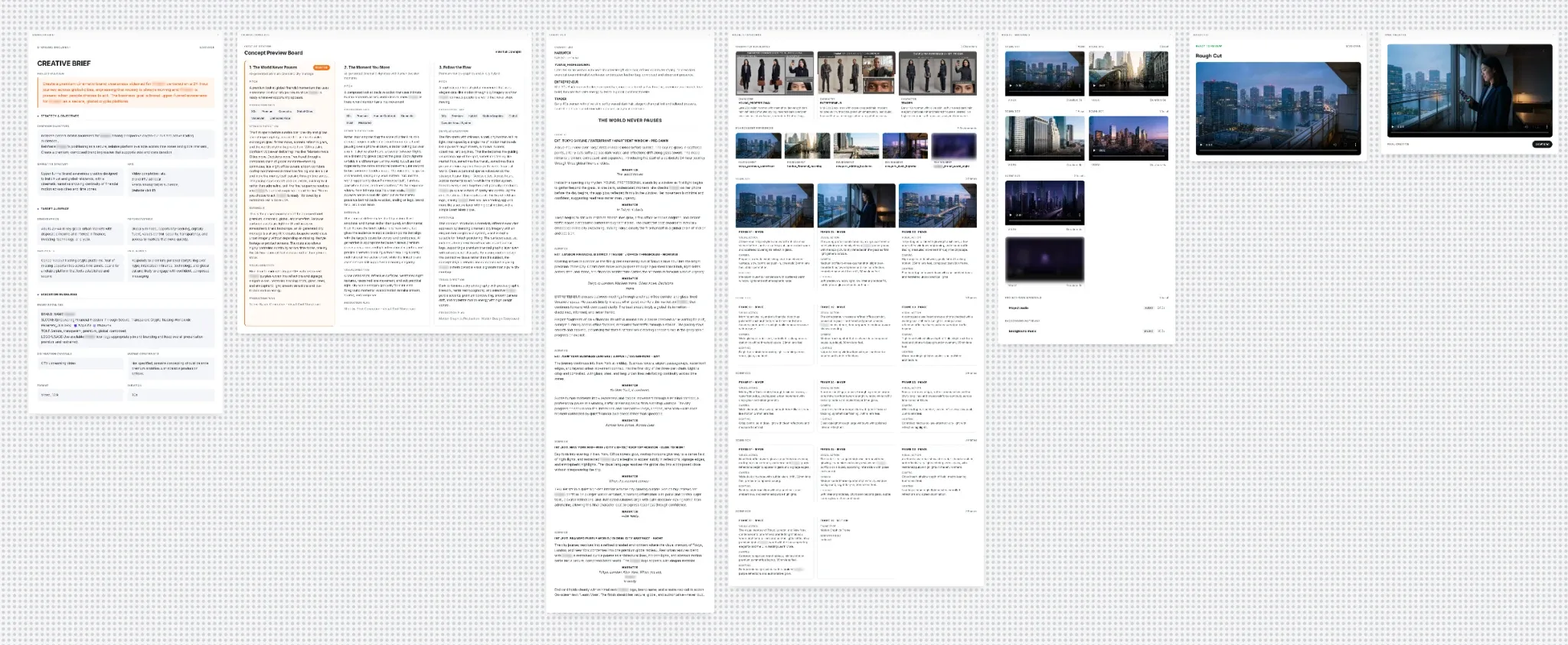
The brief fixes the objective, audience, format, length, and channels before anything is generated. In the AI Studio project, the request was a cinematic brand awareness ad, and the agent drafted a creative brief from the brand's context and guidelines, with objectives, KPIs, audience, brand rules, distribution channels, a 16:9 format, and a 30-second duration. The fields to complete are in Starti's video brief template.
2. Compare concepts
Three directions came back from the brief: two cinematic AI routes and one that combined cinematic footage with motion graphics. Each concept carried a pitch, a detailed execution, a rationale, and a visual direction.
3. Lock the script
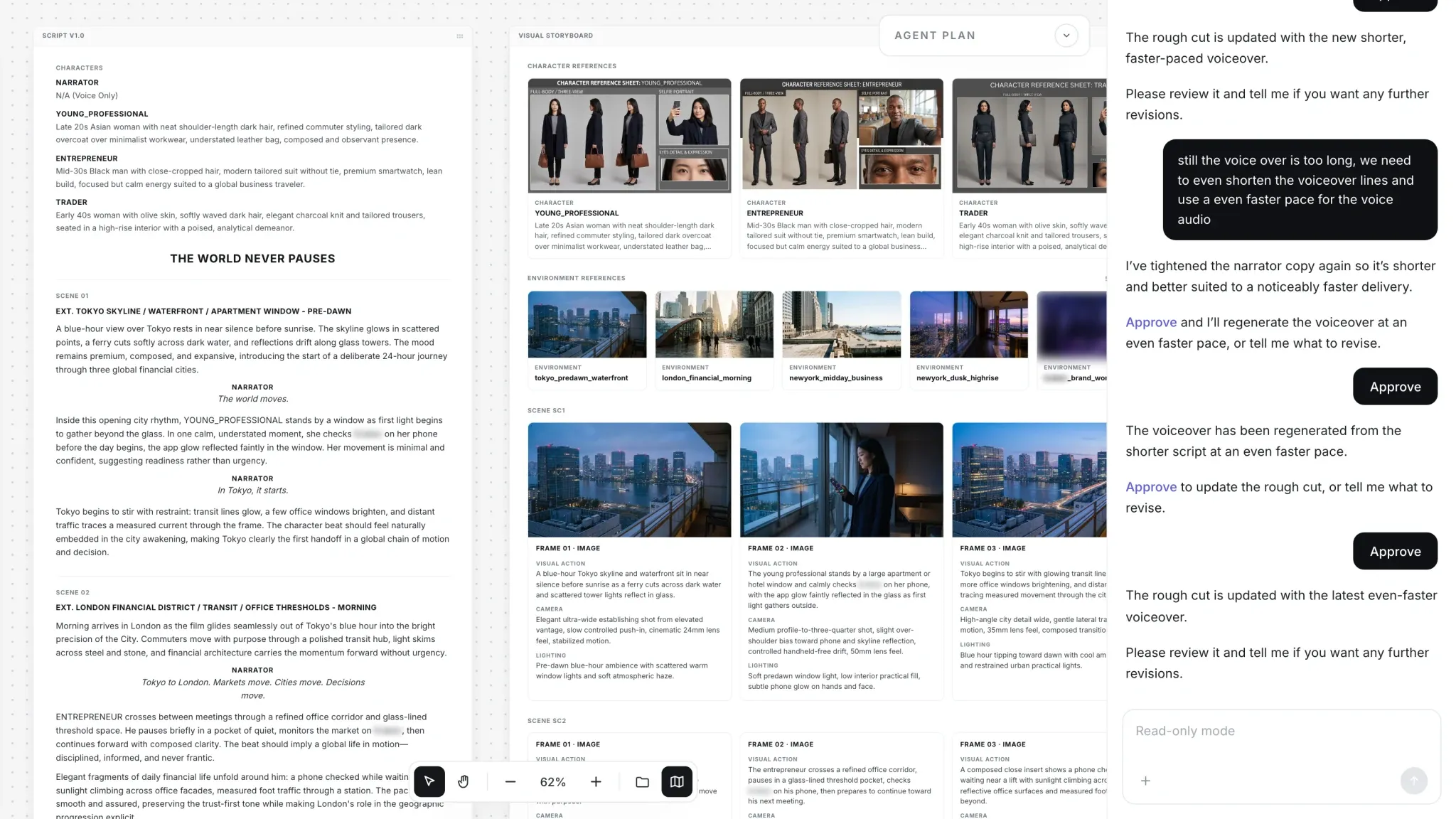
The selected concept, The World Never Pauses, became a script of five beats across 30 seconds. Two rounds of feedback changed it: the first named Tokyo, London, and New York as the three cities, and the second added three characters, one in each city. The commercial script guide covers how to fit lines and scenes to a length.
4. Build the storyboard
The storyboard broke the script into 13 frames across five scenes, plus a closing end card. It locked reference sheets for the three characters and added five environment references, covering Tokyo, London, New York by day and at dusk, and the closing brand scene. Each shot frame records its visual action, camera, and lighting, and the end card frame carries a motion plan.
5. Generate the shots
In the AI Studio project, the materials stage produced five scene videos, the full audio mix, and the end card for review. Per-generation limits differ by model:
- Google Veo 3.1: 4, 6, or 8 seconds, with extension supported.
- Runway Gen-4.5: 2 to 10 seconds.
- Kling: version 3.0 generates up to 15 seconds with speech in several languages, and version 4.0, launched in October 2026 on the web, generates 30 seconds natively.
OpenAI shut down the Sora 2 models and its Videos API on September 24, 2026.
6. Review the rough cut scene by scene
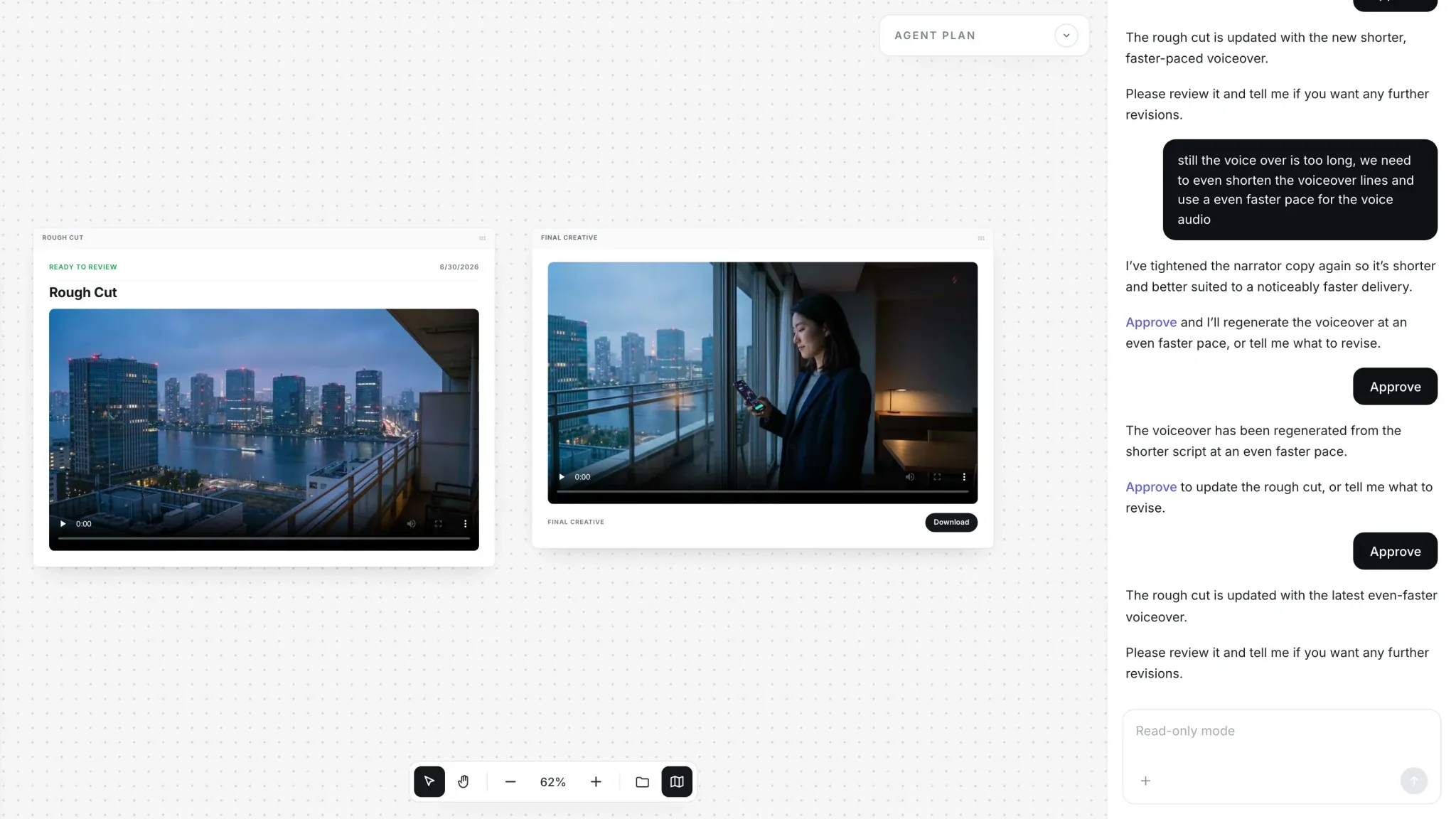
The rough cut is where quality control and most revisions happen. In the project, four requests followed the first cut: use an alternate generated video for the fifth scene, speed up the voiceover, shorten the narrator lines, and then shorten them again with a faster delivery. Each request updated only the scene, script, or audio it named, and the rough cut was updated after each approved change. Scene review before assembly has its own section in Starti's AI video production guide.
7. Deliver versions for each placement
A finished master needs placement versions: different lengths, aspect ratios, and languages, plus the file specifications each channel sets. Starti's guides to TV commercial production and TikTok ad specs cover broadcast and social delivery.
AI labels on ads in 2026
Ad platforms set their own AI label rules, and New York law adds a disclosure rule for synthetic performers:
- Meta: an "AI info" label marks ads that Meta's own generative AI creative tools made or significantly edited. It appears beside the Ad label or under About this ad in the three-dot menu, and a June 2026 update says Meta will start detecting ads built with outside AI tools from industry-standard signals.
- TikTok: ads with significantly edited or AI-generated content must carry TikTok's AIGC label or the advertiser's own disclaimer, caption, watermark, or sticker, under its ad policy.
- Google Ads: since July 2026, advertisers can add AI labels to creatives generated or modified with AI, and a "How this ad was made" section in the My Ad Center panel shows whether an ad was created or edited with AI. Election ads with synthetic content must be disclosed under Google's political content policy.
- New York: under a state law in effect since June 2026, a business that produces or creates an ad and knows it features a synthetic performer must disclose that conspicuously in the ad.
The approval checklist for AI generated ads gives each sign-off, from claims and rights to the final release, one named owner before launch.
Making AI commercials with Starti
In Starti AI Studio, Video Agent runs the same stages on a single canvas: brief, concepts, script, and a storyboard with character and visual references, each approved before the next begins. One scene can be replaced, or the tone changed, while the rest of the approved cut stays as it is, and finished versions publish directly to the team's connected TikTok, Meta, and Google Ads accounts.
When the commercial runs on connected TV, Starti AI Dash, Starti's performance CTV platform, connects audience discovery, premium inventory, real-time optimization, and delivery quality. AI Dash brings campaign delivery, creative performance, media quality, and results into one reporting layer.
Marketing teams that prefer to hand off production can work with Creative Studio, in which Starti's team sets the creative direction, makes the ads, and manages revisions until the final files are delivered.
Book a demo to see an AI commercial built on the AI Studio canvas.
Frequently asked questions
Have AI commercials aired on TV?
Yes. AI TV commercials include eToro's Veo 2 campaign on television and CTV in Italy in 2025, Taxfix's campaign with Veo 3 videos across YouTube and connected TV from July 2025, Google's Tom the Turkey, scheduled for television and cinemas from November 2025, and Fiat's Pandina commercial on TV in January 2026.
How long does it take to make an AI commercial?
Each of Taxfix's Veo 3 videos took two days from first concept to finished video, and Google's case study reports that Veo 2 cut Taxfix's production time from six to eight weeks to a few days.
Which AI models are used to make commercials?
eToro used Veo 2, Taxfix and Google used Veo 3, and Fiat's commercial used Veo on Vertex AI. Other options include Google Veo 3.1, Runway Gen-4.5, and Kling 3.0 and 4.0, while OpenAI has shut down the Sora 2 API.
How much does an AI commercial cost?
Taxfix said the costs of its Veo 3 videos were a fraction of traditional production budgets, and Google's case study describes Veo 2 work at a fraction of the usual time and production costs.
Do AI commercials need a label?
TikTok requires disclosure of significantly edited or AI-generated content, and Google requires it for election ads with synthetic content. Meta labels ads made with its own AI tools and has said it will begin labeling ads detected as made with other AI tools. In New York, a business that produces an ad it knows features a synthetic performer must disclose that conspicuously in the ad.