On this page
- The Two-Column Commercial Script Format
- How Long a Commercial Should Be
- Write the First Seconds First
- Sound On and Sound Off
- Claims, Testimonials, and Disclosures
- Script Rules for Connected TV
- Three Commercial Script Examples
- Commercial Script Checklist
- Starti AI Studio From Brief to Script
- Frequently Asked Questions
A commercial script, also called a video ad script, lists what the viewer sees and hears, moment by moment, in two columns: picture on the left, sound on the right. For a video ad that runs on TikTok, Instagram Reels, YouTube, or connected TV, the script also has to fit each placement's length, whether its viewers watch with sound on or off, and the first few seconds in which viewers decide whether to keep watching.
The Two-Column Commercial Script Format
An audio/visual script puts video cues in the left column and audio cues in the right, row by row, so an editor can see which line plays over which shot. The format is used "from documentary filmmaking, to TV news and advertising," as a Borough of Manhattan Community College script writing course puts it.
In a script template, each row carries a time plus the two columns:
- Time: where the row starts and ends, such as 0:00 to 0:03.
- Visual: the shot, the action, the product, and any on-screen text or super.
- Audio: voiceover (VO), dialogue, music, and sound effects (SFX).
Writing both columns together lets the voiceover name the benefit while the shot proves it. The same format serves a TV commercial script and a vertical video script for TikTok or Reels.
How Long a Commercial Should Be
Length is set by the placement before the script is written:
- YouTube in-stream and bumpers: bumpers are non-skippable and run 5 to 6 seconds, per Google's YouTube ad formats page. Skippable in-stream ads can be skipped after 5 seconds, and non-skippable in-stream ads run 60 seconds or shorter.
- Shorts: 10 to 30 second vertical videos for action-oriented ads, according to Google's Shorts ad guidance, which also notes that only the first 60 seconds play in the Shorts feed.
- TikTok In-Feed: TikTok's ad format policy sets 5 to 60 seconds, and the In-Feed specifications allow videos up to 10 minutes. Its video advertising guide says 21 to 34 seconds performs best.
- YouTube TV: non-skippable ads run 6 seconds or shorter, 15 seconds or shorter, 30 seconds, or 60 seconds. The 30- and 60-second ads must match that length or fall within 1 second of it, so a 30-second ad runs between 29 and 31 seconds, per Google's YouTube TV formats page.
To fit the voiceover to the length, Spotify Advertising recommends no more than 65 words for a 30-second audio ad and a 100-word script for a 60-second ad. Have the voice actor, or anyone on the team, read the voiceover aloud against a timer before production.
Write the First Seconds First
Meta defines a hook as "the text, visual, and audio components that grab and hold attention in the first few seconds of your video," in The Science of the Hook, a guide Meta released in December 2025. It names three kinds: a value promise, a statement of intent, and a question or invitation.
Platform guidance puts the brand and the message early:
- TikTok: state the proposition within 3 seconds and put the hook within 6 seconds, per its creative best practices.
- Meta: FMCG Reels brand ads that showed the brand and main message inside the first 5 seconds were 1.7 times as likely to place in the top 20% of local benchmarks for purchase intent, in a Toluna study of 100 participants across Germany, Italy, Turkey, and the UK that Meta published in December 2025.
- Google: the ABCDs ask advertisers to "introduce your brand or product from the start," and Google's creative guidance in Google Ads checks for a prominent brand logo in the first 5 seconds.
Write the opening row as a complete ad. On skippable YouTube in-stream ads the viewer can skip after 5 seconds, so the first rows carry the product and the promise on their own.
Sound On and Sound Off
In The Science of the Hook, Meta reports that campaigns with music or voiceover in Reels have delivered up to 13% higher incremental conversions, based on 10,123 conversion lift studies run between February 2024 and March 2025. Google's Shorts guidance recommends music, voiceover, or both, and suggests considering text overlays.
Some viewers will still watch without sound, so the script states the key line twice: once in the voiceover and once as on-screen text. Meta offers captions for video ads to make them "easier for people to watch with the sound off," with automated captions available in English. TikTok's guidance for performance ads recommends displaying between 5 and 10 on-screen words each second.
Claims, Testimonials, and Disclosures
Every claim in the script needs support before the ad runs. The FTC's advertising FAQ says that "the law requires that advertisers have proof before the ad runs," and health or safety claims usually need "competent and reliable scientific evidence."
Testimonials follow the FTC's Endorsement Guides:
- Real experience: endorsements must reflect the endorser's honest opinions or experience, and when an ad represents that the endorser uses the product, the endorser must have been a bona fide user of it when the endorsement was given.
- Typical results: a customer story about a key result is likely to be read as what most customers will get.
- Real customers: an ad that presents people as actual consumers should use actual consumers in both the audio and video, or clearly and conspicuously disclose that they are not.
- Disclosures: a disclosure "presented simultaneously in both the visual and audible portions of a communication is more likely to be clear and conspicuous," and the FTC notes that viewers are more likely to miss one at the end of a video.
Mark each claim in the script and attach its source before the script goes to review.
Script Rules for Connected TV
Google advises against embedding QR codes in TV ad files and recommends system-generated QR codes that appear only on TV. These system QR codes are not available on YouTube TV or Google TV inventory. On YouTube Select and reservation non-skippable ads, the QR code and call-to-action text appear after 5 seconds, so a "scan the code" line belongs after that point.
Amazon's streaming TV guide asks for the logo or product in the first three seconds, as few on-screen words as possible with voiceover carrying the message, and an end card. It does not accept videos that start or stop abruptly, or poor and inaudible audio. Starti's guide to TV commercial production covers the clearance and delivery steps after the script is approved.
Three Commercial Script Examples
Example 1: 15-second vertical app ad for TikTok and Reels
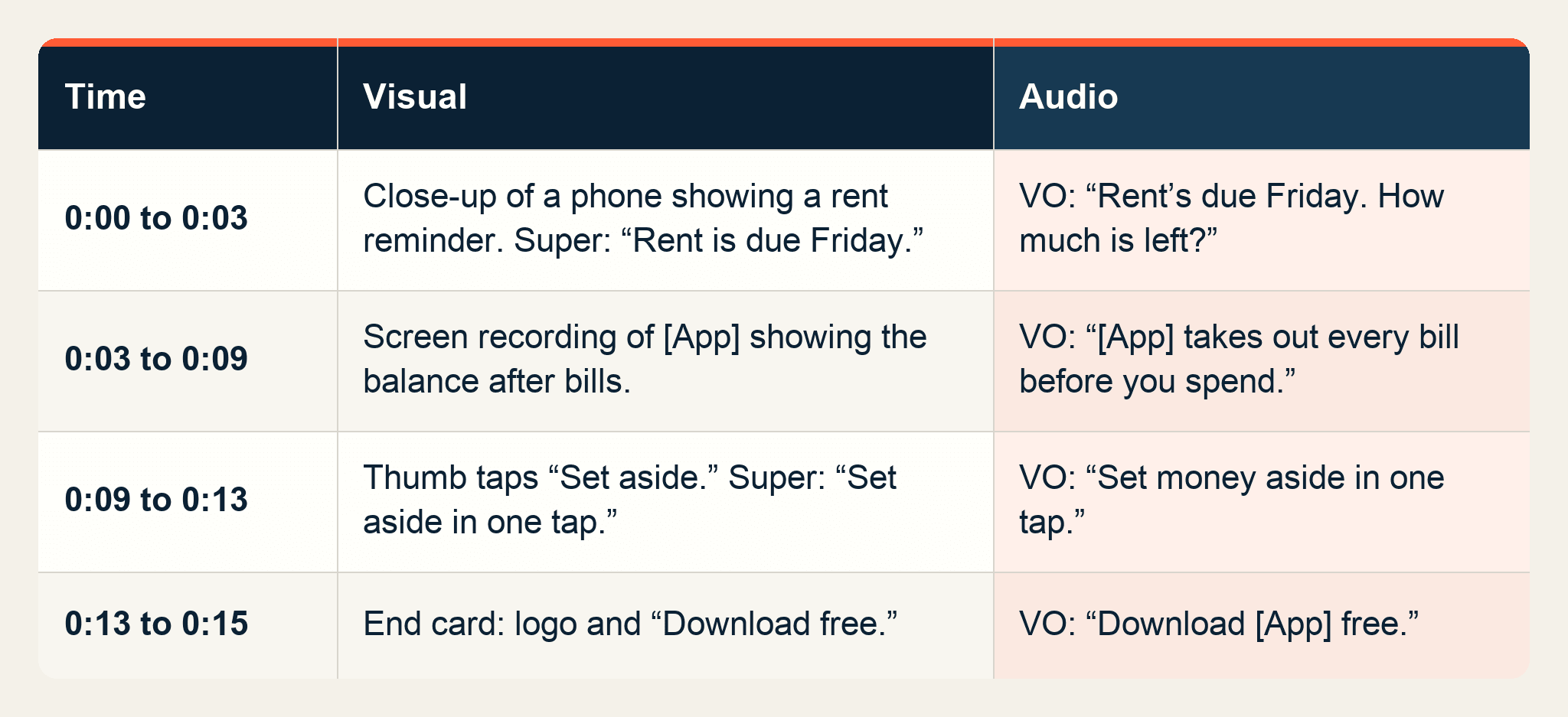
- Hook (0 to 3 seconds). Visual: close-up of a phone showing a rent reminder; super: "Rent is due Friday." Audio: VO: "Rent's due Friday. How much is left?"
- Proof (3 to 9 seconds). Visual: screen recording of [App] showing the balance after bills. Audio: VO: "[App] takes out every bill before you spend."
- Action (9 to 13 seconds). Visual: thumb taps "Set aside"; super: "Set aside in one tap." Audio: VO: "Set money aside in one tap."
- End card (13 to 15 seconds). Visual: logo and "Download free." Audio: VO: "Download [App] free."
Example 2: 30-second product ad for Reels and Feed
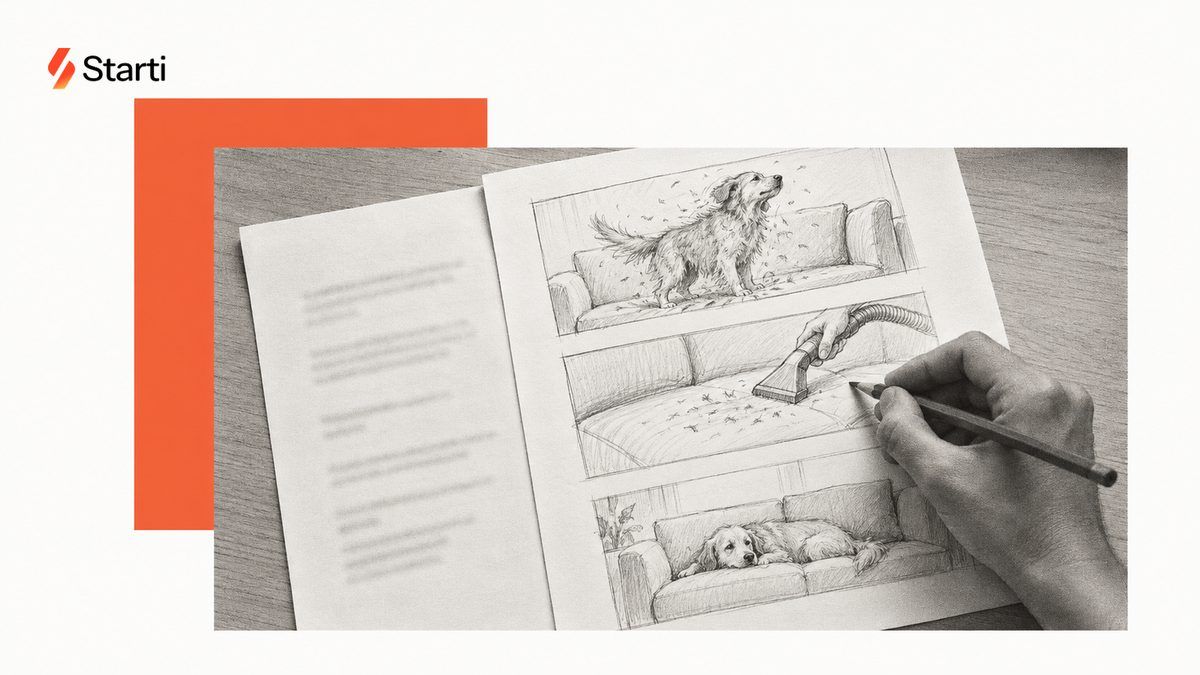
- Opening (0 to 5 seconds). Visual: a dog shakes off water on a clean sofa; brand logo in the corner. Audio: SFX: shake. VO: "Dog hair on everything?"
- Demo (5 to 18 seconds). Visual: the [Vacuum] lifts hair from the sofa in one pass; super: "One pass on upholstery." Audio: VO: "The [Vacuum] pulls pet hair from fabric in one pass." Claim: one-pass pickup on upholstery; source: [test report].
- Customer (18 to 25 seconds). Visual: a verified customer on her own sofa. Audio: customer: "I stopped using lint rollers." Endorsement: verified buyer; support that typical buyers get this result: [source].
- Offer (25 to 30 seconds). Visual: product, price, and "Shop now." Audio: VO: "Shop the [Vacuum] today."
Example 3: 30-second connected TV spot with a system QR code
- Brand (0 to 3 seconds). Visual: the [Hotel] logo over a wide shot of the coast at sunrise. Audio: music in; VO: "[Hotel], on the coast."
- Story (3 to 20 seconds). Visual: breakfast on a terrace, a swim, a family walking the beach. Audio: VO: "Rooms over the water, breakfast on the terrace, and the beach two minutes away." Claim: walking time to the beach; source: [measured route].
- Action (20 to 30 seconds). Visual: end card with the offer; the system QR code appears on screen. Audio: VO: "Scan to see this weekend's rates."
Commercial Script Checklist
Start from the video brief template, which records the goal, audience, offer, and claims a script starts from, then work through these checks:
- Confirm the placement and length before writing.
- Write the first 3 to 5 seconds as a complete ad with the brand and the promise.
- Keep one core message, and let the visuals prove it.
- Put the key line in both the voiceover and on-screen text.
- Mark every claim and testimonial with its source.
- Time the voiceover aloud against the target length.
- Close on one call to action, spoken and shown.
- For TV, move any "scan" line to after the QR code appears.
Starti AI Studio From Brief to Script
Video Agent, part of Starti AI Studio, takes a brief through concepts, scripts, and storyboards, each carrying character and visual references, and the team reviews concepts, scripts, and the finished ad on one shared canvas. A request can revise a headline, replace a scene, or change the tone while the rest of the project stays as approved, and the team approves each stage before it moves forward.
Creative Studio is Starti's managed production service for teams that want the creative direction, production, and revisions handled through delivery.
Book a demo to see Video Agent write and storyboard a script.
Frequently Asked Questions
What is a commercial script?
A commercial script is the written plan for an ad that lists what the viewer sees and hears, row by row. Most use two columns, with visuals on the left and audio on the right.
How do you write a commercial script?
Confirm the placement and length, write the opening seconds first with the brand and the promise, keep one core message, put key lines in both voiceover and on-screen text, support every claim, and time the voiceover aloud.
What is the format of a commercial script?
The audio/visual format: two columns, with shots, action, and on-screen text on the left, and voiceover, dialogue, music, and sound effects on the right, with times for each row.
How many words are in a 30-second commercial script?
Spotify Advertising recommends no more than 65 words for a 30-second audio ad and a 100-word script for 60 seconds. Time a video voiceover aloud against the target length.
Do video ads need captions?
Not under FCC rules, which leave ads of five minutes or shorter out of captioning requirements. Meta and TikTok both offer caption tools, and on-screen text keeps the message readable for viewers watching without sound.
How long should a commercial be?
Placement sets the length: 5 to 6 seconds for YouTube bumpers, 10 to 30 seconds for action-oriented YouTube Shorts, 21 to 34 seconds in TikTok's video advertising guide for In-Feed ads, and 6 seconds or shorter, 15 seconds or shorter, 30 seconds, or 60 seconds for non-skippable YouTube TV ads.