
On this page
Meta Andromeda is the retrieval system in Meta's ad delivery. Each time someone opens Facebook or Instagram, it narrows tens of millions of candidate ads to a few thousand, and larger ranking models then choose which of those to show. Meta introduced it in the second half of 2024 and extended it to more surfaces and hardware through 2025.
Meta's December 2025 guidance spells out what this means for advertisers: its ads system groups ads that look or feel alike and treats them as variations of one creative, with learnings and delivery optimizations shared at the creative level. Instead of a fixed number of ads refined over time, Meta now recommends "a broad portfolio of assets that take more creative liberty across text, image, and video."
What Meta Andromeda Does
Meta's ads system works in stages. Retrieval comes first and selects a few thousand relevant ads from tens of millions of candidates. Ranking models then predict the value for the person and the advertiser and choose the final set. Meta's engineering post introducing Andromeda notes that retrieval processes three orders of magnitude more ads than the stages after it.
Before Andromeda, retrieval applied limited personalization and relied on isolated model stages and rule-based heuristics. Meta built Andromeda on NVIDIA Grace Hopper Superchips and its own MTIA accelerators. On its Q4 2024 earnings call, Meta said the system enabled a 10,000x increase in the complexity of the models it uses for ads retrieval.
Andromeda, GEM, and Lattice
In Meta's ad delivery, Andromeda, Lattice, and GEM each play a different part:
- Andromeda: retrieval, the first cut from tens of millions of ads to a few thousand.
- Lattice: the ranking architecture that generalizes across campaign objectives and surfaces in place of many smaller models, each built for a single objective and surface. By Q3 2025, Meta had cut about 100 ranking and recommendation models and planned to consolidate another 200 over the coming years.
- GEM: the Generative Ads Recommendation Model, a foundation model trained at the scale of large language models. Meta transfers what GEM learns to the smaller runtime models that serve ads.
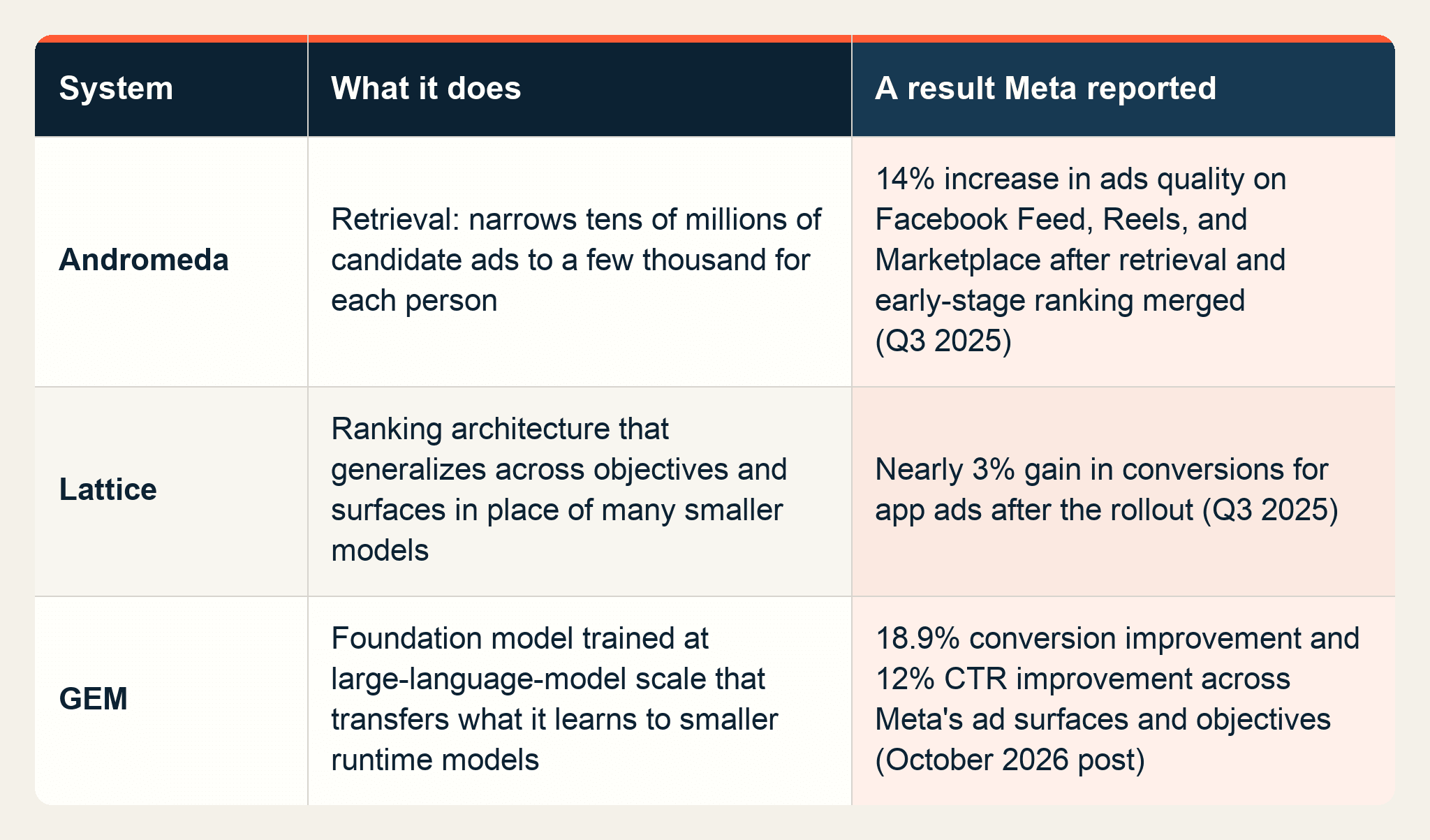
Meta's October 2026 GEM post describes the 2026 generation of GEM as a single central foundation model and reports an 18.9% conversion improvement and a 12% CTR improvement across its ad surfaces and objectives, after an earlier post credited GEM's launch with a 5% increase in ad conversions on Instagram and 3% on Facebook Feed in Q2 2025. Rolling Lattice out to app ads drove a nearly 3% gain in conversions for that objective in Q3 2025, per the Q3 2025 call.
On its Q2 2026 call, Meta said it had deployed the first generative model into its ads retrieval system, the stage Andromeda powers. It also introduced Meta Generative Recommender, which uses LLMs "to reason about ad content and user preferences together, and predict the best ad for each person."
Meta Andromeda Updates From 2024 to 2026
- Second half of 2024: Meta introduces Andromeda, publishes the engineering post in December, and reports an 8% increase in ads quality on the objectives it tested, per the Q4 2024 call.
- Q2 2025: enhancements select more relevant and personalized candidates, coverage extends to Facebook Reels, and conversions on Facebook mobile Feed and Reels rise nearly 4%, per the Q2 2025 call.
- Q3 2025: retrieval and early-stage ranking merge into one model on Facebook Feed, Reels, and Marketplace, driving a 14% increase in ads quality on those surfaces, with Instagram Feed and Reels planned for Q4, per the follow-up call.
- Q4 2025: Andromeda runs on NVIDIA, AMD, and MTIA chips, and Meta reports nearly tripled compute efficiency on its Q4 2025 call.
- April 2026: Meta's KernelEvolve post reports over 60% higher inference throughput for the Andromeda ads model on NVIDIA GPUs.
Similar Creatives and Creative Diversification
In its December 2025 post Demystifying Creative Diversification, Meta says Andromeda scans tens of millions of ads so that only the most relevant and distinct creatives move forward, and ranking models informed by GEM choose from what remains. The ads system also groups ads that share key visual and thematic attributes. In Meta's words, "When multiple ads look or feel alike, these are seen as variations of the same creative, meaning learnings and delivery optimizations are shared at the creative level, not just the individual ad level."
The same post describes creative iteration as manual A/B testing to refine assets, formats, and messages, with the example of two ads that share identical visuals and differ only in the text call to action. Creative diversification produces distinctly different assets for different customer personas or use cases, such as a Reels ad made for Gen Z and a separate partnership ad with a creator who connects with new moms. Meta adds that creative similarity, meaning ad images that are visually too alike, can also drive fatigue.
Meta's Cyber 5 2025 review ties format variety to cost: across purchase-optimized ads from October 1 to November 30, 2025, ad sets that included at least an image, a video, and a vertical video with audio delivered 7.3% lower CPA.
Ads per Ad Set: What Meta Publishes
Meta's published numbers on ad volume are limits: an ad set can hold up to 50 ads. Meta's guidance on ad volume says that when an advertiser runs too many ads at once, each ad delivers less often, fewer ads exit the learning phase, and performance can suffer. Its advice is to decrease ads per ad set while keeping diverse creative assets per ad set. One ad can contain up to 10 creative assets, and the flexible ad format accepts up to 10 images and videos.
Under Meta's grouping, edits that keep the same footage and change only the text look alike, so they are treated as variations of one creative. Production planning therefore starts from the number of distinct concepts, and the number of ads follows from it.
How to Build Creative for Andromeda
- Give each concept a different reason to buy, built on one of the "different potential customer personas or use cases" in Meta's definition of diversification.
- Change the visuals along with the words. Meta asks for ads that are "truly distinct in their visuals, messaging, and formats."
- Cover the three formats from Meta's Cyber 5 result: an image, a video, and a vertical video with audio in the same ad set.
- Read results by concept, and compare distinct concepts with each other.
- Replace fatigued creative with something materially different. In ad sets with one creative, Ads Manager shows a Creative fatigue status when cost per result is twice or more that of past ads, and Meta recommends a new image or video "materially different from the original creative."
Starti's creative testing article sets out how to frame each test around a single question.
Meta's own generative tools also add to creative volume. Over 9 million small businesses were using at least one of Meta's AI ad creative tools in Q2 2026, according to the Q2 2026 call. In October 2026, Meta made video generation from static assets generally available in Advantage+ creative.
Starti AI Studio for Creative Diversity
Video Agent, part of Starti AI Studio, turns a brief into concepts, scripts, and storyboards with character and visual references. Finished videos can be reframed for 9:16, 4:5, 1:1, and 16:9 placements. Approved versions can be published from the asset library to Meta, Google Ads, and TikTok once those accounts are connected.
Smart Insight compares nine creative attributes, such as the opening, visual style, and call to action, against CTR, completion, and other outcomes across Meta, TikTok, and Google Ads accounts. Each finding comes with its supporting creatives and counterexamples, and it can go into the next brief in AI Studio. The creative intelligence guide explains how attribute tagging makes those comparisons possible.
Book a demo to see Video Agent and Smart Insight.
Frequently Asked Questions
What is Meta Andromeda?
Meta Andromeda is the retrieval system in Meta's ad delivery. It narrows tens of millions of candidate ads to a few thousand for each person, and ranking models then choose which ads to show.
When did Meta launch Andromeda?
Meta introduced Andromeda in the second half of 2024 and described it in a December 2024 engineering post. It extended Andromeda to Facebook Reels in Q2 2025, merged retrieval with early-stage ranking on Facebook surfaces in Q3 2025, and ran it on NVIDIA, AMD, and MTIA hardware from Q4 2025.
What is the difference between Andromeda, GEM, and Lattice?
Andromeda handles retrieval. Lattice is the ranking architecture that replaced many smaller models built for single objectives and surfaces. GEM is the foundation model that trains at large scale and transfers what it learns to the smaller models used when ads are served.
How many ads should an ad set have under Andromeda?
Fewer than the 50-ad limit, with diverse creative assets in each ad set, per Meta's guidance on ad volume. Meta states that one ad can contain up to 10 creative assets.
Does Andromeda change creative testing?
Yes. Meta says Andromeda moves forward only the most relevant and distinct creatives, and its ads system treats look-alike ads as variations of one creative. Tests are more informative when they compare distinct concepts.
What is creative diversification on Meta?
Meta defines creative diversification as creating unique campaign assets for different customer personas or use cases. It contrasts this with creative iteration, manual A/B testing to refine assets, formats, and messages, such as two ads with identical visuals and different text calls to action.