
On this page
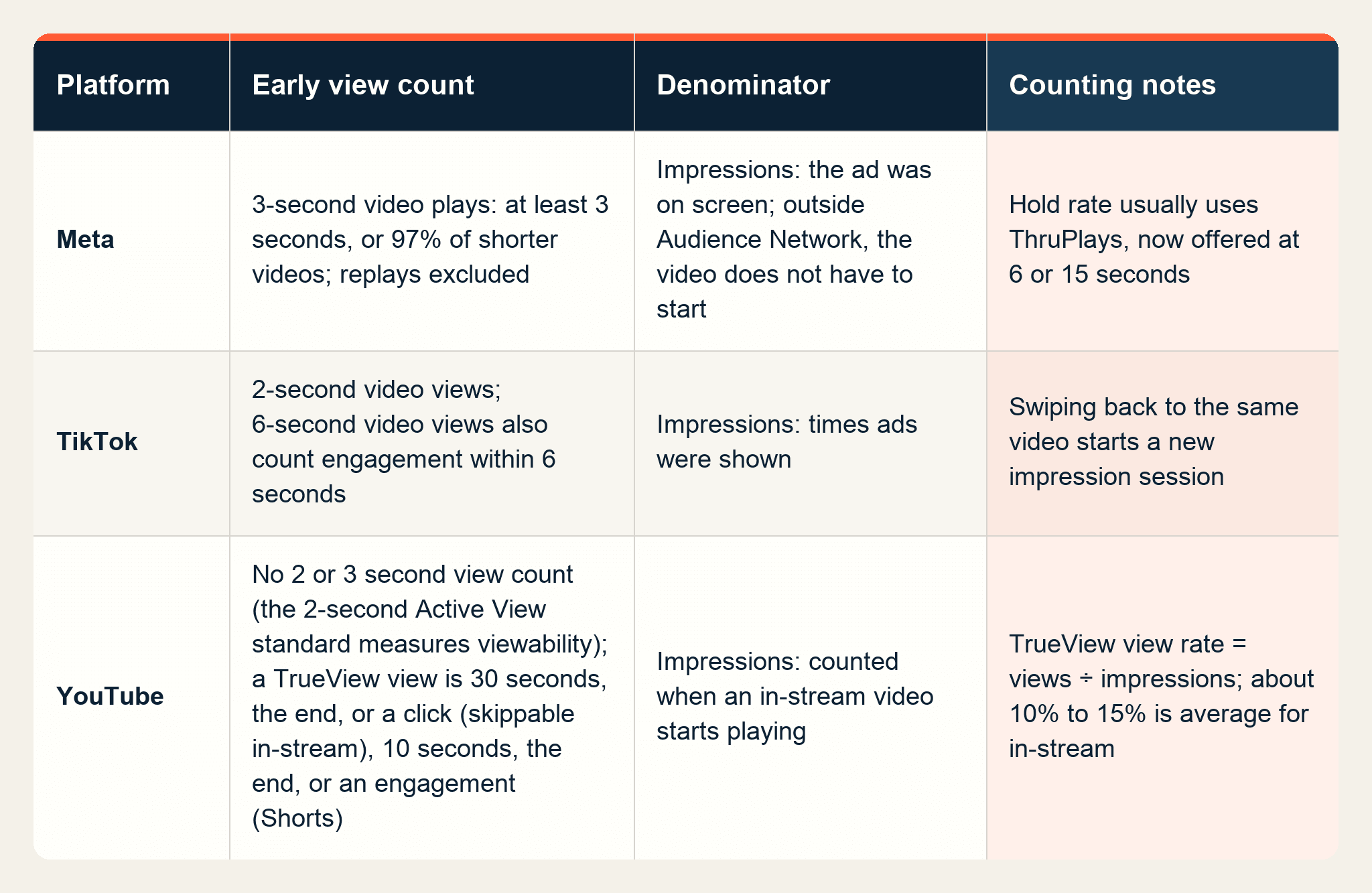
Hook rate is the share of ad impressions in which a viewer keeps watching past the first few seconds. It is a ratio marketers build from each platform's own counts, so the formula differs by platform. On Meta, the usual version is 3-second video plays divided by impressions.
Meta's December 2025 guide The Science of the Hook calls the hook the mix of text, visuals, and audio that holds attention at the start of a video. TikTok's creative best practices set the timing: lead with the proposition by second 3 and make the hook the priority through second 6. Hook rate shows whether that opening worked, separately from the rest of the ad.
Hook Rate Formula
On Meta, the common formula is:
Hook rate = 3-second video plays ÷ impressions × 100
An ad with 10,000 impressions and 2,800 three-second plays has a hook rate of 28%. Both inputs are Meta's own metrics:
- Meta's 3-second video plays: the number of times a video played for at least 3 seconds, or 97% of its length if shorter, counted separately for each impression and excluding replays.
- Impressions: the number of times an ad was on screen. Outside Meta Audience Network, Meta notes that a video does not have to start playing for an impression to count, which differs from industry standards for video ads.
TikTok reports its early-view counts at different thresholds. Its video play metrics include 2-second video views, counted when a video plays for at least 2 seconds in an impression session. Its 6-second video views also count a view when the person engages within the first 6 seconds. A TikTok hook rate is usually 2-second video views divided by impressions.
YouTube has no 2- or 3-second view count. Its 2-second measure is Active View viewability, which counts an impression as viewable when at least half the ad is on screen while it plays for 2 seconds. The closest watch-based rate is the TrueView view rate, defined as views divided by impressions. Since October 2025, Google Ads has called its Views metric "TrueView views." A view on a skippable in-stream ad means watching 30 seconds or to the end, or clicking the ad; on Shorts it means 10 seconds or to the end, or a click, Like, Comment, or Share.
Hold Rate and Thumbstop Rate
After the hook, hold rate measures whether viewers keep watching. The usual formula on Meta is ThruPlays divided by 3-second video plays. Meta offers ThruPlay at 6 or 15 seconds, and its 15-second ThruPlay counts a video played to completion or for at least 15 seconds. Name the ThruPlay length in the report, and compare hold rates between ads of similar length: on a video shorter than the ThruPlay duration, a ThruPlay requires 97% of the video, which makes hold rate a completion rate.
An ad with 2,800 three-second plays and 700 ThruPlays has a 25% hold rate. Read together, hook rate and hold rate point to four different fixes:
- Low hook, high hold: viewers who get past the opening stay, so the first scene is the one to replace.
- High hook, low hold: the opening stops the scroll, but viewers leave before the ThruPlay mark, so the scenes right after the hook need work.
- Low hook, low hold: both the opening and the scenes after it lose viewers, so the next test needs a new concept, with the opening and body both rebuilt.
- High hook, high hold: attention is not the constraint; check the click and conversion steps that follow.
Two other Meta video metrics are often read alongside hook rate and hold rate:
- Milestone plays at 25%, 50%, 75%, 95%, and 100%: these include plays that skipped to that point.
- Average play time: this includes replays, so Meta notes it can be longer than the video itself, and Instagram loops videos for as long as they are visible. Meta labels it, and video plays at 100%, as in development and advises against using metrics in development for historical comparison.
Thumbstop rate is often another name for hook rate, so a shared report should state the formula next to the name.
Comparing Hook Rates Across Platforms
Each platform counts the inputs differently. Outside Audience Network, Meta counts an impression whether or not the video starts, while YouTube waits for in-stream playback to begin. A swipe back to the same TikTok video opens a new impression session; on YouTube Shorts it adds no impression or view. The early-view counts also differ: Meta reports 3-second video plays and 2-second continuous video plays, and TikTok reports 2-second and 6-second video views.
A 30% hook rate on Meta and a 30% rate on TikTok therefore describe different behavior. Compare hook rates within one platform and one placement, across ads with the same objective, and against the account's own history.
Google publishes a reference point for the related YouTube rate: a TrueView view rate of about 10% to 15% is average for in-stream ads across industries, measured on 30-second views.
How to Add Hook Rate in Ads Manager
Both Meta and TikTok let advertisers build the ratio as a custom metric, and Google Ads reports its closest rate as a standard column:
- Meta Ads Manager: select Columns, choose Customize columns, then Create custom metric. Divide 3-second video plays by impressions and pick the percentage format. Once a custom metric is shared, its formula cannot be edited or deleted.
- TikTok Ads Manager: choose Custom Columns, then Add Custom Metrics, and use the +Metrics button to add 2-second video views and impressions to the formula.
- Google Ads: TrueView view rate needs no custom column; the VTR (in-stream), VTR (in-feed), and VTR (shorts) columns report it by format.
TikTok's video insights go further with a key frame analysis of clicks and video views, second by second.
How to Improve Hook Rate
Three practices apply to the opening and how it is tested:
- Hook in sight and sound: ecommerce Reels ads that carried the hook in both picture and sound were 1.5 times as likely to reach the top 20% for purchase intent against Toluna's local benchmarks, in research Meta released in December 2025 with 100 participants in Italy, Germany, Turkey, and the UK.
- Early branding: in System1's study of 887 short-form ads with TikTok, published in June 2025, ads with exceptional branding in the first 2 seconds drove 88% more memory lift than ads with weak early branding.
- One hook per test: Meta recommends A/B testing versions of a Reel that each carry a unique hook.
Meta notes that A/B tests shorter than 7 days may produce inconclusive results, and TikTok's split test guidance recommends at least 7 days and a budget with a power value of at least 80%. The creative testing article on Starti explains how to keep everything but the tested element constant.
Hook Testing With Smart Insight and Video Agent
Smart Insight checks nine creative attributes, the opening among them, against outcomes such as CTR and completion from Meta, TikTok, and Google Ads. A finding needs enough data; for CTR, that means 10,000 or more impressions plus three creatives and two campaigns on each side of the comparison. Signals labeled Winner, Scaling, Watch, and Fatigue rank which creatives to review first.
When a finding points to the opening, Video Agent in Starti AI Studio can replace that one scene and leave the approved scenes as they are, so the next test changes only the hook.
Book a demo to see Smart Insight and Video Agent.
Frequently Asked Questions
What is hook rate?
Hook rate is the percentage of ad impressions in which a viewer keeps watching past the first few seconds. On Meta it is usually 3-second video plays divided by impressions.
How do you calculate hook rate?
Divide the platform's early-view count by impressions and multiply by 100. On Meta, use 3-second video plays; on TikTok, 2-second video views. An ad with 2,800 three-second plays from 10,000 impressions has a 28% hook rate.
What is a good hook rate?
One above the account's own recent results on the same platform, placement, and objective. Ad platforms publish no hook rate benchmark; for in-stream YouTube ads, Google describes an average TrueView view rate of about 10% to 15%, measured on 30-second views.
What is the difference between hook rate and hold rate?
Hook rate measures whether viewers get past the opening. Hold rate measures whether they keep watching after it, usually as ThruPlays divided by 3-second video plays on Meta.
How do you calculate hook rate on TikTok?
Divide 2-second video views by impressions. TikTok also reports 6-second video views, which include people who engaged within the first 6 seconds.
Is thumbstop rate the same as hook rate?
Often. Many teams use the two names for the same ratio, so state the formula in the report.