
AI Didn't Peak in Advertising. The Prompt Era Did.
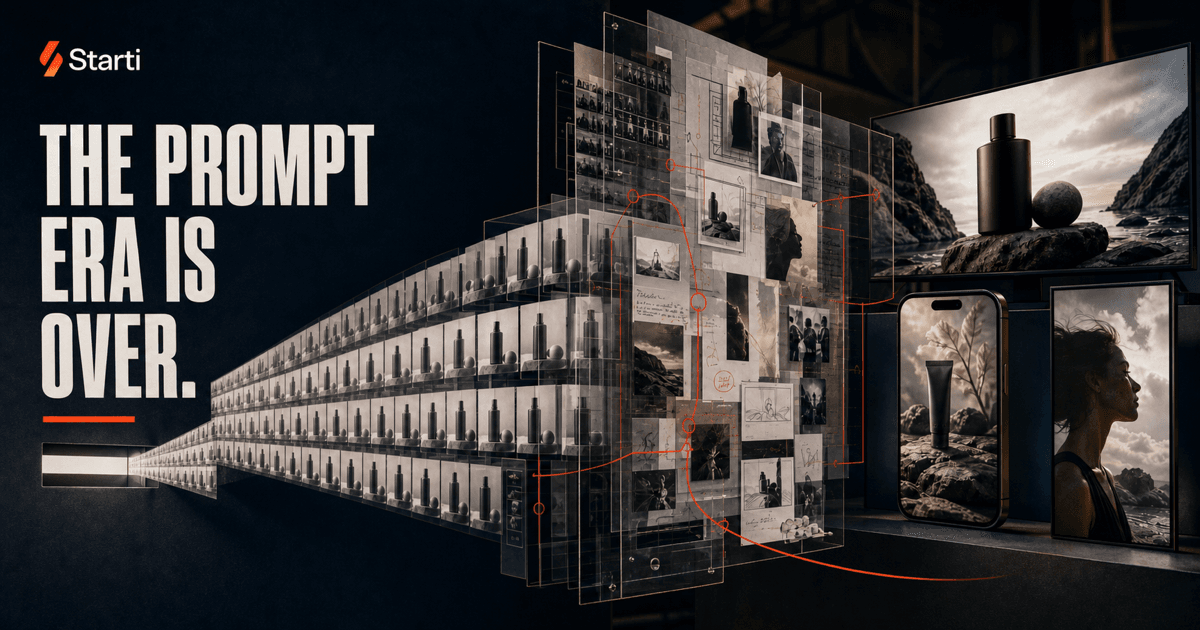
Your team probably ships two or three times the ad creative it did two years ago. Check whether the dashboard noticed. For most teams that adopted AI generation, the honest answer is: output multiplied, win rates on new variants drifted down, fatigue arrived faster, and the volume that was supposed to compound just got absorbed.
It is tempting to read that as AI overpromising. What actually happened is the opposite. The first generation of AI helped marketers produce more creative. The next one will help marketers make better creative decisions. The gap between those two sentences decides who wins the next two years.
The first act succeeded itself out of relevance
Here is a test you can run in five minutes. Open the showreels of any three AI video tools. Cover the logos. Try to guess which clip came from which tool. We make ad creative with AI for a living, and we cannot reliably do it.
That sameness is not a malfunction. A prompt is a request for the most probable version of your idea, the models were trained toward the same aesthetic optimum, and everyone feeds them the same trending references. Most probable, by definition, is what everyone else gets too.
The industry is putting numbers on it. In Funnel's 2026 Marketing Intelligence Report, 23% of in-house marketers agree their AI tools create campaigns that all look the same. An Optimizely study found only 30% of marketers still believe their brand's voice is genuinely distinctive. And Merriam-Webster made "slop" its 2025 word of the year, which is what happens when a production problem becomes a culture problem.
But read those numbers carefully, because they describe a technology that succeeded, not one that failed. Eighteen months ago, generating fifty variants overnight was an edge. Today the planning meeting simply assumes it. When a capability becomes universal it stops being an advantage and becomes a cost of entry. Nothing disappointed. The first act just ended, the way first acts always do.
Every general technology has two acts
Electricity did not transform factories until factories reorganized around it. For decades they simply swapped the steam engine for an electric motor, and productivity barely moved. The gains arrived when work was redesigned around what small motors made possible. Paul David, the economist who documented this, put the delay at roughly thirty years. The payoff was never in the motor. It was in the reorganization.
Act one of a technology accelerates the old workflow. Act two restructures the workflow around what the technology actually makes possible. The gap between them is where most adopters stall, congratulating themselves on the bolted-on motor.
Prompt-to-video was advertising's bolted-on motor. It made the old workflow faster: same brief, same thinking, quicker rendering. Act two is not about rendering at all.
Act two: AI moves up the stack
The expensive part of an ad was never the pixels. It is the few hundred dependent decisions behind them. Who this is for, narrowly enough that a competitor would choose differently. Which angle, out of the five you could defend. What proof a skeptical viewer needs. Which format fits which screen, because an ad watched on a television and an ad thumbed past on a phone are different species. What to redo when shot four fails, and what to leave alone.
Through 2025, software could not touch that layer, so it stayed manual, and at fifty ads a month it quietly became the bottleneck. Run the arithmetic: fifty ads times a few hundred decisions each is a five-figure pile of judgment calls per quarter, mostly made today by two people between meetings. Most teams we talk to resolved the tension by letting the deciding slide, which is exactly why the feed converged. Same tools, same references, same absent thinking, same ads.
That layer is what AI is absorbing now. Call it second-act AI. Not a text box waiting for a prompt, but agents that hold the whole campaign context, propose distinct creative angles, carry a brief through storyboard and production without losing the brand's facts on the way, scope a revision to the one scene that failed, and feed conversion data back into the next round. The deciding gets industrialized without getting flattened, because the input is no longer a one-line prompt. It is everything you know about the campaign.
Campaign context: the input your competitor cannot copy
The obvious objection: if AI is doing the deciding, why would that converge any less? Because convergence comes from shared inputs, not from AI itself. Prompts converge because everyone's prompt draws on the same references and the same phrasing. Campaign context is everything a prompt leaves out: which audience you cut and why you cut it that narrowly, the offer, the proof that moves your particular buyer, the claims your legal team already cleared, what failed last quarter and what you learned from it.
A prompt cannot carry that. It is one line written under a deadline, and whatever does not fit gets filled in by the model with the most probable answer, which is to say, with everyone else's campaign. The prompt era flattened ads because it threw that context away at the door. The agent era exists to carry it all the way through.
One pattern kept repeating in our client conversations this year: the request was almost never more options. It was the same video with one decision changed, because the other decisions were already right for reasons no model could have guessed. That is the strategic value of context. Models are shared and references are shared, but your audience cut, your offer, your screen plan, your conversion history are yours alone, and an agent's output is only as generic as what it is given. Competitors can buy the same tools tomorrow. They cannot buy your context.
(Disclosure, because we are an interested party: this is the bet Starti is built on. AI Studio is an agent, not a prompt box. It does the structured deciding, brief, angles, storyboard, and carries those decisions through production with your approval at each stage, and our team places the finished ads for clients. We benefit if you find this argument convincing. Judge accordingly.)
What act two looks like on a real campaign
WalkFit, a subscription fitness app, ran their creative on the cadence this essay describes. Operationally, three things changed. The refresh trigger moved from the calendar to conversion data: a variant earned its slot by performing, not by being recent. The revision unit shrank from "redo the video" to the scene that underperformed, so a fix no longer meant starting over. And each new variant started from what the data said about the last one, not from a fresh brainstorm.
New variants shipped before the old ones wore out. Installs grew 46% while cost per trial start fell 24%. The driver was not a prettier hero spot. It was cadence: production speed finally matched decision speed, so the campaign never spent weeks running yesterday's answer.
The caveats you should apply: one case, one vertical, and the numbers reflect the whole system of creative, placement, and measurement working together, not any single tool. But the mechanism is the transferable part. Ask when your current best ad shipped, and what evidence chose its replacement. If the answer is a calendar, you are expecting act-two results from act-one operations.
Three signs you are still in act one
Your AI input is a one-line prompt instead of a campaign brief. Your revision unit is "regenerate everything" instead of the scene that failed. And your creative refresh runs on a schedule instead of on conversion data. Any one of these is normal. All three together is the ceiling. It is wearing your logo.
The honest boundary
Act one is not over for everyone, and pretending otherwise would be selling.
If you are retargeting warm traffic with a discount code and a two-second glance, volume is the game and a prompt tool is the right instrument. Cheap, fast, disposable. None of that is an insult. Some ads are supposed to be disposable.
The calculus flips when the ad has to carry weight: a considered purchase, a living-room screen instead of a thumb, a brand where looking generic costs more than the media does. That is where the second act earns its keep.
You can also staff that layer with people. At five ads a month, you should. At fifty, teams end up choosing between quality and the calendar, and the calendar always wins.
Where this goes
By next year, "made with AI" will carry about as much information as "edited on a laptop." Nobody will ask. The question that will separate advertisers is how much of the deciding their AI is trusted with, because that share is heading one direction only.
The teams ahead of you in 2026 are not using less AI than you. They are using it higher up.
That layer is where Starti works: an AI agent that carries campaign context from brief through production, reviewed at every stage, and a team that places the finished work where it has to perform. WalkFit's numbers are what that looks like in practice. If your ads have to carry weight next year, the question is not which tool renders better. It is where the deciding happens.