
On this page
- Eight types of app ad hooks
- Where video ad spend goes by hook type
- Video ad hooks by platform
- How to test ad hooks
- Hook type vs hook rate vs opening scene
- Does a hook that wins attention also bring installs that pay?
- Example: Hook test for a running app
- Hook testing with Starti AI Studio
- Frequently asked questions
A video ad hook is the opening of an ad, usually its first three to six seconds, made to stop a scrolling viewer and keep them watching. Meta's definition covers "the text, visual, and audio components that grab and hold attention in the first few seconds of your video." In app advertising, ad hooks decide whether the viewer stays long enough to see the product and the reason to install.
Platforms set the timing. TikTok's creative best practices advise advertisers to "Introduce your content proposition in the first 3 seconds" and to place the hook within the first 6. On YouTube, Google's creative guidance for Demand Gen in-stream skippable ads reports that showing the brand in the first 5 seconds drives 4% higher conversions on average, and a human voice 12% higher, both from US data for July 2026.
Eight types of app ad hooks
Platform guides name only a few hook types, so the eight below are a working list that combines the labels Meta, TikTok, and AppsFlyer use, plus offer first. Each comes with the source label and an example opening:
- Problem: the ad opens on the frustration the app removes. AppsFlyer tags it "Problem." Example for a budgeting app: a hand finding an overdraft notice on the kitchen counter.
- Gameplay or product in use: the first frame is inside the app. AppsFlyer tags "Gameplay," and TikTok's video advertising guide lists "Show the product in action right away." Example for a puzzle game: a block puzzle with one gap left in the final row.
- Value promise: the ad opens on the outcome. Meta describes the value promise as one that "puts the viewer's benefit front and center." Example for a language app: a traveler ordering dinner in Spanish without a pause.
- Question: a question the viewer answers in their head. Meta calls it a "question / invitation," AppsFlyer tags "Question," and TikTok's guide says "Ask a relatable question." Example for a sleep app: "When did you last wake up before your alarm?"
- Statement of intent: the opening tells the viewer what they are about to see, in a text overlay or from a person on camera. TikTok's guide also lists "Drop a bold statement" and advises "Avoid static talking heads." Pair the speaker with the product moving on screen. Example for a fitness app: a coach mid-squat saying "Here's the one move to start this week."
- Transformation or surprise visual: a before-and-after change or an unexpected image, which TikTok's guide lists as "Reveal a transformation or surprise visual." Example for a photo editing app: a dull photo turning vivid in one swipe.
- Social proof: a rating, a review, or a user count in the first seconds. AppsFlyer tracks it as Social Proof Emphasis. Example for a meal planning app: a stack of five-star reviews before the first dish appears.
- Offer first: a free trial, a bonus, or a discount stated before anything else. Example for a streaming app: "First month free" over the opening scene.
The same names work as tags. Creative intelligence in advertising uses opening-type values that overlap with these, such as problem, value promise, question, gameplay or product in use, social proof, and offer.
Where video ad spend goes by hook type
AppsFlyer's State of Creative Optimization 2026, built on 1.2 million video and image variations, reports hook data for video as share of spend: the budget ad platforms gave to creatives with each hook. Its 2026 figures by vertical:
- Software: "'Problem' accounts for 68.6% of video spend, well ahead of 'Question' (18.5%)." AppsFlyer's reading: "It seems Software's pitch works best by naming a pain point up front."
- Puzzle and lifestyle games: on social and search channels, the Gameplay hook takes 24.5% of video spend, while ad networks and DSPs lean harder on Problem hooks, at 29% and 27.9%. High social proof emphasis takes 56% to 69% of video spend across channels.
- Finance: hook tone, a separate attribute, leans informative, with 35.9% of video spend on social and search and 56.3% on DSPs. AppsFlyer adds: "It seems a finance audience responds better to an opening that signals substance over energy."
- Media and entertainment: on social and search, "user-generated-style content wins video overwhelmingly, 90.8% of spend marked 'TRUE.'"
AppsFlyer treats these shares as a performance signal, since "media platforms direct more budget to creatives that work." Each team still confirms a hook type on its own app's cost per install and revenue.
Video ad hooks by platform
TikTok hooks
The platform asks for the content proposition within 3 seconds and the hook within 6, built on "suspense, surprise, or other emotions." That rules out a slow start: its guide adds "Skip long intros or logo animations" and advises advertisers to "use captions for clarity." For In-Feed Ads, the stated length is "Up to 60 seconds, though 21-34 seconds performs best."
Instagram and Facebook Reels
Meta's December 2025 guidance on hooks focuses on "those punchy text overlays in the first few seconds of a Reel ad," and adds that "Sometimes, a hook can be all about visual drama."
YouTube
Google's July 2026 figures cover Demand Gen in-stream skippable ads: the brand in the first 5 seconds, a human voice, and text overlays each came with higher average conversions in US data.
Ad networks and DSPs
The buying channel changes which opening takes the video spend. In AppsFlyer's data for puzzle and lifestyle games, ad networks and DSPs lean harder on Problem hooks (29% and 27.9%), while social and search leans harder on Gameplay (24.5%). For software apps, the hook audio on social and search splits almost evenly: "'Music' (42.6%) and 'Voiceover' (39.6%) run nearly even."
CTV
IAB's 2026 classification standard says "Most streaming ad inventory is completion-required." File and format rules for TV are in CTV ad specs.
How to test ad hooks
A hook test puts three or four openings on one middle and end, so any difference comes from the first seconds. Read hook rate with each platform's own definition, then IPM and cost per install, then day-7 revenue per install. The wider test sequence is in our guide to creative testing.
Hook type vs hook rate vs opening scene
Three terms that are easy to mix up:
- Hook type: what the opening does, such as problem or value promise.
- Opening scene: the first shot or scene of the ad, which carries the hook.
- Hook rate: opening views as a share of impressions, the metric that measures a hook.
Does a hook that wins attention also bring installs that pay?
Not always, and the test shows when it does not. Hook rate measures the opening only, and an opening that promises one thing while the app delivers another can raise views and lower installs or revenue. Reading IPM, cost per install, and day-7 revenue per install for each opening shows whether the attention turned into paying users.
Example: Hook test for a running app
The test, with illustrative numbers:
- Body: the same 20-second middle and end, a runner logging a morning route in the app and a free-trial close.
- Openings: problem (a hand snoozing the alarm a third time), value promise (the same runner on day 30 of a streak), question ("What would 30 days of 10-minute runs change?"), and statement of intent (a coach mid-stride saying "Here's the one habit to start this week").
- Placement: TikTok only, $2,000 per opening over seven days.
- Hook rate: 31%, 27%, 24%, and 33%.
- IPM: 9.5, 11.3, 8.7, and 10.2.
- Cost per install: $3.10, $2.60, $3.40, and $2.90.
- Day-7 revenue per install: $0.42, $0.51, $0.38, and $0.40, for day-7 ROAS of 13.5%, 19.6%, 11.2%, and 13.8%.
- Decision: the value promise opening goes to scale on the lowest cost per install and the highest day-7 ROAS, the coach opening gets a new version with the app visible from the first second, the question opening is dropped, and the problem opening stays as the control for the next round.
Hook testing with Starti AI Studio
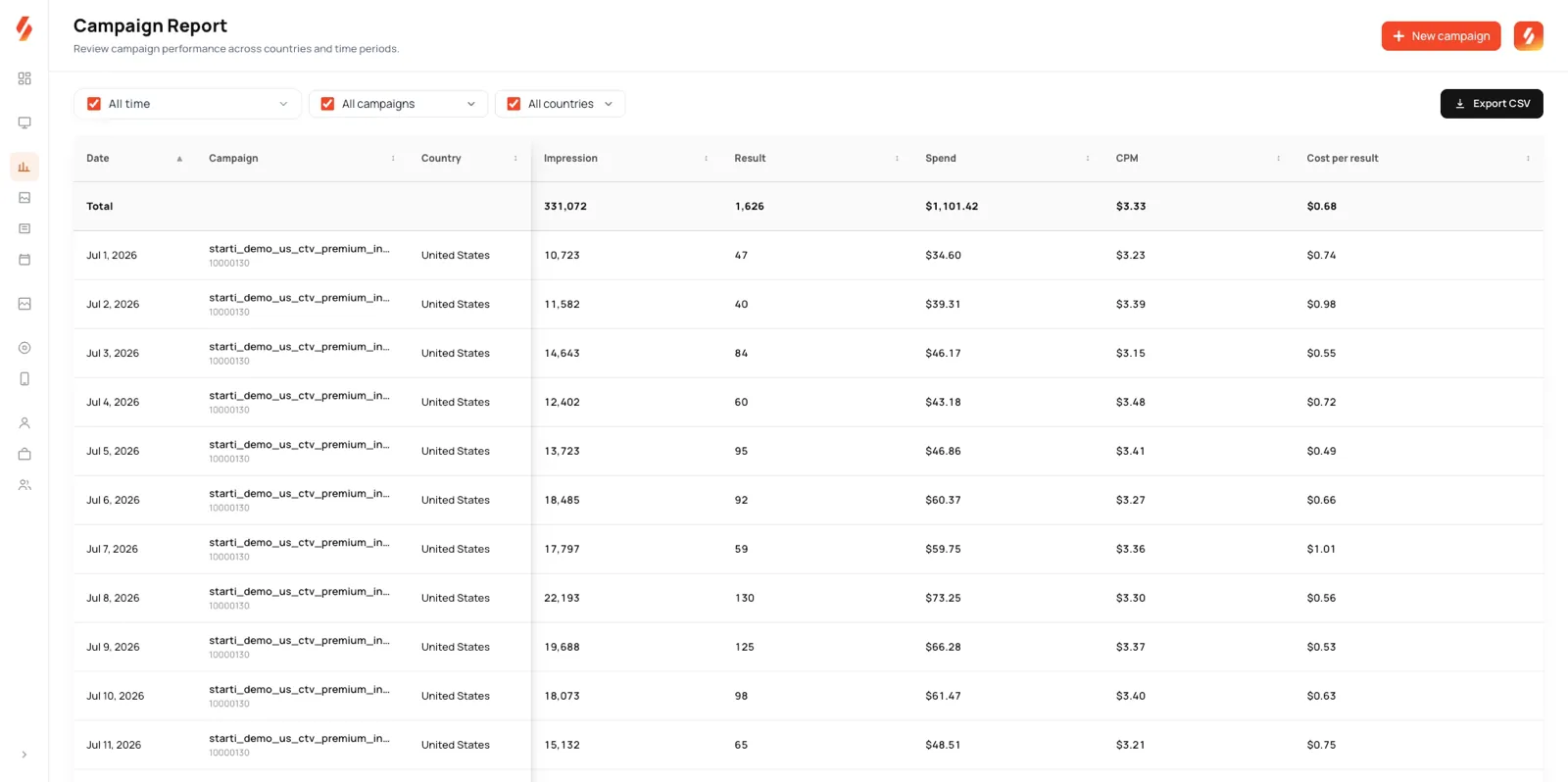
Smart Insight reads results across connected ad accounts and ranks the hooks and visual styles linked to higher CTR and completion. Each finding cites its supporting ads, and the team puts the next production budget on choices backed by evidence. It compares nine creative attributes against CTR, completion, and other outcomes, showing whether an opening performs differently across a group of ads.
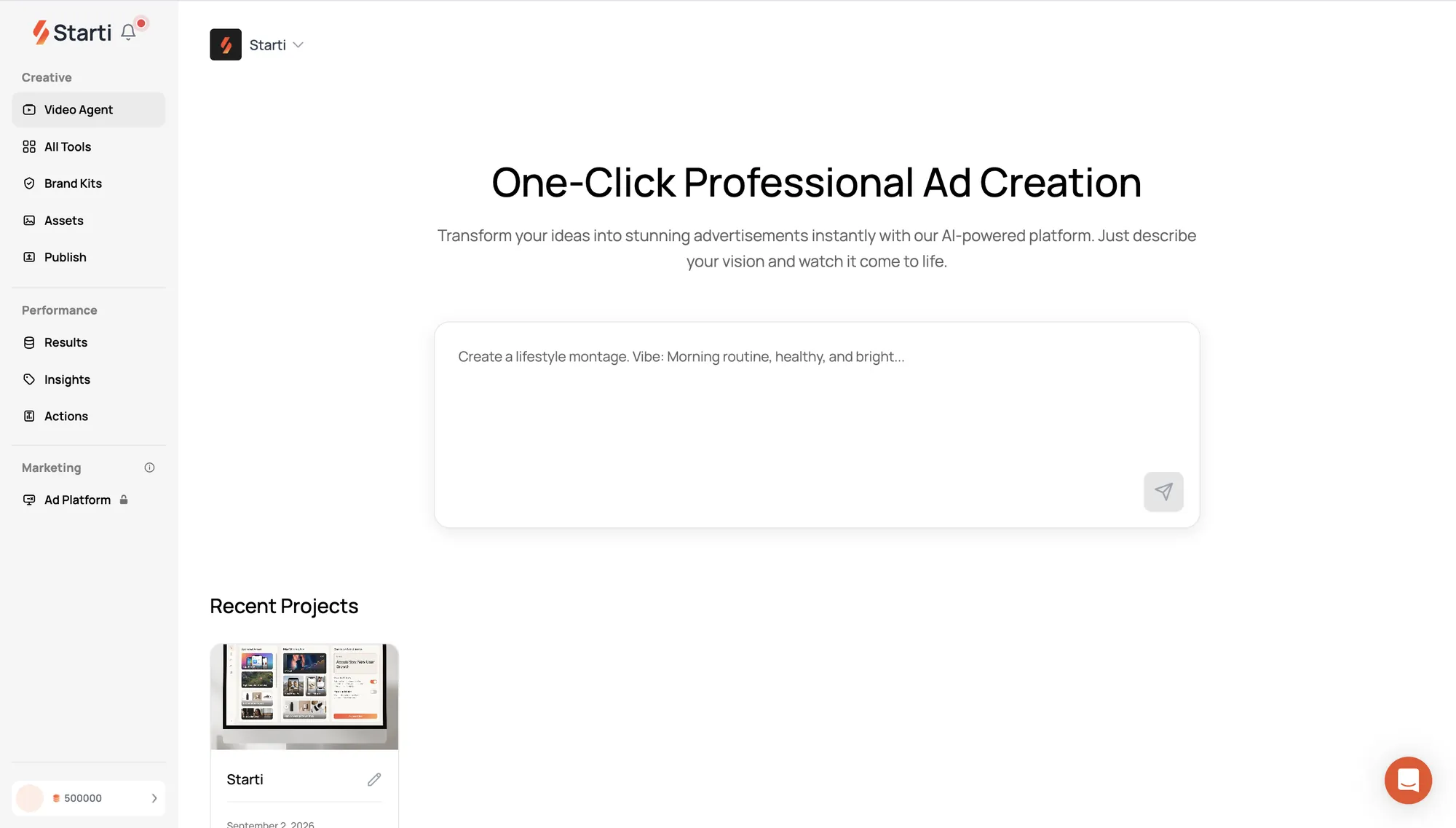
In AI Studio, Video Agent takes a brief from first concept to final cut on one canvas, and a note reworks one scene and leaves every approved scene untouched. In Creative Studio, findings become a focused brief for the next hooks, messages, or variations, quoted before production.
Book a demo to plan a hook test for your app.
Frequently asked questions
What is a video ad hook?
It is the first few seconds of a video ad, the part that decides whether a viewer stops scrolling and keeps watching. Meta's definition counts the words on screen, the visuals, and the audio that catch attention at the start.
What types of ad hooks are there?
Eight working types of hooks in app ads are problem, gameplay or product in use, value promise, question, statement of intent, transformation or surprise visual, social proof, and offer first.
How long should a video ad hook be?
TikTok advises introducing what the ad offers within 3 seconds and placing the hook within the first 6, and Google's July 2026 data for Demand Gen in-stream ads ties brand appearance in the first 5 seconds to 4% higher conversions.
What are TikTok hooks?
TikTok hooks are the opening seconds of a TikTok ad or video. TikTok recommends placing the hook within the first 6 seconds and building it on suspense, surprise, or other emotions, with captions and no long intro.
Which hooks do mobile game ads use?
In AppsFlyer's 2026 data for puzzle and lifestyle games, gameplay hooks took 24.5% of video spend on social and search, while problem hooks took 29% on ad networks and 27.9% on DSPs.
Do video ad hooks need sound?
Sound and captions both carry weight. Google's July 2026 data ties a human voice to 12% higher conversions in Demand Gen in-stream ads, and TikTok advises captions for clarity.