


On this page
- What TV attribution measures
- How linear TV attribution works
- Streaming TV attribution
- Linear vs streaming TV attribution
- What OTT attribution means
- How attribution windows work for TV advertising
- Cross-device attribution for TV
- Example: An attribution plan for a home insurance brand on linear and streaming TV
- TV attribution with Starti AI DASH
- Frequently asked questions
TV attribution assigns credit for a website visit, app install, or sale to the TV ads a household saw before it. In the Media Rating Council's outcomes standards, attribution is "associating an outcome such as a lead, sale or visit to media and advertising exposure," generally "at a household or individual level."
Linear TV and streaming TV reach that match by different routes and on different clocks. Linear works from airing times, viewing data, and matched markets, and reads spot response in the minutes after an airing. Streaming TV matches each impression record to a household and credits outcomes over hours or days.
What TV attribution measures
Attribution shows which exposures came before an outcome, and stops short of cause: MRC notes that it is "often difficult for these 'bottom up' approaches to account for other and external factors in driving Outcomes," and its standards add test and control designs to "estimate incremental effects."
Most measurement teams already run more than one method. In IAB's State of Data 2026 survey of 430 US buy-side decision makers, published in February 2026, 76% use incrementality tests, 73% attribution analysis, and 67% marketing mix models, with 39% using all three together. Each answers a different question for TV:
- Attribution: steers the campaign week to week, by app, daypart, and creative.
- Incrementality tests: decide whether the channel keeps its budget, by comparing exposed and unexposed households or regions.
- Marketing mix models: estimate performance across channels to set budget between them. In the same IAB survey, 38% of MMM users with line of sight into broadcast and cable TV said it is underrepresented in their models, and 41% of those with line of sight into CTV said the same of CTV.
How linear TV attribution works
Linear TV attribution is modeled, not linked directly. Outcome measurement for linear TV "traditionally relies on matched market analysis (e.g., test/control regions) or panel-based survey data," says IAB's Anatomy of Outcomes in Video Advertising, published in October 2025, and linear attribution "relies on statistical modeling rather than direct linking." Three kinds of data feed it:
- Airing logs: each spot's network and airing time, lined up with search, site, or app traffic in the minutes that follow and compared with the baseline just before. Academic work on this method, such as a Journal of Marketing study of pickup truck ads, merges minute-by-minute search data with spot-level airing data.
- Viewing data: panels, automatic content recognition (ACR), and set-top box data show which households saw a spot. "Panel data, ACR data, modeled attribution" is the list for linear TV in IAB's outcomes paper, and its September 2026 classification standard counts ACR and set-top box data, with login data, as deterministic signals tied to user or household identity.
- Matched markets: spots run in test regions and not in comparable control regions, and the difference in outcomes between the two is the lift.
Pick the route by the outcome. A website or app action that follows a spot within minutes suits airing logs, which compare networks, dayparts, and creatives against each other. Sales that land weeks later, or in stores, need matched markets or a model, since IAB notes that "Delayed effects (e.g., seeing an ad today, purchasing weeks later) complicate causal inference."
Streaming TV attribution
Each impression on streaming TV leaves a record to match. CTV measurement "often relies on matched exposure and outcome datasets, using device graphs, IP matching, or partnerships with data providers (e.g., credit card networks, loyalty programs)," according to IAB's outcomes paper, which adds that "Household-level attribution is common; person-level attribution is rare."
App installs are matched through a mobile measurement partner, web actions through a pixel, and lift through holdouts or geo tests inside the buying platform or across regions. Read matched installs and visits as attribution, and the holdout as the test of how many of them the ads added.
Linear vs streaming TV attribution
The two differ at each step:
- Exposure record: linear uses airing logs, panels, and ACR or set-top box data; streaming TV logs each impression with the household's IP address.
- Match: linear matches by airing time, market, or panel; streaming TV matches the household to the outcome.
- Window: linear spot response is read in minutes and linear sales effects over weeks; streaming TV view-through windows run in hours for app installs and days for web actions.
- Validation: linear relies on matched markets and models; streaming TV adds household holdouts inside the platform.
Report linear and streaming TV as separate lines before adding them. IAB lists over-attribution, "The same conversion is claimed by multiple platforms," among the results of inconsistent rules, identity mismatches, and different time windows.
What OTT attribution means
OTT covers more screens than the TV. It is video, linear or on demand, delivered directly to viewers over the internet, in the definition of IAB Europe's 2025 framework, which adds that it "is not limited to connected TV (CTV)."
On a TV screen, OTT advertising is attributed like streaming TV, by household. Logins add a person-level match: IAB's 2026 standard gives "someone logged into a streaming app" as its example of an ad delivered to a specific person. Ask for OTT results split by device type and by household-level and person-level matches.
How attribution windows work for TV advertising
An attribution window is the time after exposure during which an outcome can be credited to the ad, "the time over which exposure will be considered for attribution" in MRC's definition. The length needs a basis: MRC requires windows that are "empirically supported" and "logical with regard to campaign objectives and length as well as category sales cycles." IAB's outcomes paper gives 1 day, 7 days, and 30 days as examples of windows that "account for immediate and delayed effects."
Three rules for setting them:
- Sales cycle: a short window for app installs and low-cost orders, a longer one for considered purchases.
- Before launch: MRC requires windows to be "disclosed up front, in advance of campaign execution and measurement."
- One window per comparison: streaming TV and paid social are compared under the same window, because CTV platform defaults range from hours to weeks.
Cross-device attribution for TV
TV ads are watched on one screen and acted on from another. Household matching links the two through a shared IP address or a device graph. That link is not equally firm everywhere. In IAB's 2026 standard, streaming measurement "is partially deterministic within logged-in platforms, but becomes increasingly probabilistic when extended across devices, platforms, and ACR-based signals." One address can stand for several people: MRC lists IP addresses among the "known multi-user identifiers" that probabilistic cross-device methods draw on.
Ask the measurement partner three things about its cross-device match:
- Identity: whether the match uses the IP address alone, a device graph, or logins.
- Household counting: whether several orders or installs from one home are credited to a single impression.
- Unmatched outcomes: how many conversions could not be tied to any household, and where they are reported.
Example: An attribution plan for a home insurance brand on linear and streaming TV
A sample plan, with example inputs:
- Outcome: online quote requests, read as cost per quote.
- Markets: four test and four control markets, paired by pre-period quote request rate and household count.
- Linear: spots in the test markets only, over six weeks plus four weeks after the last airing for delayed quote requests.
- Airing logs: site visits in the minutes after each spot against the minutes before, by network and daypart.
- Streaming TV: household pixel matching, with the same 7-day window used for paid social, fixed before launch.
- Cross-device: household IP matching through one measurement partner across streaming buys, reported per household.
- Report: linear and streaming TV as separate lines.
- Decision: linear spend grows if quote requests per 1,000 households in the test markets beat the control markets by the margin set before launch.
TV attribution with Starti AI DASH
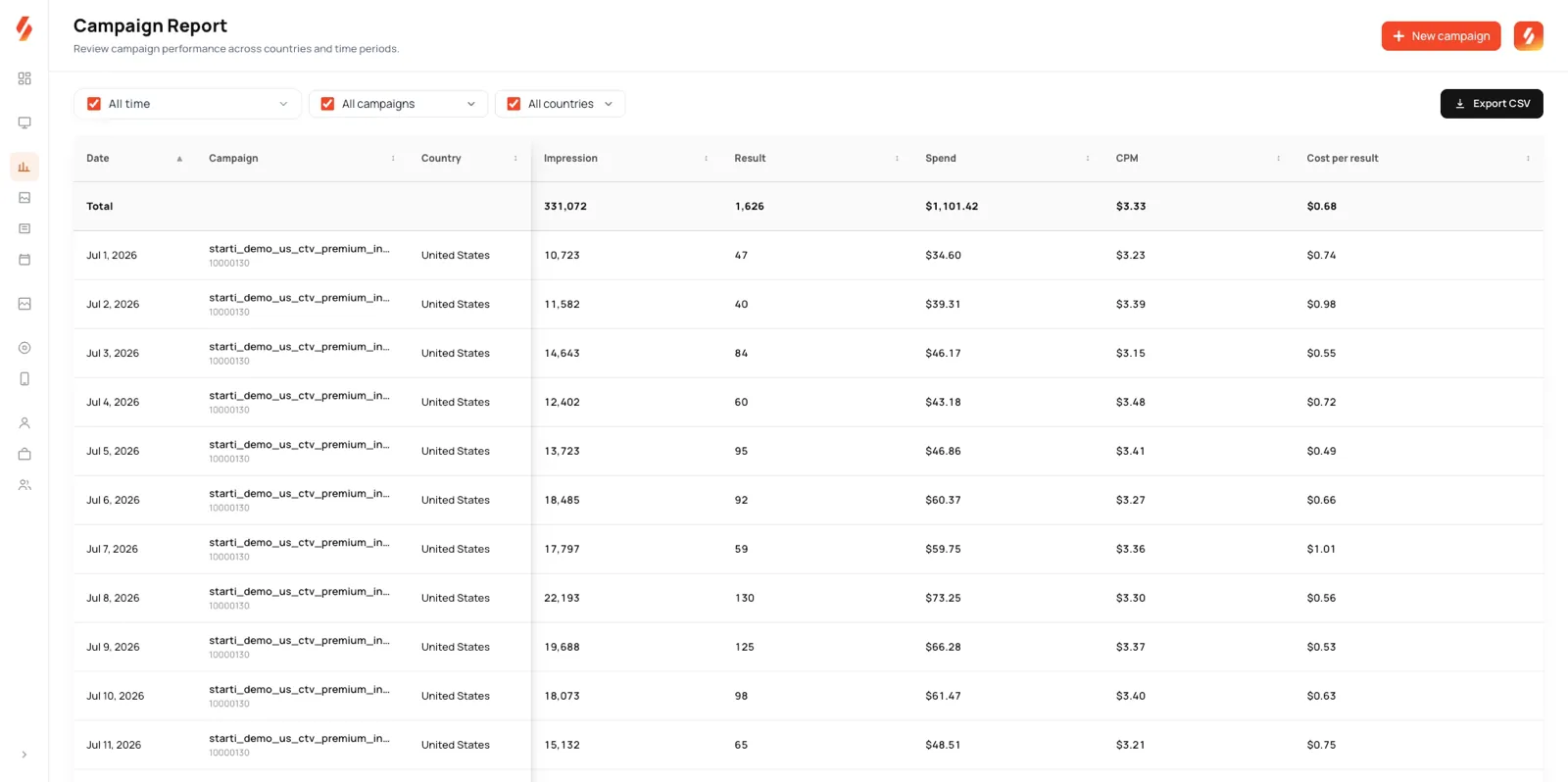
Starti runs finished ads on premium streaming, with optimization in flight and every impression tied to installs, registrations, and revenue. AI DASH brings campaign delivery, creative performance, media quality, and results into one reporting layer, and connects CTV exposure to supported visits, installs, registrations, purchases, and revenue through supported web pixels and mobile measurement partners.
Household Resonance extends CTV campaigns to eligible mobile, tablet, and desktop devices in the same household. Web Solution optimizes toward the website actions that create value, from registrations and lead forms to purchases and bookings. Each campaign is measured against its own goal, and the results shape the next round of creative and CTV placement.
Book a demo to plan attribution for a first streaming TV test.
Frequently asked questions
What is TV attribution?
TV attribution assigns credit for a visit, install, or sale to the TV ads a household saw before it, within a set window. Linear TV works from airing times, viewing data, and matched markets; streaming TV matches each impression to a household.
How does linear TV attribution work?
Linear TV attribution compares web or app traffic in the minutes after each airing with the baseline before it, uses panel, ACR, or set-top box data to see which households saw a spot, or compares outcomes in test markets with control markets.
What is OTT attribution?
OTT attribution credits outcomes to ads delivered over the internet on any screen. On a TV it matches households, and a streaming login adds a person-level match.
How do attribution windows work for TV advertising?
An attribution window sets how long after exposure an outcome can be credited to the ad. Linear spot response is read in minutes, streaming TV windows run from hours for app installs to days for web actions, and each window is fixed before launch.
What is cross-device attribution for TV?
Cross-device attribution links a TV exposure to an action on a phone or computer in the same household, through a shared IP address or a device graph.