

On this page
A performance creative agency makes ads for paid channels and is judged by what those ads do in the campaign: the clicks, sign-ups, installs, and purchases they drive. Each concept arrives in versions for different placements, lengths, and markets, and the next round is planned from the results of the last one. Agencies differ most in how they run that loop. Before signing, check how the brief gets written, how tests are planned, who reads the results, who owns the files and accounts, and how the work is billed.
What performance creative means
Performance creative is ad creative made to drive a measurable action and judged against a campaign metric such as cost per acquisition, click-through rate, conversion rate, or video completion. It can reuse brand footage, style, and story, but the planning differs: each round of ads is written around a question the campaign data can answer, the team makes enough versions to answer it, and the answer becomes the starting point of the next brief.
A Google Ads video experiment shows different video ads to the same audience to find which one works better; Google's own example hypothesis compares a 2-minute tutorial with a 15-second direct-offer video. TikTok's split testing tool lists the hook, the opening 2 to 3 seconds of a video ad, among the creative variables it tests, one variable per test.
What a performance creative agency delivers
The work falls into six kinds:
- Brief: product, audience, offer, goal, placements, and the question the first round of ads should answer.
- Concepts and scripts: creative directions approved before production starts.
- Production and versions: finished ads cut to the aspect ratio and length of each planned placement.
- Localized versions: voice and on-screen text for each target market.
- Results reviews: a read of how each ad performed and what to keep, change, or test next.
- Refreshes: new versions for ads that worked and have started to decline.
The first four kinds end at delivery, and results reviews and refreshes carry the work past it. Versions multiply fast: three concepts in three aspect ratios, two lengths, and three languages come to 54 finished files. Plan the ratios and lengths for each placement as part of video ad production, and agree on that count in the scope before production starts.
How to evaluate a performance creative agency
Ask about seven areas on the first call and compare the answers across the shortlist:
- Brief: "What do you need from us, and who writes the brief?" Product, audience, goal, and existing assets are enough to start; the agency drafts the brief, and you approve it before concepts.
- Test plan: "What question does each round answer?" One question per round, one element that changes, a deciding metric, and the platform tool and account the test runs in.
- Results: "Who reviews results after launch, and is that in the fee?" A named owner, a set review rhythm, and a written finding that goes into the next brief.
- Versions: "Which ratios, lengths, and languages come as standard?" Versions agreed from your media plan before production, with shorter cuts re-edited for their length rather than trimmed.
- Rights: "Who owns the raw files, and what do talent and music licenses cover?" Ownership of raw footage and project files written into the contract, with license terms, channels, and territories recorded per asset.
- Reviews: "At which stages do we approve, and where does feedback go?" Direction approved before full production, feedback in one shared workspace, and a clear line between a revision and a new ad.
- Billing: "What does the fee include?" Versions, localization, revision rounds, results reviews, and refreshes listed in the scope.
Ask for a recent test plan first
Test plan, results ownership, and rights separate one agency from another; brief, versions, reviews, and billing are terms to negotiate. Of the three, the test plan shows the most about how an agency works, so ask to see one from a recent project. It should name the question, what changes between versions, what stays fixed, and the metric that decides, and it should say where the test runs, such as a Google Ads video experiment or a TikTok split test. Check how the plan connects to the brief as well, because a creative testing framework sits inside the brief.
A sample test plan, filled in
An example of round two for a budgeting app's install campaign on TikTok, after a concept test has picked the idea:
- Question: does opening on the problem, an overdraft alert, hold viewers better than opening on the result, a savings goal reached?
- Variable: the opening two to three seconds, which TikTok's split testing treats as video hooks under its Creative Assets variable.
- Held fixed: the app demo, the voiceover after the opening, the free-trial offer, the end card, the 15-second length, the 9:16 format, the audience, the optimization goal, and the bid.
- Deciding metric: cost per install, with video view metrics for the opening seconds read alongside to explain the result.
- Guardrail: trial starts per install, so a cheaper install that never starts a trial cannot win.
- Setup: two equal audience groups that never see each other's version, run for at least seven days, TikTok's recommended minimum, on a budget that its estimated testing power puts at 80% or higher.
- Decision rule: the version TikTok declares the winner on the key metric at its 90% confidence level becomes the fixed opening for round three. With no winner, round three tests openings that differ more.
- Next round: the offer line, with the winning opening fixed.
The same round on YouTube runs as a Google Ads video experiment, where conversion metrics need at least 100 conversions per campaign before Google reports a difference and a result counts as conclusive at 95% confidence. At a $5 cost per install, two arms need at least $1,000 in spend before that first read. Other businesses swap the guardrail: trial-to-paid conversion for subscription apps, a funded account for fintech, a first booking for travel.
Look at live work, then ask about results
Portfolio reels show finished ads without their results. Ask for the brands behind a few recent projects and look their ads up in the public ad libraries. Meta's Ad Library lets anyone search the active ads running across Meta's products, and Google's Ads Transparency Center shows the ads an advertiser has served on Search, Display, Gmail, and YouTube, with filters for date and location. Live ads reveal how many versions of a concept are running and in which formats. For the results themselves, ask the agency to walk through what a few of those ads achieved and what changed in the round after.
Keep files, licenses, and ad accounts on your side
Talent, music, and stock licenses set where and for how long an ad can run. In the contract, check who owns raw footage and project files, how long talent and music are cleared, which channels and territories each license covers, and which AI tools the agency uses in production. Record the same fields for every asset the agency delivers, as part of creative asset management.
Ad accounts belong in the advertiser's business, with the agency added as a partner. In TikTok Business Center, an advertiser can add a partner and set permissions for each shared account and asset, and on Google Ads, an admin on the client account can remove a manager account's access from the client side. Ads run from an agency's own accounts take the performance history with them when the contract ends.
Red flags in a pitch
Four signs in a proposal or first call show production capacity sold as performance creative:
- Volume as the headline: the proposal leads with a monthly ad count, and no test question appears anywhere.
- Every version changes everything: variations differ in opening, music, offer, and length at once, so a winning ad teaches nothing the next round can reuse.
- Trimmed short cuts: the 6-second version is the first six seconds of the 30-second ad, with the call to action cut off.
- Sibling-only wins: case results compare new versions with one another, never with the advertiser's best running ad.
Match the billing model to the work
Agencies price performance creative in four common ways:
- Project fee: a fixed price for a defined set of ads and versions. Fits a launch or a seasonal campaign.
- Per-asset or package pricing: a price per finished ad or per bundle of versions. Easy to compare across agencies, and it rewards output more than learning.
- Monthly retainer: a set scope of work each month. Fits a steady refresh cadence.
- Performance-linked fee: part of the fee tied to an agreed result. Works when attribution is clean and the metric is fixed before launch.
Compare quotes on cost per test round: the fee divided by the test questions the scope answers, with versions and localization counted inside each round.
For a first engagement, a project fee on one product and one test question shows how the agency briefs, tests, and reports before a retainer commits both sides to a pace.
How to evaluate creative agency performance after launch
Once the ads are running, judge the work on three measures:
- Campaign metric: the metric named in the brief, measured against the ads already running in the same campaigns. A new ad that beats the account's current best has moved results; one that beats only its sibling versions has answered a narrower question.
- Results reviews: each review hands back a finding about one element, such as the opening or the offer, and a plan for the next round.
- Timing: production and review time for a replacement stays shorter than the time a winning ad takes to fatigue in the account, read from the ad fatigue signals on Meta, TikTok, and YouTube.
What a results review should hand back
A useful results review fills six fields:
- Finding: one sentence naming the element tested, the version that won on the deciding metric, and the confidence the platform reported.
- Evidence: each version's deciding metric and guardrail metric, with spend, dates, and the campaign it ran in.
- Account benchmark: how the winner compares with the strongest ad already running in the account.
- Keep or retire: which elements become fixed for the next round and which are dropped.
- Next question: the test for the next round, written as the first line of its plan.
- Fatigue watch: which running ads show fatigue signals, and when their replacements are due.
Performance creative with Starti Creative Studio
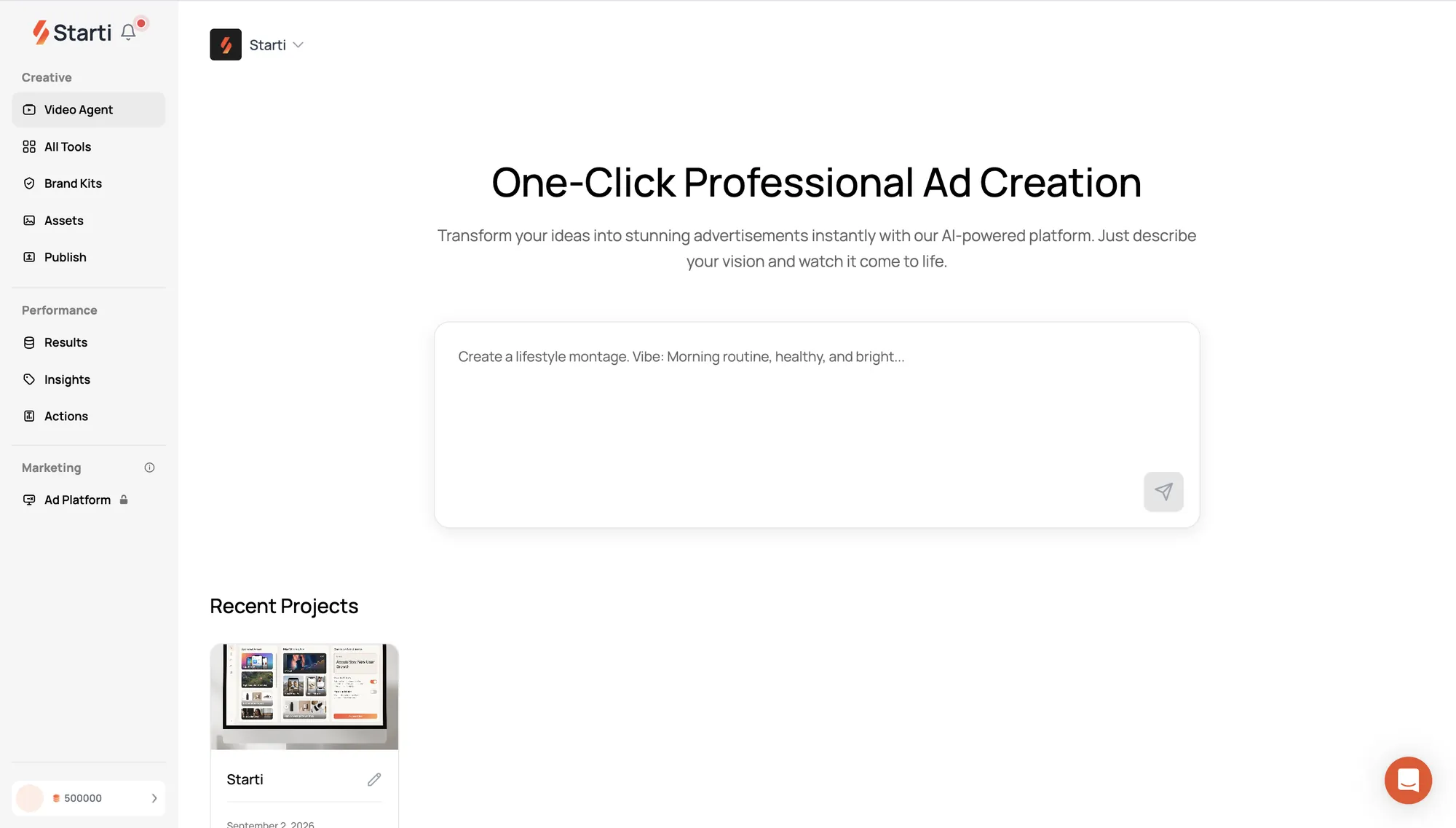
Starti Creative Studio runs this loop for the advertiser: Starti's team takes every video ad from brief to delivery, with free performance tracking that shapes the next round.
- Brief: the client brings the product, audience, goal, and any references or assets. Brief Agent helps clarify the details, and the client confirms the brief before it goes to the Studio team, so no finished brief is needed up front.
- Versions: formats, cut lengths, and languages are chosen for each media plan and confirmed in the project quote. Base production covers one language and one aspect ratio, with additional languages, formats, and cut lengths quoted with the project. Each ratio is framed to look at home in its feed, the 30s, 15s, and 6s cuts open strong and close on the offer, and voiceover and on-screen copy are localized for each market.
- Reviews: the client approves the scope, quote, timing, and revision rounds, then reviews each delivery in a shared project workspace, requests revisions, and approves the final version. Production errors are corrected without using a revision round.
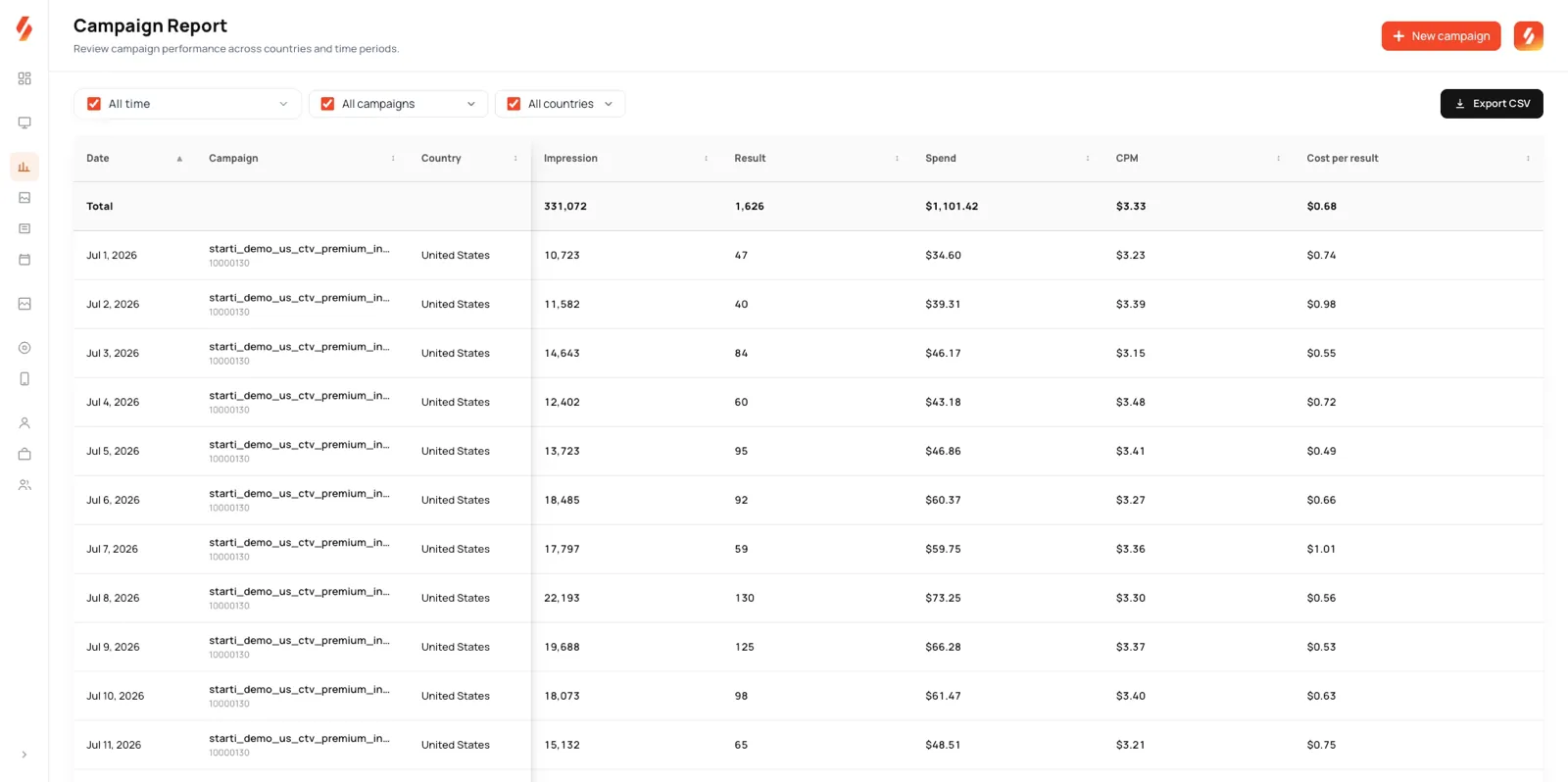
- Results: every ad Starti produces gets free performance tracking after launch. The team that made the ads reviews how each one performs on conversion and user quality and proposes what to test next, and the findings become a focused brief for the next round, quoted before production.
Selected work is on the Creative Studio page.
Frequently asked questions
What is a performance creative agency?
A performance creative agency makes ads for paid channels and measures its work by campaign results. It delivers each concept in versions for every planned placement, length, and market, reviews how each ad performs, and plans the next round from those results.
What is performance creative?
Performance creative is advertising built to drive a measurable action, such as a click, an install, or a purchase, and judged against a campaign metric. Each round of ads answers a defined question, and its results shape the next brief.
How do you evaluate creative agency performance?
Compare the agency's new ads with the ads already running in the same campaigns, on the metric agreed in the brief. Then look at what each results review hands back and whether refreshed versions arrive before the running ads wear out.
What should you ask a performance creative agency before hiring?
Ask who writes the brief, what a recent test plan looked like, who reviews results after launch, which versions and languages are standard, who owns raw files and ad accounts, how reviews work, and what the fee includes.
How do performance creative agencies charge?
Common models are a project fee, per-asset or package pricing, a monthly retainer, and a performance-linked fee. Compare what each one includes: versions, localization, revision rounds, results reviews, and refreshes.
What sets the best creative agencies for performance marketing apart?
The best creative agencies for performance marketing write a test plan for every round, name an owner for results after launch, plan versions from the media plan, and leave raw files, licenses, and ad accounts on the advertiser's side.