


On this page
- A mobile game marketing timeline
- Mobile game marketing before launch
- Measurement: MMP, ATT, and AdAttributionKit
- Launch and scale: Mobile game user acquisition by channel
- Genre benchmarks for setting targets
- Creative for each stage
- Re-engagement and live ops
- Mobile game creative with Starti AI Studio
- Frequently asked questions
For growth and UA teams at studios and publishers, mobile game marketing centers on paid user acquisition: buying installs, measuring what players do, and bringing them back with live events. Adjust's gaming app insights report: 2026 edition puts the global gaming cost per install at $0.56 in 2025, up 30% on the year, and at $1.71 in the US. With acquisition costs that high, a mobile game marketing strategy ties each stage's ad spend to what players do after the install.
A mobile game marketing timeline
Google's lead-time advice and the stores' limits set most of the calendar around launch:
- Pre-registration: Google advises turning it on three to six weeks in advance for most campaigns and nine to twelve weeks in advance for a game expected to draw heavy interest, with App campaigns for pre-registration and Play listing experiments running across that window.
- App Store pre-orders: open any time from 180 to 2 days before release.
- Before the first ad: the mobile measurement partner (MMP) connected to every network and the iOS conversion value schema set.
- Launch week: install campaigns on installs or one early event, and product page optimization tests starting on iOS.
- Weeks 2 to 4: campaigns past 100 conversions move to an in-app action goal, and the first live event runs on both stores.
- After three to four weeks of conversion value history on target CPA: value goals such as target ROAS.
Mobile game marketing before launch
On Google Play, pre-registration lets players sign up from the store listing, and every pre-registered user gets a push notification at launch. Each country's window lasts 90 days, and the game must launch before it closes.
Paid sign-ups come through Google's App campaigns for pre-registration, an Android campaign type that bids to a target cost per pre-registration across Google Play, YouTube in-stream, and the Display Network. Google advises turning on pre-registration at least two weeks before pre-launch marketing begins, and three to six weeks is enough for most campaigns.
Apple's equivalent is the pre-order. A brand-new game can open pre-orders 2 to 180 days before release, and on release day it downloads automatically to the devices of people who pre-ordered.
Store page tests differ by platform. Google Play's store listing experiments test up to two listing variants and can use pre-registration clicks as the target metric. On iOS, Apple's pre-order guide says existing apps can use custom product pages and product page optimization for their pre-order page. The Play variant that draws the most pre-registrations makes a strong control for Apple's product page optimization at launch, which tests up to three alternate versions of the icon, screenshots, and previews.
Measurement: MMP, ATT, and AdAttributionKit
An MMP attributes each install and in-app event to its source and sends post-install events back to the networks that optimize on them.
On iOS, tracking players across other companies' apps or reading the advertising identifier needs App Tracking Transparency permission. Apple's September 2026 update adds an alternative prompt in the EU from iOS 27.2, the only version for apps distributed in Germany, France, Italy, Poland, and Romania. EU users can be asked again a year after their last choice.
Attribution without tracking runs through AdAttributionKit, which builds on SKAdNetwork and needs no ATT prompt. It credits a click within 30 days or a view within 24 hours by default. A game can set its own windows of 1 to 30 days for clicks and 1 to 7 for views. Postbacks follow three conversion windows: days 0 to 2, 3 to 7, and 8 to 35. Only the first can carry one of 64 fine conversion values; the second and third carry a coarse low, medium, or high.
Postbacks also arrive late. The first window closes two days after first launch, and Apple then adds a random delay of 24 to 48 hours, so the first postback for an install reaches the network three to four days after the player first opens the game. Read iOS results with that lag: a day's iOS numbers describe installs from several days earlier.
A conversion value schema, worked through
Apple sets each install's postback data tier from crowd size, counting the publisher app, the advertised app, the country, and the source identifier: in Tier 2 and Tier 3 the first postback carries the fine value, in Tier 1 it carries the coarse value instead, and in Tier 0 it carries no value and no later postbacks follow. Postbacks also gain data as more installs are attributed to an ad, so narrow source identifiers, small countries, and low-volume campaigns land in the lower tiers more often.
Build the schema from the coarse levels down, since Tier 1 installs report only those. Fine values then split each level into detail. For a midcore role-playing game, one workable layout for days 0 to 2:
- Low, fine values 0 to 15: installed and played, split by tutorial completion and the highest early level reached.
- Medium, fine values 16 to 39: strong engagement without a purchase, such as a guild joined or a second-day return, split by session count.
- High, fine values 40 to 63: a purchase, split into revenue bands.
The second and third windows reuse the three levels for depth: low for a return visit, medium for continued play or a small purchase, high for revenue above the band the team treats as a likely payer. Locking the first window as soon as a purchase happens gets that postback prepared at once, and Apple then ignores later updates in the window, so lock when the purchase is the strongest signal days 0 to 2 can carry. Set the schema once with the MMP and share the mapping with every network buying iOS installs.
Launch and scale: Mobile game user acquisition by channel
Each channel sets the goals a campaign can optimize for:
- Google App campaigns: ads assembled from text, image, video, and HTML5 assets run across Search, Google Play, YouTube, Discover, and the Display Network. Install campaigns bid to a target cost per install, cost per in-app action, or return on ad spend. For target cost per install and cost per in-app action bids, Google recommends bidding 1.5 times higher on iOS than on Android.
- Meta: Advantage+ app campaigns run as one campaign with one ad set under Meta's machine learning, optimizing for installs or, with the value goal, total purchase value within the attribution window.
- TikTok: Smart+ App campaigns optimize for installs or in-app events on iOS and Android, and for value on Android.
- In-app ad networks: Unity's campaign goals default to installs and add ROAS for in-app purchase revenue, ad revenue, or both, plus events such as level completion, payers, or retention.
- CTV: trailers and launch films run on the household TV, and the MMP credits installs and in-app events that follow TV exposure within the attribution window the team sets. Choose that window and the priority settings with the four-MMP rundown in CTV ad measurement.
When to move a campaign up the goal ladder
A new title starts on installs or one early event, such as a tutorial or level milestone, and moves budget to value goals once purchases flow. Each network sets its own signal that a campaign has enough data for the next goal:
- Google: the in-app action behind a target CPA should be one that at least 10 different users complete each day. Target ROAS follows once a campaign moving from target CPA has three to four weeks of conversion value history. Google's best practices set budgets at 50 times the bid for target cost per install and pre-registration, 10 times for target cost per in-app action, and 15 times for engagement campaigns. The same page leaves the install event without a value and asks for a target ROAS conversion window long enough to capture around 90% of in-app conversions and under 30 days.
- TikTok: value-based optimization for apps gets at least seven days of learning with budget and target ROAS left untouched, a daily budget of 30 times the CPA for in-app purchase value, and at least 15 creatives at the start.
- Unity: in-app purchase ROAS campaigns leave learning after 75 unique purchasers with matured day 7 data, and a day 7 cohort matures nine days after install at the earliest. Ad revenue ROAS needs 1,000 attributed installs and matured ad revenue above $0. The opening budget should buy at least 10 purchasers a day in the first week.
Treat Google's 100 conversions as the earliest point for a step up: changes before that mark can disrupt learning. Recheck the budget before switching, because the required multiple depends on the bid type: a $2 install bid needs at least $100 a day, and a $15 bid on a tutorial completion needs at least $150. For target ROAS, Google advises reading trends over 14 to 30 days with the most recent days left out, making significant changes to the target or budget at most once every one to two weeks, and keeping target changes within 15% to 20% of historical averages. Major adjustments restart a 7 to 14 day learning phase.
Genre benchmarks for setting targets
Adjust's 2026 report gives these reference points, from 2025 data unless marked:
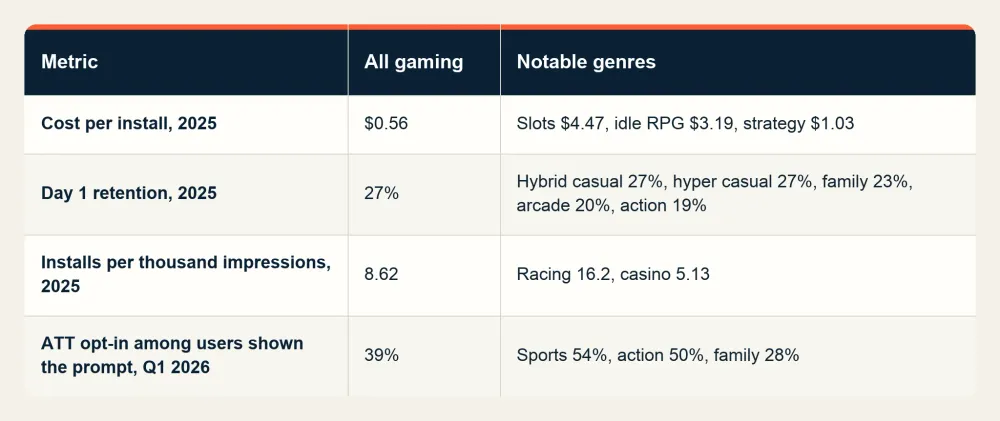
- Cost per install: $0.56 across gaming, against $4.47 for slots, $3.19 for idle RPG, and $1.03 for strategy.
- Day 1 retention: 27% across gaming. Hybrid casual and hyper casual matched that 27%, the highest of any genre, family rose from 18% to 23%, and arcade and action sat at 20% and 19%.
- Installs per thousand impressions: 8.62 across gaming, with racing highest at 16.2 and casino at 5.13.
- ATT opt-in among users shown the prompt, Q1 2026: 39% across gaming, 54% for sports, 50% for action, and 28% for family.
Set targets against the genre row. An idle RPG paying $3.19 per install is on par with its genre at nearly six times the gaming average, and an action title holding 20% day 1 retention beats its genre while trailing the all-gaming figure. ATT opt-in decides how much of iOS can be read at the user level: just over half of prompted players opt in for sports titles against just over a quarter for family games, and the rest of the iOS read rests on AdAttributionKit postbacks.
To turn a benchmark into a target, tie it to payback. Take a game where, for example, 3% of installs pay and a paying player spends $40 in the first 90 days. That makes gross revenue per install over 90 days $1.20, so breaking even by day 90 caps the blended cost per install at $1.20 before app store fees. Against strategy's $1.03 that leaves a thin margin; against idle RPG's $3.19 the plan needs a higher payer rate, a bigger first purchase, or a longer payback window.
Creative for each stage
Google's HTML5 and playable ad formats serve in install campaigns but not in pre-registration or engagement campaigns, and Unity runs creative testing campaigns that balance impressions across creative packs.
Test in the order of the stages: concepts and key art against cost per pre-registration before launch, openings and formats against installs per thousand impressions at launch, and offers against payer rate once value goals run. Creative shows first in installs per thousand impressions, and quality shows in day 1 retention. A cut that lifts the install rate while day 1 retention falls is buying the wrong players, so compare creatives on retention at similar install volumes in the MMP before scaling a winner.
Plan the creative calendar from the game's calendar: trailer and key art before pre-registration opens, gameplay and playable variants at launch, and a video cut for each live event. Variant volume between those dates comes down to creative throughput for mobile game advertising, and keeping it up takes a weekly production rhythm for app video ads.
Re-engagement and live ops
Most players don't return on day 1. Live events bring some of them back, and both app stores promote those events outside paid media.
Apple's in-app events appear as event cards with an image or a looping video on the product page, in search, and in editorial and personalized recommendations. Each can last up to 31 days and appear up to 14 days before it starts.
Google Play's promotional content covers offers, time-limited events, and major updates for up to four weeks, and Google highly recommends a YouTube video for each entry. Games eligible for Play's premium growth tools can aim events at players who haven't opened the game in 28 days or have uninstalled it, and can request featuring four times a quarter for broad-audience events.
Paid re-engagement needs an installed base. Google's App campaigns for engagement require at least 50,000 installs, deep links, and audience lists, and TikTok offers app retargeting on Android and iOS 14.5 and lower, optimized for in-app events or value. AdAttributionKit reports re-engagement from ad clicks on iOS, and CTV retargeting reaches existing players on the TV.
Hold out a random slice of lapsed players who see none of the engagement campaign's ads. The gap in return rate between that group and the players who do see the ads is the campaign's own lift, apart from players the live event would have brought back anyway.
Schedule live events first and buy re-engagement media against them. One event can run as an App Store card, a Play promotional content entry, and an engagement campaign offer, and titles under Google's 50,000-install mark start with the store surfaces.
Mobile game creative with Starti AI Studio
Two Gaming samples from AI Studio fit the pre-launch and install stages: a twelve-second racing trailer cut to win attention in the opening frame, and a character-led app install ad that carries players through to the download.
In AI Studio's Video Agent, the team approves concepts, scripts, and storyboards before production. A revision note changes one scene and keeps every other approved scene, so a live event offer can replace the closing scene of an install ad. Finished videos reframe to 9:16, 16:9, 1:1, and 4:5, localize into ten languages with dubbing and lip sync, and publish to connected Meta, Google Ads, and TikTok ad accounts.
Once install campaigns run, Smart Insight reads Meta, TikTok, Google Ads, and configured custom networks, shows whether an opening, visual style, or call to action performs differently on CTR, completion, and other outcomes, and carries the findings into the next brief.
Creative Studio is the managed route, where Starti's creative team takes the brief through concepts, production, and revisions. For the TV line, Starti's performance CTV platform, AI DASH, measures CTV exposure against supported visits, installs, registrations, purchases, and revenue. Both Gaming samples play on the AI Studio page.
Frequently asked questions
What is mobile game marketing?
Mobile game marketing, also called game app marketing, covers how a studio or publisher finds players, gets them to install, and brings them back. For growth and UA teams, it centers on paid user acquisition across Google, Meta, TikTok, in-app ad networks, and CTV, supported by store pages and live events.
How do you market a mobile game?
To market a mobile game, work by stage. Before launch, build pre-registrations on Google Play and pre-orders on the App Store. At launch, buy installs with goals that move from installs to in-app events to value as data comes in. Set up an MMP and the iOS conversion value schema before launch, then use live events and engagement campaigns to bring players back. App store optimization (ASO), community channels, and creator content add installs alongside paid UA.
What is mobile game user acquisition?
Mobile game user acquisition (UA) is buying installs from players likely to stay and spend. A user acquisition strategy sets what each campaign optimizes for: installs, an in-app event such as a level or a first purchase, or revenue through target ROAS.
What is a good day 1 retention rate for a mobile game?
Adjust measured 27% across gaming apps in 2025. Genre moves the bar: hybrid casual and hyper casual reached 27%, family 23%, arcade 20%, and action 19%, so judge a title against its own genre.
How are iOS game installs measured?
Through an MMP, using App Tracking Transparency permission for players who opt in and AdAttributionKit postbacks for attribution without tracking. Those postbacks follow three conversion windows: days 0 to 2, 3 to 7, and 8 to 35.
How do mobile games re-engage lapsed players?
With live events promoted on the App Store and Google Play, plus paid engagement campaigns. Google's App campaigns for engagement need at least 50,000 installs, deep links, and audience lists.