On this page
Creative asset management is the practice of storing, describing, and governing the files a creative team makes and uses: raw footage, stills, music, voiceover, graphics, project files, and finished ads with all their versions. Frontify's guide describes it as the creative-team side of digital asset management, while DAM is the broader system of record for finalized assets across a company.
For an ad team, each asset carries more than a file name and a folder: an expiry date for the actors in it, a license that covers some channels and not others, a set of versions cut for different placements, and, more often now, a record of which AI tool generated it. When those facts live in email threads instead of the library, teams redo work. In Canto's State of Digital Content 2026 survey of 434 professionals in the US and UK, respondents linked poorly managed assets to wasted or misused budget (39%), duplicated or redundant work (38%), and delayed campaign launches (35%).
What counts as a creative asset in advertising
Ad teams manage more than finished spots. Their marketing creative assets fall into six kinds of files:
- Footage: camera originals, selects, b-roll, and generated shots.
- Stills and key art: product photography, campaign images, and thumbnails.
- Audio: licensed music, voiceover recordings, and sound effects.
- Brand elements: logos, colors, fonts, end cards, and legal supers.
- Project files: edit timelines, graphics templates, and scripts.
- Finished ads: each master and every version cut from it for a length, ratio, language, or market.
What to record for each asset
A search returns a file, and the record attached to it shows the rights and versions that come with the file. The example record covers a 30-second master with two principal performers, cut to 15 and 6 seconds and cropped to 4:5, 1:1, and 9:16.
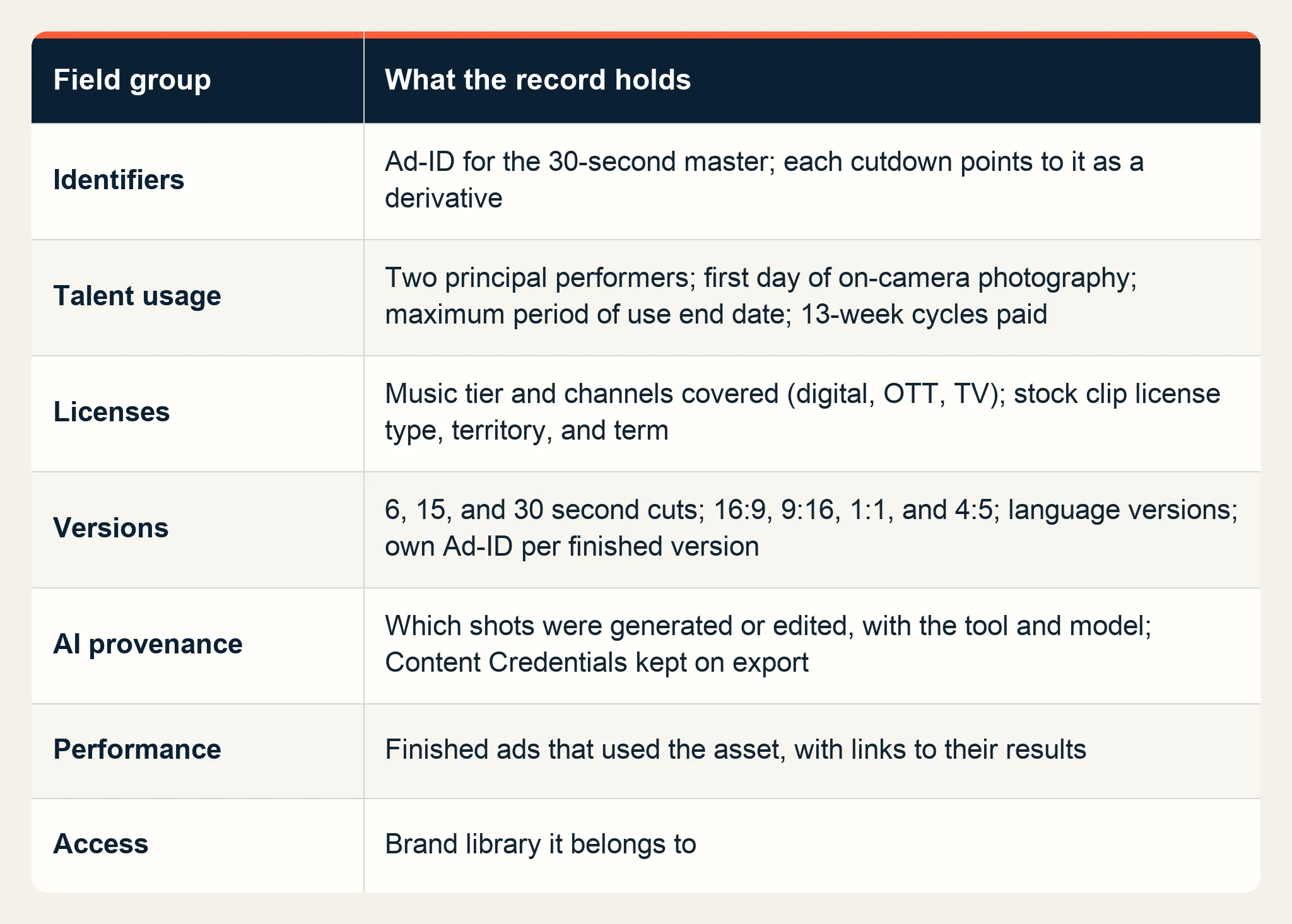
Identifiers
In the US, finished commercials are identified by an Ad-ID, which the Ad-ID registry calls the standard identifier for advertisements in the United States. Its glossary includes a code record type that marks whether an asset is an original or a derivative of another asset, which is the same parent and child link a library needs between a master and its cutdowns. The slate and delivery rules for TV are covered in Starti's guide to TV commercial production.
IAB Tech Lab's Ad Creative ID Framework carries a registered identifier such as the Ad-ID in the VAST UniversalAdId field, so a creative keeps one ID across the video supply chain. Storing the Ad-ID on every delivery file of a spot, including the streaming files, keeps reporting tied to one creative.
Talent usage
On a US union production, the right to air a commercial runs for a set period. Under the SAG-AFTRA Commercials Contract, a fixed cycle is 13 consecutive weeks. For commercials produced under Linear or Linear + Digital, which includes streaming, holding fees are automatic, and each holding fee equals a session fee. The 2025 contract, which runs from April 1, 2025 through March 31, 2028, sets a maximum period of use of 24 months beginning 10 business days after on-camera principal photography starts. After that, continued use needs the performer's consent.
Editing has its own rules in the 2025 contract. Versions cut from the same footage cost nothing extra for the first two, one session fee for the third, and 30% of a session fee for each one after that. Edits that change the concept or the commercial message, add an on-camera principal who was not part of the same production and script, or add a product or brand that the editing rules do not allow create a new commercial. The contract also names asset libraries directly: a commercial submitted to an advertiser's Advertising Library "or other similar asset management platform" gives the advertiser and its agencies unlimited versions for traditional digital use, for four session fees per principal performer during the maximum period of use.
For each asset with union talent, record the first day of on-camera principal photography, the maximum period of use end date, the cycles paid, and the media purchased.
Music and stock licenses
Licenses set where a file runs. Under Getty Images' license agreement, royalty-free content is licensed for worldwide, unlimited, perpetual use, rights-managed content is limited to the specific use, medium, period, and territory selected, and content marked editorial cannot be used in advertising unless a Getty invoice or license agreement explicitly allows it. On Epidemic Sound, digital ads are covered from the Pro plan up, while OTT, TV, radio, and commercial streaming are covered only on Enterprise. Content published during an active subscription stays cleared after cancellation, and content soundtracked after the subscription ends is not.
The same track can therefore be cleared for a social ad and not for a CTV spot. Record the license tier, the channels it covers, the territory, the term, and the date the ad was published.
Versions and renditions
One approved master usually becomes many files: shorter cutdowns, vertical and square crops, and language versions. Each one should point back to its master and carry its own length, ratio, language, and Ad-ID. Platform requirements differ, as the TikTok ad specs guide shows, and the ratio and length fields let a media buyer pull the right file without opening each one. How language versions are produced is covered in the video localization guide.
AI provenance
Generated shots need a record of how they were made. The C2PA specification, at version 2.5 since October 2026, defines Content Credentials: digitally signed statements about an asset's origin, its edits, and its use of AI. The IPTC photo metadata standard records similar facts, including a Digital Source Type for media created with generative AI and, since version 2025.1, fields for the AI system and prompt used.
Ad platforms now read or attach these signals:
- YouTube: uses C2PA metadata to apply AI labels, and creators cannot adjust those labels.
- Google Ads: images and videos generated inside Google Ads tools carry SynthID and C2PA metadata, and ads with assets marked as AI-generated or edited include a disclosure in "How this ad was made."
- TikTok: its advertiser guide, updated October 6, 2026, requires disclosure for ads that are completely AI-generated or significantly AI-modified, and says TikTok uses C2PA Content Credentials to label eligible AI-generated content.
- Meta: in a June 1, 2026 update, Meta said it will begin detecting ads created or edited with third-party AI tools through industry-standard signals and will show an "AI info" label in About this ad.
Record which tool and model produced each generated shot, and keep provenance metadata intact when files are exported. Starti's sign-off checklist for AI ads keeps an approval record that lists which model rendered which scene.
Performance
Linking each asset to the finished ads that used it shows results for each piece of footage as well as for each ad. When three spots that share an opening shot all hold viewers longer, the shot itself becomes the reusable asset. Starti's article on creative intelligence explains how tagged attributes are compared with results.
How teams find assets
Folder names work until a library holds thousands of clips. Tags help when a marketing team agrees on a fixed vocabulary and applies it to every file. In DAM solutions with AI search, descriptions change the search itself: instead of remembering a file name, an editor types what the shot shows. In Canto's 2026 survey, 54% of teams that use AI for asset search said locating assets is extremely easy, compared with 6% of teams that do not.
Agencies have one more requirement. Each client's files should sit in a separate library, so a search for one brand never returns another brand's footage.
Reuse approved footage in new ads
Reusing approved assets is faster than shooting or generating a scene again, and it keeps a new ad consistent with the last one. Reuse also requires a new check of the rights fields. Under the SAG-AFTRA contract, when footage made for one commercial is integrated into another, a principal performer whose face appears in that footage is entitled to use payments for the new commercial.
A reuse workflow follows four steps:
- Search the library for the shot the new script needs.
- Check the talent, license, and AI provenance fields on the result.
- Place the cleared clip in the new storyboard.
- Produce or generate only the shots the library cannot supply.
AI video ad production explains where owned footage fits before any scene is generated.
Creative asset management checklist
Before a library is called organized, it should answer these questions for any file:
- Identity: which master the file came from, and its Ad-ID if it is a finished spot.
- Talent: the first day of on-camera principal photography, the end of the maximum period of use, the cycles paid, and the media purchased.
- Licenses: the tier, channels, territory, and term for every music track and stock clip, and the date each ad using it was published.
- Versions: length, ratio, language, and market for each rendition.
- Provenance: whether AI generated or edited it, with which tool and model.
- Usage: which finished ads used it and how they performed.
- Access: which brand library it belongs to.
Creative asset management in Starti AI Studio
Starti AI DAM, part of Starti AI Studio, describes media that teams upload or sync from Google Drive. On import, each video is split into scenes and shots with a description of each, and tags cover action, emotion, composition, and lighting, so a search such as "wide shot at golden hour" returns clips with matching composition and lighting. Audio is tagged by mood, tempo, and style, and images by subject, color, and scene.
Each brand keeps its own library and brand kit in one account. Search results can be placed straight into the storyboard of a new video in Video Agent, with the brand kit applied, so production starts from footage the team already owns.
Book a demo to see AI DAM search a brand library.
Frequently asked questions
What is creative asset management?
Creative asset management is the practice of storing, describing, and governing the files a creative team produces and uses, including footage, images, audio, brand elements, project files, and finished ads with their versions.
How does creative asset management differ from DAM?
Digital asset management for marketing is the broader system of record for finalized assets across a company. Creative asset management describes the creative team's side of that system, including work in progress and the rights and versions attached to each file.
What is an example of a creative asset?
A 30-second commercial master is a creative asset, and so is each version cut from it, the footage it was edited from, its music track, and its voiceover recording.
What metadata should an ad asset have?
An identifier such as an Ad-ID for finished spots, talent usage dates, license tier and channels, version details such as length and ratio, AI provenance, and links to the ads that used it.
How long can a commercial with union actors run?
Under SAG-AFTRA's 2025 commercials contract, the maximum period of use is 24 months from 10 business days after on-camera principal photography begins. Use after that requires the performer's consent.
Do ad platforms read AI metadata in files?
Yes. YouTube and TikTok state that they use C2PA metadata to label AI-generated content, Google Ads attaches C2PA metadata to images and videos generated in its own tools, and Meta says it will begin detecting ads made with third-party AI tools through industry-standard signals.