
On this page
Ad fatigue happens when people see the same ad too many times, so they engage with it less and it costs more to get results. Amazon Ads' guide defines it that way and splits it in two: creative fatigue, when an audience tires of the same creative elements, and audience fatigue, when the same people meet a brand again and again across several campaigns.
Repetition is common. In an Omnicom Media study released in April 2026, more than 60% of consumers reported seeing the same ad multiple times in a single session on streaming and social platforms. Omnicom calls the point where repeat impressions start to frustrate viewers and cut effectiveness "negative reach," and found that the effective range often falls between two and seven exposures.
Signs of ad fatigue
Fatigue shows up as a pattern across several metrics on the same ad. Compare each ad with its own earlier results:
- Frequency rises, so the same people see the ad more often.
- Click-through rate falls, usually among the first metrics to decline.
- Engagement drops. On video, track the hook rate and completion rate alongside clicks.
- Conversion rate falls and cost per click or cost per result climbs.
- Negative feedback grows: more people hide the ad or leave critical comments.
Read the metrics together: a click-through rate that falls as frequency climbs, on an ad that performed well before, points to fatigue.
How Meta flags creative fatigue
Ads Manager reports fatigue in the Delivery column with two statuses from Meta's creative fatigue page. An ad shows Creative limited when cost per result sits above the advertiser's past ads but below double, and Creative fatigue when it reaches double or more.
Meta counts every recent exposure of the ad's image or video toward these statuses, including exposures from other campaigns run by the same Page. For objectives other than sales, Ads Manager also warns before launch if it predicts fatigue within the first 7 days. The statuses apply to ad sets with one creative, outside Advantage+ catalog ads, dynamic creative, and Advantage+ app campaigns. For ad sets with several ads, compare each ad's cost per result and click-through rate with its own earlier weeks.
Its three suggested fixes are to launch a new ad with a substantially different image or video while the original keeps running, to widen the audience to people who have seen the ad less, and to try Advantage+ creative. Starti's guide to Advantage+ creative enhancements covers what that last option changes in an ad.
TikTok, YouTube, and LinkedIn fatigue signals
On TikTok, the Smart+ App best practices list two strong indicators of campaign fatigue: campaign CPA at twice its business-as-usual level or ROAS two times lower, and campaign creatives whose CTR or CVR decreased over the past 2 days. TikTok then suggests adding 2 to 5 more creatives and watching performance for at least 3 days. Elsewhere, TikTok advises:
- Video Shopping Ads: add a new creative to the ad group ideally once a week, or when fatigue appears.
- Performance ads: refresh creatives when delivery shows a consistently declining trend, adding them to the existing ad group so it keeps running.
- Smart Creative: this setting detects fatigue on its own. It first delivers the most differentiated videos in the ad group and observes them for 3 to 5 days on no more than 10% of the ad group's total budget. Initial videos that show fatigue within those 3 to 5 days are paused and replaced with new videos from a waiting list.
Google's YouTube optimization tips treat rising cost per view on an ad that has run for a couple of weeks as a possible sign of creative fatigue, and suggest rotating 2 or 3 different ads in and out of the auction. With YouTube's Target frequency goal, Google recommends adding at least as many creatives as the frequency target. Display and Video campaigns support frequency caps. Demand Gen does not, and Google's advice there is to add new assets before removing old ones and to pause only low performers that have had at least 14 days to ramp up.
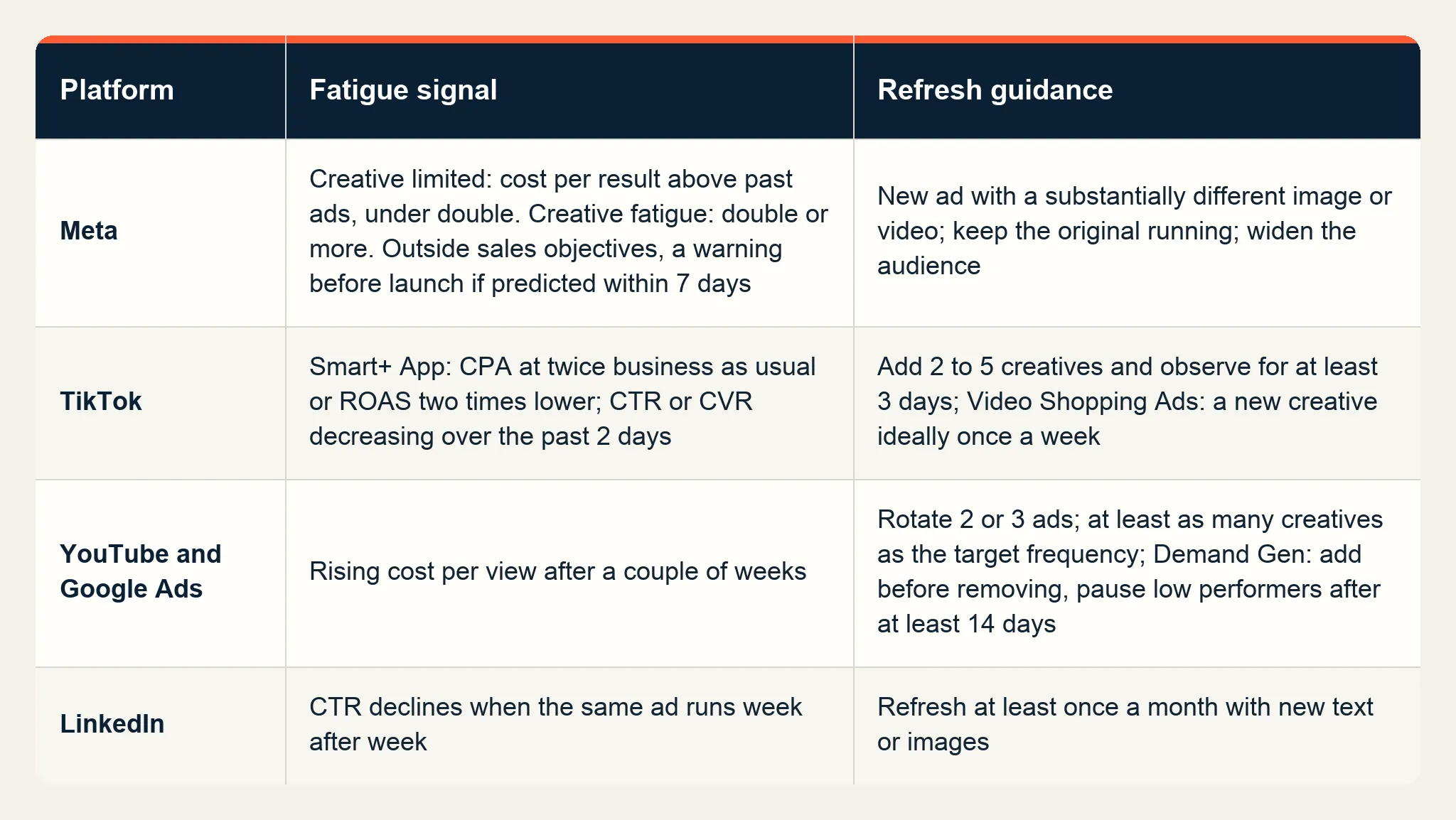
LinkedIn's ad creative help notes that an ad's CTR commonly declines when the same ad runs week after week, and recommends refreshing ads at least once a month with new text or images.
Ad fatigue on CTV and streaming
Attention on TV screens falls with repetition. A study in the Journal of Advertising Research, posted by the ARF on July 31, 2026, tracked second-by-second attention from more than 1,300 viewers over nearly a year. Repeating the same ad lowered attention on both connected TV and linear TV, with a sharper drop on connected TV, especially when the ad repeated within a short time.
Household frequency and the other CTV signals are covered in Starti's CTV audience targeting article.
Is it creative fatigue or something else?
Four other causes raise costs the same way, each with its own fix:
- Auction pressure. The same YouTube page that links rising cost per view to fatigue also links it to more competition in the auctions. If every ad in the account got more expensive in the same week, including new ones, look at the auction and the season before the creative.
- Learning phase. TikTok says volatility usually starts to decline after about 25 campaign results or 7 days, and advises against changes in the first 7 days of a Smart+ lead generation campaign. Google says a new Demand Gen campaign goes through a learning period of about 50 or more conversions.
- Audience saturation. When frequency climbs because the audience is narrow, the fix is reach: wider targeting or a bigger audience, which is Meta's second recommendation.
- Weak creative. An ad that underperformed from launch has not fatigued. Starti's creative testing guide covers how to tell a losing variant from one that has worn out.
Treat an ad as fatigued when it performed well, then declined as its own frequency rose while other ads in the account held steady.
How to fix and avoid ad fatigue
Match the fix to the cause:
- When the whole ad has worn out, replace it with one built on a different idea, setting, or opening.
- If hook rate has dropped but people who watch past the opening keep finishing, replace the first scene and keep the rest.
- Add new creatives before pausing old ones. Google advises adding new assets before removing old ones, and Meta and TikTok both advise keeping the current ads running alongside the new ones.
- Keep 2 or 3 ads in rotation on YouTube, and at least as many creatives as the target frequency.
- Set a frequency cap in Google Display and Video campaigns, TikTok Reach campaigns, and CTV buys.
- Expand the audience when frequency rises because the audience is small.
To stay ahead of fatigue, add tested creative on a set schedule before the old ads decline. Starti's article on a weekly production rhythm for mobile app video ads lays out the cadence.
Prioritizing fatigued ads with Smart Insight
Smart Insight in Starti AI Studio brings Meta, TikTok, Google Ads, and configured custom networks into one analysis and flags campaigns and creatives as Winner, Scaling, Watch, or Fatigue, so a team knows which ads to review first. Each creative's spend, engagement, and video completion sit in one record across platforms and campaigns, next to the ad itself.
When a fatigued ad needs a new opening, Video Agent revises that one scene and leaves the approved scenes as they are. Creative Studio, Starti's managed production service, tracks performance and optimizes the creative of every ad it produces at no extra cost, for example by bringing the product into the opening sooner.
Book a demo to see Smart Insight analyze your connected accounts.
Frequently asked questions
What is ad fatigue?
Ad fatigue happens when an audience sees the same ad too many times, so engagement drops and the cost of each result rises. It covers creative fatigue, tied to the ad itself, and audience fatigue, tied to repeated exposure to a brand across campaigns.
What are the signs of ad fatigue?
Rising frequency, falling click-through rate, lower engagement such as hook rate or completion rate on video, a lower conversion rate, and a higher cost per result, all on the same ad compared with its own earlier performance.
How common is ad fatigue?
More than 60% of consumers in Omnicom Media's April 2026 study reported seeing the same ad multiple times in a single session on streaming and social platforms.
How do I know if my Facebook ad is fatigued?
Meta Ads Manager shows Creative limited in the Delivery column when cost per result is above past ads but below double, and Creative fatigue at double or more. The statuses apply to ad sets with one creative; for ad sets with several ads, compare each ad's cost per result and click-through rate with its own earlier weeks.
What is the difference between creative fatigue and audience fatigue?
Creative fatigue comes from the ad's own creative elements being seen too often. Audience fatigue comes from the same people meeting the brand repeatedly across several campaigns and channels, and Amazon Ads lists frequency capping and expanding target audience segments among the fixes.
How do you avoid ad fatigue?
Add new creative before the old ads decline, keep current ads running while the new ones ramp up, and cap frequency or widen the audience when the same people see one ad too often.
How often should you refresh ad creative?
Weekly to monthly, by platform. TikTok suggests adding a new creative to Video Shopping Ads ideally once a week, and LinkedIn recommends refreshing ads at least once a month. On Demand Gen, Google advises adding new assets before removing old ones and giving low performers at least 14 days before pausing them.
What frequency causes ad fatigue?
Omnicom Media's April 2026 study found no universal threshold: the effective range often falls between two and seven exposures.