


On this page
- How the industry sorts CTV inventory
- The five types of CTV inventory
- Ad formats across CTV inventory
- How to choose CTV inventory by campaign goal
- CTV inventory vs related terms
- Do performance campaigns need premium inventory?
- Example: Choosing inventory for a food delivery app's first CTV test
- CTV inventory with Starti AI DASH
- Frequently asked questions
CTV inventory, also called connected TV inventory or CTV ad inventory, is the ad space available on internet-connected TV screens: the commercial breaks of ad-supported streaming services, free ad-supported channels, live sports streams, and ad placements on smart TV platforms and home screens. Buyers reach it directly from media owners or programmatically through a demand-side platform.
Spending on that supply keeps rising. IAB's 2026 Digital Video Ad Spend and Strategy Report, published in July 2026, projects $29.3 billion in US CTV advertising for 2026, an 11% rise, based on Guideline estimates. Streaming took 49.6% of US TV watch time in Nielsen's August 2026 Gauge, covering July 27 to August 30 and released October 22, 2026. The Gauge counts total TV viewing: YouTube held 15.8% of US TV time, Netflix 7.7%, Disney Streaming 4.8%, Paramount Streaming 2.3%, and Peacock 1.6%.
How the industry sorts CTV inventory
IAB's standard for classifying video advertising, published in September 2026, sorts supply by who controls the content:
- Publishers and broadcasters: inventory that "is professionally produced and rights-managed, representing an expectation of editorial accountability and brand safety assurance."
- User-generated content: inventory "appearing alongside material created and published by individuals."
- Aggregators and FAST channel operators: companies that "curate and distribute content across channels without necessarily originating the programming themselves."
- Retail and owned-and-operated platforms: supply "where the content environment is controlled by a commerce or platform entity, often with proprietary audience data and closed measurement ecosystems."
Buyers usually talk about the same supply by where the ad runs. The five types below follow that view, and the premium label that cuts across several of them is defined in What is CTV?
The five types of CTV inventory
1. Ad tiers of subscription streaming services
Subscription services sell ads inside their ad-supported plans, and each describes its audience differently. Netflix's 2026 upfront put its ad tier at "more than 250M global monthly active viewers," a measure Netflix defines as members who watched at least 1 minute of ads in a month, multiplied by the average number of people in a household. Amazon's upfront recap of May 12, 2026 points to hours watched: "Prime Video ad-supported customers now watch 17% more hours every month than a year ago."
Programmatic access is widening. For Pause Ads and live programming, Netflix said at its May 2026 upfront that clients "can now buy both via their preferred DSP partner," with availability that summer in the US and Canada.
2. FAST channels
Each of these channels is free to watch, carries ads, and runs a schedule like broadcast TV. In IAB's description, a FAST channel "delivers a programmed, linear-style experience controlled by a programmer," and its ads are not all inserted the same way. Some FAST inventory runs stitched-in units bought like linear TV, IAB notes, while other FAST inventory runs through dynamic ad insertion "with data-informed targeting and impression-level measurement." Three services report their scale in their own terms:
- Tubi: 110 million monthly active users and more than 13 billion hours streamed over 12 months, in an August 6, 2026 release.
- Samsung TV Plus: more than 100 million monthly active users globally across Samsung TVs, Galaxy phones, and other Samsung devices, with over 4,300 channels, in a January 21, 2026 release.
- Roku Channel: the "#2 app on our platform by engagement in the U.S. and also globally" in the third quarter of 2026, according to Roku's shareholder letter.
3. Platform-owned supply: TV operating systems and home screens
Companies that run a TV operating system also sell ads on it, on the home screen and inside their own channels.
4. Live sports and live streams
Sports rights are moving to streaming, and IAB's May 2026 release ties CTV's growth to "the structural shift of sports rights to streaming: for example, the NBA on Amazon, NFL on Peacock and Netflix, and MLB across platforms." One season shows the scale: Thursday Night Football on Prime Video averaged 15.3 million viewers per game over its 15-game 2025 season, and drew 122.09 million unique US in-game viewers across the season, according to Amazon, citing Nielsen. Buyers value live content most: in the buyer survey of 360 ad buyers in IAB's July report, 93% say "Live" is more valuable than all other digital video content.
5. YouTube, live TV services, and other streaming apps
What counts as CTV here depends on the report. YouTube held the largest share of US TV time of any distributor in Nielsen's August Gauge, and IAB's July report counts YouTube.com as social video and YouTube TV as CTV. Live TV streaming services such as YouTube TV, Hulu + Live TV, and Sling sell ad breaks inside their channel lineups. The July report counts these virtual pay-TV services as part of CTV, while IAB's September standard classifies them as linear when they are delivered live and scheduled to the TV screen.
Ad formats across CTV inventory
In-stream formats, "including pre-roll, mid-roll, and post-roll," are "delivered within a video content stream," according to the IAB standard, which also states that "Most streaming ad inventory is completion-required, particularly across AVOD and FAST environments." Pause ads and home screen placements on TV platforms sit outside the ad break.
How to choose CTV inventory by campaign goal
A starting point for each goal, with the reason behind it:
- App installs, registrations, or purchases: start with inventory that reports results by app, from any of the five types, so spend can move toward the apps that convert. Deal types for each goal are covered in how to run a CTV campaign.
- Reach for a launch: ad tiers of the large subscription services.
- Date-bound moments: live sports and live events, which put the ad in front of a simultaneous audience on a known date.
- Audiences defined by a platform's own data: platform-owned supply. The IAB describes retail and owned-and-operated platforms as often holding "proprietary audience data and closed measurement ecosystems."
Prices differ by type and deal, and the ranges are covered in CTV advertising cost.
CTV inventory vs related terms
Terms that are often used interchangeably:
- CTV inventory: ad space on internet-connected TV screens.
- OTT inventory: ad space in internet-delivered video on any screen, including phones and laptops.
- Premium CTV inventory: the professionally produced share of CTV supply, explained in What is CTV?
- FAST inventory: ad space in free, scheduled streaming channels, which can be premium or not depending on the programming.
- Linear TV inventory: ad time on broadcast and cable schedules, bought by network and daypart.
Do performance campaigns need premium inventory?
Performance campaigns need inventory that reaches the target cost per result, and premium apps are one source of it. The IAB classification ties publisher and broadcaster supply to "an expectation of editorial accountability and brand safety assurance." For installs or purchases, the test is cost per result by app and by inventory type, with a household holdout to measure the results the ads added. Budget then follows the results: premium apps that hit the target keep their share, and FAST or platform supply that hits it at a lower cost takes more.
Example: Choosing inventory for a food delivery app's first CTV test
The plan, with illustrative numbers:
- Goal: first orders in the app, with cost per first order as the outcome.
- Budget: $80,000 over six weeks in three US metro areas.
- Mix: $40,000 on ad tiers of subscription services through private marketplace deals, $25,000 on FAST channels, and $15,000 on platform-owned supply.
- Measurement: first orders sent through the measurement partner, reported by inventory type and app, with 15% of target households held out.
- Result to compare: 1,000 attributed first orders from ad tiers ($40 each), 700 from FAST ($36), and 350 from platform-owned supply ($43); exposed households placed 9% more first orders than held-out households.
- Decision: spend shifts toward FAST and the best-performing ad-tier apps on attributed cost, and the 9% lift over the holdout is the evidence for keeping the total budget.
CTV inventory with Starti AI DASH
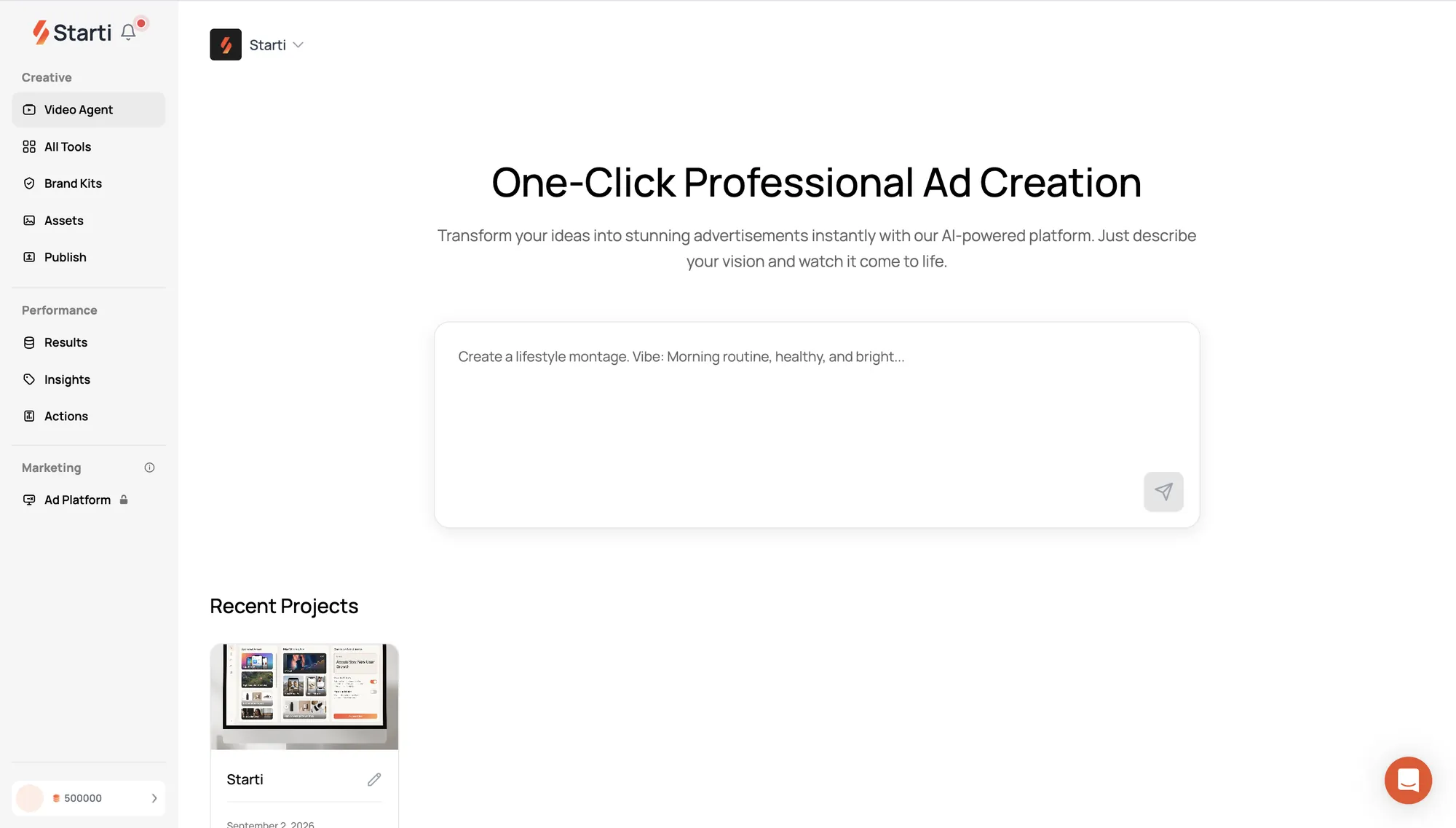
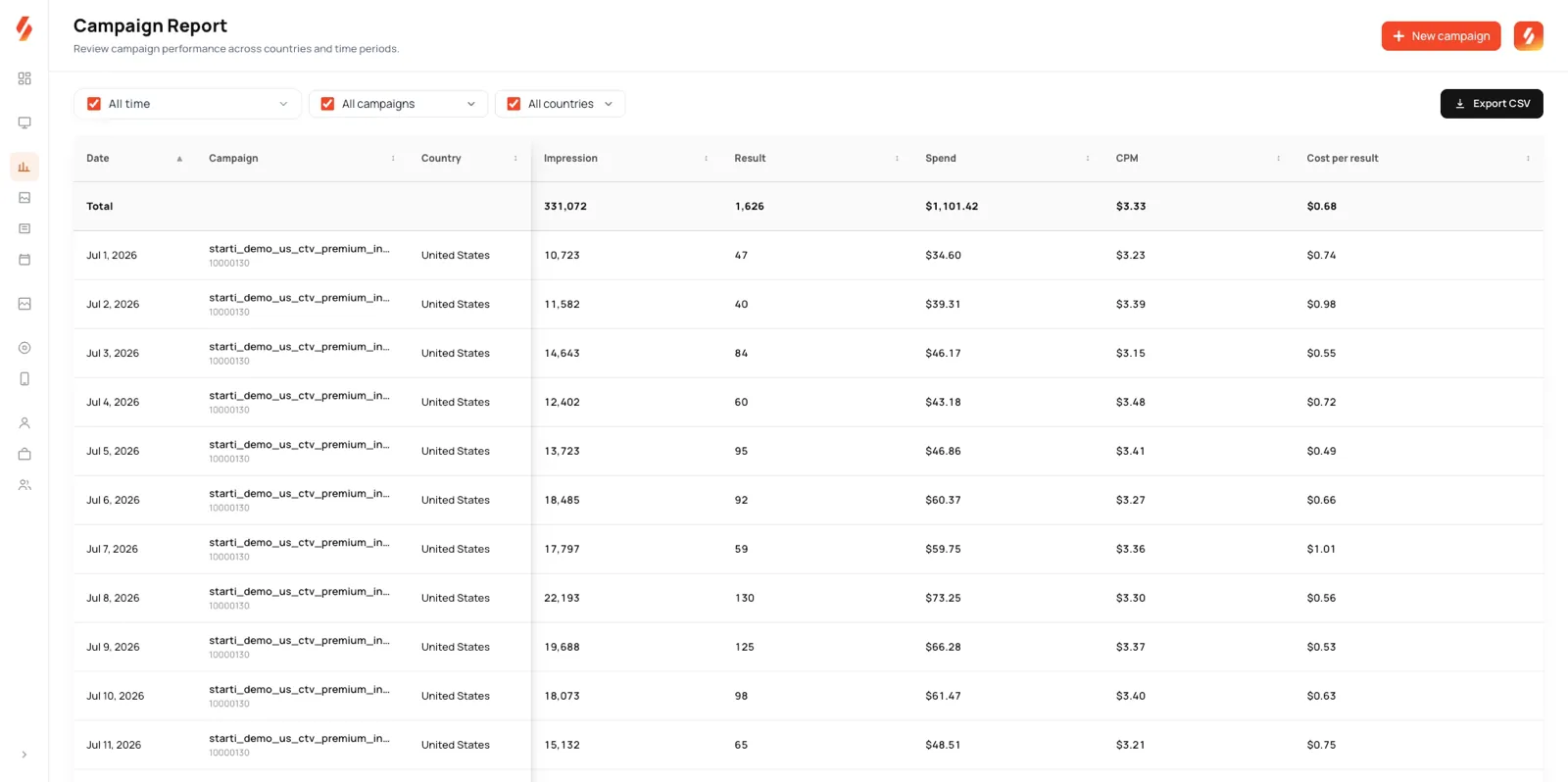
AI DASH connects audience discovery, premium inventory, real-time optimization, measurable outcomes, and delivery quality in one connected platform. Through it, advertisers can access brand-safe streaming, FAST, sports, entertainment, and news inventory, and AI DASH reaches viewers across premium streaming apps and channels, including entertainment, news, and live sports, with performance insights in the same platform. Its campaign, creative, and media views show what drives performance across campaigns, creatives, and inventory.
Book a demo to plan a CTV test across inventory types.
Frequently asked questions
What is CTV inventory?
CTV inventory is the ad space available on internet-connected TV screens, including ad tiers of subscription services, FAST channels, live sports streams, and smart TV platforms and home screens.
What are the main types of CTV inventory?
The five main types are ad tiers of subscription streaming services, FAST channels, platform-owned supply on TV operating systems, live sports and live streams, and YouTube, live TV services, and other ad-supported apps.
What are FAST channels?
FAST channels are free, ad-supported streaming channels that run a programmed, scheduled lineup like traditional TV. Tubi, Samsung TV Plus, and The Roku Channel are three of the services that carry them.
What is the difference between CTV and OTT inventory?
CTV inventory runs on internet-connected TV screens. OTT inventory covers internet-delivered video on any screen, including phones and laptops.
How is CTV inventory bought?
Directly from media owners or programmatically through a demand-side platform. The deal types are explained in What is CTV?
Which CTV inventory should an app test first for installs?
Inventory that reports results by app, drawn from two or three of the five types, compared on cost per install or per first purchase against a household holdout.