

On this page
CTV, or connected TV, is a television that reaches the internet, either through built-in capabilities in a smart TV or through a streaming box, stick, or game console. CTV advertising is video advertising delivered through streaming apps and channels to those screens. It is sold the way digital media is, one impression at a time, and targeted and reported by household.
Most American homes already have the screen. Leichtman Research Group's 2023 study of 1,770 US TV households found that 88% had at least one internet-connected TV device. In Nielsen's Q2 2026 Ad Supported Gauge, ad-supported TV took 71.5% of total TV viewing, and streaming held a 48.2% share of that ad-supported viewing.
What is CTV advertising?
In advertising, CTV means the device. CIMM's July 2025 CTV guide says it directly: "CTV is a category of device." CTV advertising covers the ads that run in the TV-like content those devices play.
Connected TV (CTV) advertising is the part of streaming advertising watched on a television. Streaming ads on streaming platforms also run on phones and laptops, and OTT advertising describes video delivered over the internet to any screen.
CTV budgets often come out of other channels. In IAB's 2026 video ad spend survey of the 149 buyers planning to raise CTV spending, 54% named linear TV as a funding source and 38% named social media. Judge a CTV test against the budget it replaces: cost per household reached against linear TV, and cost per outcome against paid social.
How digital TV advertising reaches the screen
CIMM's list of services that play on a connected TV includes subscription-only streaming services, ad-supported streaming services, FAST aggregators, and virtual MVPDs. Ads run on all but the subscription-only services, and ad-supported streaming comes in two models:
- FAST channels: free, ad-supported streaming TV. Digiday's glossary describes them as channels that "air 24/7 based on a set programming schedule" and carry ads that interrupt the programming.
- Ad-supported on-demand streaming: shows and movies watched at any time, either free or as the ad tier of a paid subscription, with ads before, during, or after the program.
Most ad-supported streaming viewing happens outside FAST platforms. Nielsen's 2026 Upfront Planning Guide found that, within ad-supported streaming, 81.1% of viewing by adults 18 to 49 went to the ad-supported tiers of large streaming and video platforms, and 19% to FAST platforms.
Ads are often stitched into the stream on a server. The Media Rating Council defines server-side ad insertion as "the use of an intermediary server to insert ads dynamically into video streams on the server side."
IAB's September 2026 video classification standard notes that FAST inventory comes both ways: some carries ad units baked into the stream, bought much like linear TV, and some is served through dynamic ad insertion with data-informed targeting and impression-level measurement. For a performance test, ask which FAST units in a deal use dynamic ad insertion; those are the units with that targeting and measurement.
What premium CTV inventory means
Premium CTV inventory is professionally produced, long-form programming such as series, films, news, and live sports, watched on the TV screen and sold under negotiated terms. IAB and CIMM describe two of those traits:
- Professionally produced content: IAB's 2026 standard describes publisher and broadcaster inventory as "professionally produced and rights-managed," against user-generated content made by individuals.
- Negotiated access: CIMM links premium inventory with direct deals and private marketplaces, curated deals that can carry premium inventory sold outside the open exchange.
When a seller calls inventory premium, ask for the app-level list, the share of impressions on the TV screen, and reporting by app. A performance test needs all three.
How CTV advertising is bought
CIMM sets out four ways to buy CTV inventory:
- Direct: bought from the publisher on negotiated terms.
- Programmatic guaranteed: guaranteed impressions at a fixed price, with an automated workflow.
- Private marketplace: a curated programmatic deal between publishers and advertisers.
- Open exchange: real-time bidding on impressions from many publishers.
Most advertisers reach the programmatic options through a CTV DSP. Choose by what the test has to hold fixed. Programmatic guaranteed deals fix impressions and price, direct deals give guaranteed access, and a private marketplace keeps selected inventory on pre-negotiated terms with room to optimize as results come in.
Targeting and measurement on CTV
CIMM describes CTV as "IP-delivered and fully digital," which lets campaigns target and measure at the household level:
- Targeting: the household is the unit, and CTV audience targeting options draw on IP address, device ID, and identity graph signals.
- Measurement: CTV ad measurement matches impressions to site visits through web pixels and to app installs through mobile measurement partners. A holdout group of households that sees no ads shows the lift.
Set the path by where the conversion happens before buying: a pixel on the confirmation page for web sign-ups, CTV view-through attribution switched on in the mobile measurement partner for installs, and a holdout when the budget decision rests on lift. Campaigns bought and judged this way are called performance TV.
CTV ad formats, with examples
The standard unit is an in-stream video ad of 6, 15, or 30 seconds that plays as a pre-roll or mid-roll in long-form content. CIMM's creative format list adds formats built for the TV screen and its streaming content:
- Pause ads: ads that "appear when viewers pause content, typically displayed alongside the paused video frame." Example: a travel app shows a still of a beach resort beside the paused show.
- QR code ads: commercials with QR codes "that viewers can scan with smartphones to access websites, apps, or special offers." Example: a mobile game's 30-second trailer ends on a QR code that opens the app store page.
- Shoppable ads: interactive ads that "connect consumers with products or services within the ad itself." Example: a furniture brand's spot lets viewers browse the sofa it shows.
Pick the format by where the viewer acts. When the install or sign-up happens on a phone, end the in-stream ad on a QR code that CIMM's format table says should be "large enough to scan from the couch" and visible "for sufficient duration," and build each file to the CTV ad specs.
Example: A first CTV advertising plan, filled in
A plan for a personal finance app testing CTV for web sign-ups, as an example:
- Goal: completed sign-ups on the website, read as cost per sign-up.
- Inventory: news and entertainment apps on the TV screen only, bought through one private marketplace with an app-level list, with FAST units only where served through dynamic ad insertion.
- Format: a 15-second in-stream ad ending on a QR code that opens the sign-up page, plus a pause ad with the same offer.
- Targeting: households that resemble current customers.
- Measurement: the site pixel on the sign-up confirmation page, and a holdout group of households that sees no ads.
- Read: cost per sign-up by app and by format each week, and holdout lift at the end of the test.
Starti AI DASH for CTV advertising
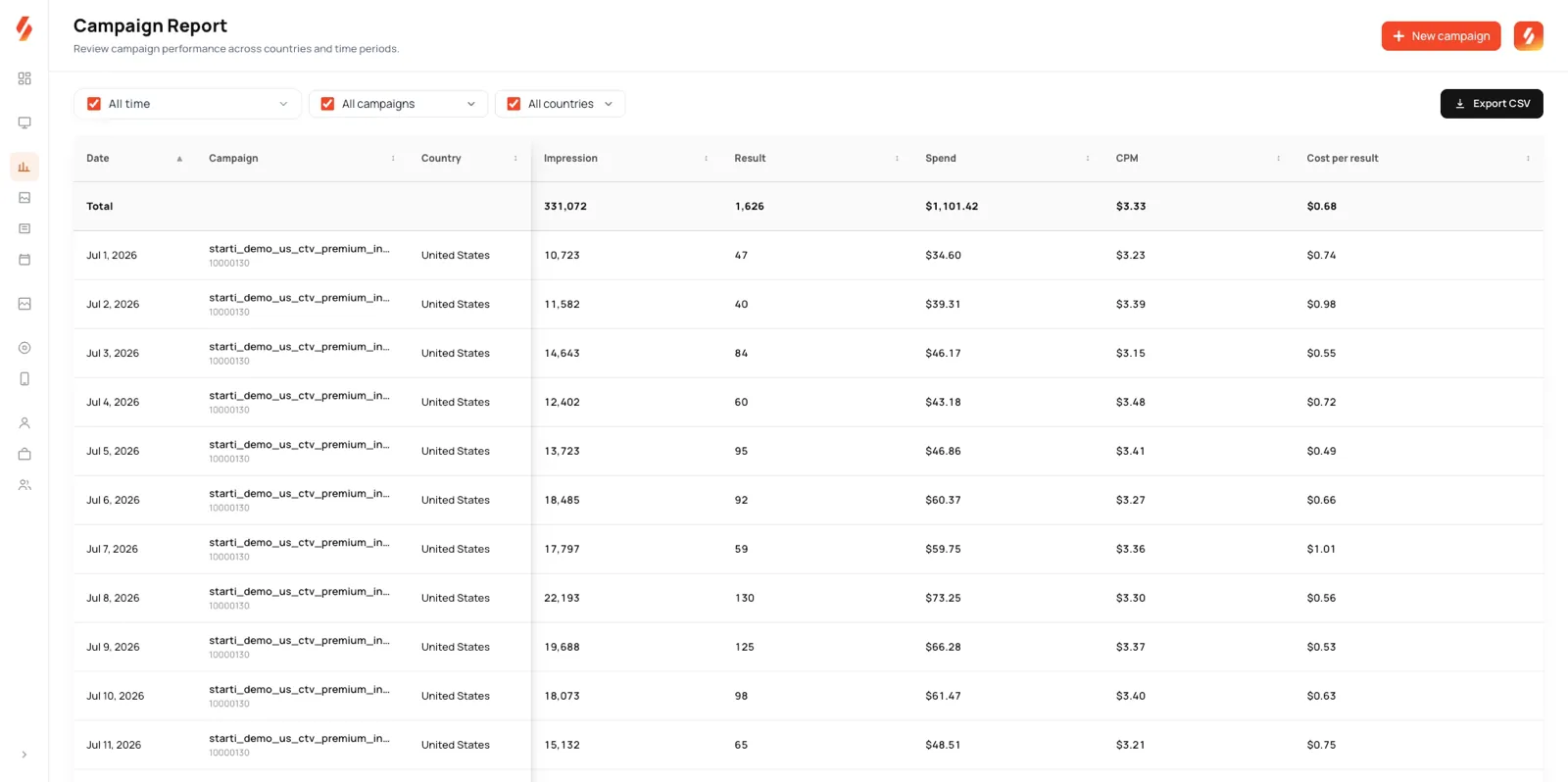
AI DASH is Starti's platform for performance CTV, with premium streaming inventory in one place across apps and channels that include entertainment, news, and live sports. SmartReach concentrates spend on the households most aligned with the product and campaign goal, the Adaptive Performance Engine optimizes bids and budget as performance changes, and reporting shows what drives performance across campaigns, creatives, and inventory.
Book a demo to see which inventory fits a first CTV test.
Frequently asked questions
What is CTV in advertising?
CTV stands for connected TV: a smart TV with built-in internet access, or a television connected through a streaming stick, box, or game console. CTV advertising is video advertising that runs in streaming apps and channels on those screens, sold by the impression and targeted by household.
What is premium CTV inventory?
Premium CTV inventory is professionally produced, long-form programming such as series, films, news, and live sports, watched on the TV screen and sold through direct deals or private marketplaces. Before buying, ask the seller for the app-level list, the share of impressions on the TV screen, and reporting by app.
How is CTV advertising bought?
Through direct deals with publishers, programmatic guaranteed deals, private marketplaces, or the open exchange, with the programmatic routes usually placed through a CTV DSP.
What are examples of CTV ads?
In-stream ads of 6, 15, or 30 seconds within shows, such as a mobile game trailer that ends on a QR code to the app store page; pause ads, such as a travel app's beach still beside the paused show; and shoppable ads.