


On this page
- The funnel a fintech campaign is judged on
- How CTV fits a fintech campaign
- Attribution windows and read days for finance apps
- Can CTV drive funded accounts, or only awareness?
- TV disclosure rules for finance app ads
- Example: A first CTV test for a digital bank app
- Fintech advertising with Starti AI DASH
- Frequently asked questions
Fintech advertising is the paid promotion of financial apps and services, such as digital banks, investing apps, and payment apps, to people likely to open and fund an account. On connected TV, the ad reaches a household on the big screen, and the result happens later on a phone: an install, an application, identity verification, and a first deposit.
That gap between the screen and the funded account shapes where CTV sits in a fintech marketing strategy, and how its campaigns are planned, measured, and reviewed. IAB's 2026 Digital Video Ad Spend and Strategy Report, published in July 2026, estimates US financial services spend on digital video, which covers CTV, social, and online video, at $5.5 billion in 2026, up 6% from 2025, citing Guideline estimates.
The funnel a fintech campaign is judged on
A finance app counts value at the funded account, several steps after the install:
- Install: the app is downloaded and opened.
- Registration: the user creates a login.
- Application and verification: the user submits an account application and passes identity checks (KYC).
- Account opened: the bank partner approves the account.
- First deposit: money moves in, and the account is funded.
Measurement partners publish event names for these steps. AppsFlyer's recommended finance events include complete registration, submit account application, and open account success, and Adjust's recommended events for finance and banking include "Account opened" and "Make deposit." A team that sends the first deposit as its own event can read the funnel to the step that pays.
In fintech marketing, the core metric is cost per funded account: ad spend ÷ accounts that made a first deposit. Payback adds revenue per funded account, from interchange, interest, or subscription fees, over the months the account stays active.
How CTV fits a fintech campaign
Mobile installs for finance apps got cheaper in 2025. Adjust's Mobile App Trends 2026, with data from January 2024 to January 2026, reports that finance app CPI in North America fell from $7.03 in 2024 to $4.13 in 2025, while day 30 retention for finance apps worldwide slipped from 3% to 2%. Against those numbers, cost per funded account says more about a campaign than cost per install. How finance app categories differ on acquisition and re-engagement is set out in Starti's look at Europe's finance app landscape.
CTV advertising for financial services adds reach to households on the TV set, where the ad fills the screen with the sound on. The measurement path to the phone runs through the measurement partner:
- Install credit: AppsFlyer's CTV-to-mobile attribution, offered through designated partners, credits an install to a TV impression by IP-based probabilistic modeling within a view-through window of 1 to 72 hours, 24 by default, and notes that "Multiple installs within the same household can be attributed to the same CTV ad impression."
- Later events: once an install is credited, AppsFlyer attributes the user's in-app events to the same media source, so a first deposit days later still counts for the CTV campaign.
- Priority: Adjust's CTV measurement places CTV impressions last in its attribution order by default, and an install goes to CTV when no higher-priority touchpoint is eligible.
- Existing users: AppsFlyer supports retargeting on CTV, and its documentation adds that "Cross-platform retargeting into mobile isn't supported." A CTV ad that brings an existing app user back into the mobile app does not register as a mobile re-engagement.
A household holdout measures what attribution leaves out: the funded accounts the ads added. The setup is covered in CTV ad measurement, and reading cohorts by revenue in D7 ROAS.
Attribution windows and read days for finance apps
Account funding takes longer than an app install, and the read day has to allow for it:
- Install window: a starting view-through window of 24 hours, AppsFlyer's default, the same for every channel compared, with a longer window up to 72 hours tested against the holdout read.
- Event read: first deposits counted per install cohort, with the read day set from the app's own install-to-deposit history, such as the day by which 90% of past deposits arrived.
- Holdout read: the lift in funded accounts between households that saw the ads and households held out, with the read date fixed before launch.
- Payback read: revenue per funded account against cost per funded account, at the month the business sets for payback.
Can CTV drive funded accounts, or only awareness?
Opening and funding an account is a longer decision than installing a game, and a CTV campaign for a finance app runs long enough for households to see the ad more than once before the read. The answer then comes from the campaign's own data, read two ways. Attributed first deposits from the measurement partner show which streaming apps, audiences, and creatives bring funded accounts. The holdout shows how many funded accounts the ads added in total, including the ones attribution missed. A CTV campaign that shows lift in funded accounts against the holdout is driving accounts, whatever its share of last-touch credit.
TV disclosure rules for finance app ads
Several US rules on financial advertising name television and radio, and others apply in any medium. The compliance team decides how each applies to a streaming spot and to the partner bank:
- Deposit rates: Regulation DD (12 CFR 1030.8) requires an ad that states a rate to state it as an "annual percentage yield." Ads made through "Broadcast or electronic media, such as television or radio," may leave out several disclosures, such as whether the rate is variable and how long it is offered, while the minimum balance and most bonus disclosures still apply.
- Credit terms: under Regulation Z (12 CFR 1026.16 and 1026.24), a TV or radio ad that states a triggering term, such as the payment amount on an installment loan, may state the annual percentage rate and list a toll-free number for the remaining cost information.
- Deposit insurance: the FDIC's rule on misrepresenting insurance (12 CFR 328.102), with compliance required since January 1, 2025, applies to any person, non-banks included. A fintech app that implies deposits are FDIC-insured has to name the insured bank and disclose that it is "not an FDIC-insured depository institution and that FDIC insurance only covers the failure of the FDIC-insured depository institution."
- Investing apps: FINRA Rule 2210 requires broker-dealer communications to "be fair and balanced," and the SEC's Marketing Rule-1) bars investment adviser ads from discussing benefits "without providing fair and balanced treatment of any material risks or material limitations."
The FDIC's exemption for TV ads of 30 seconds or less covers the official advertising statement that insured banks carry. The disclosure rule for non-banks in 12 CFR 328.102 has no such exemption.
Example: A first CTV test for a digital bank app
The plan:
- Outcome: cost per funded account, with a first deposit of any amount.
- Spend and flight: $60,000 over six weeks on premium streaming apps, with 20% of target households held out so the lift read has enough accounts behind it.
- Events: install, complete registration, submit account application, open account success, and a custom first deposit event, all sent through the measurement partner.
- Creative: two concepts, one on paying friends and one on savings, with the savings ad stating the rate as an annual percentage yield, its minimum balance, the partner bank's name, and the FDIC disclosure.
- Read day: day 30 after the last install of each week, the day by which 90% of the app's past first deposits arrived.
- Results by concept: the savings ad brings 1,300 attributed installs, 390 opened accounts, and 160 funded accounts on $30,000, $188 per funded account; the payments ad brings 1,500 installs, 300 opened accounts, and 100 funded accounts on $30,000, $300 per funded account.
- Payback: at an assumed $12 a month in net revenue per funded account, the savings ad pays back in about 16 months and the payments ad in 25.
- Decision: the savings concept takes the budget if the holdout shows a lift in funded accounts, and the payments concept gets a new opening before another round.
Fintech advertising with Starti AI DASH
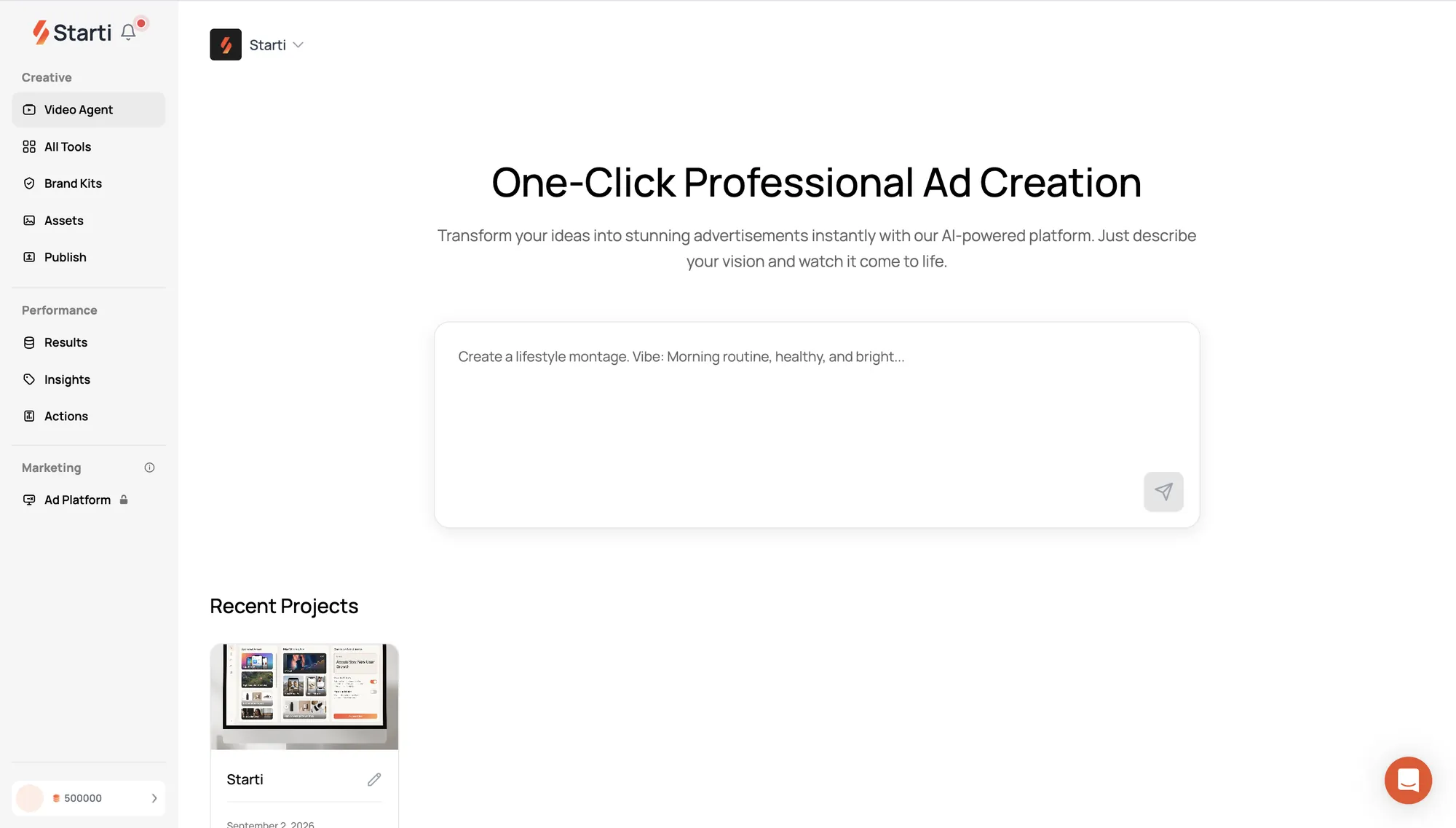
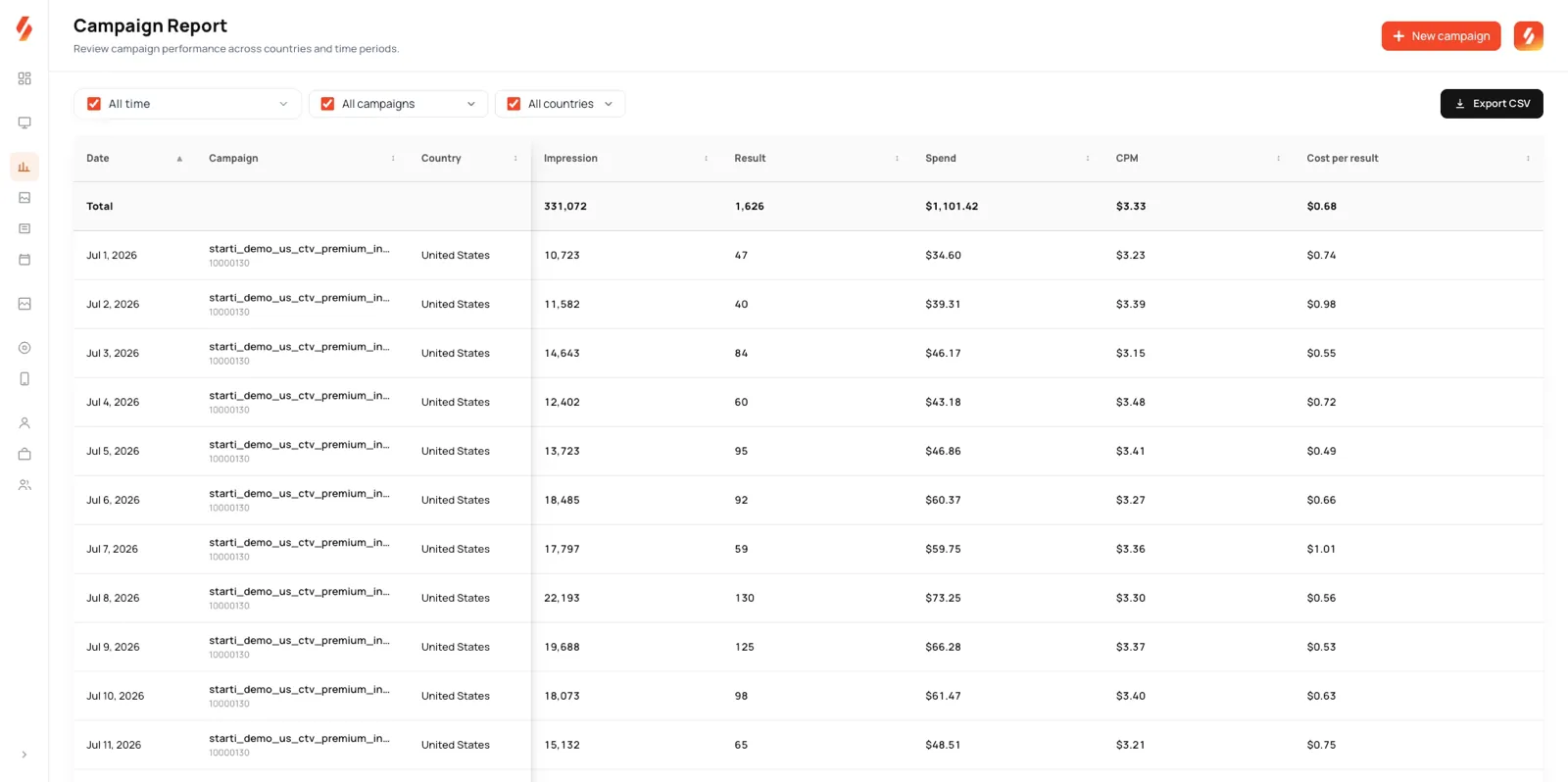
AI DASH connects CTV exposure to supported visits, installs, registrations, purchases, and revenue. SmartReach helps advertisers discover relevant audiences using product intelligence, first-party data, and campaign goals.
Each campaign is measured against its own goal, installs, registrations, or revenue, and the results shape the next round of creative and CTV placement.
Book a demo to plan a CTV test against cost per funded account.
Frequently asked questions
What is fintech advertising?
Fintech advertising is the paid promotion of financial apps and services, such as digital banks, investing apps, and payment apps, to people likely to open and fund an account.
How do you measure fintech advertising on CTV?
Track installs, applications, opened accounts, and first deposits through the measurement partner, credit them to the CTV campaign through its view-through window, and test the lift in funded accounts against a household holdout.
What is cost per funded account?
Cost per funded account is ad spend divided by the number of new accounts that made a first deposit. It sits closer to revenue than cost per install, and many installs never reach a funded account.
Do fintech TV ads need an FDIC disclosure?
A non-bank app that implies deposits are FDIC-insured has to name the insured partner bank and disclose that it is not an FDIC-insured bank and that FDIC insurance covers only the failure of the insured bank, under 12 CFR 328.102.
What must a TV ad say when it states a savings rate?
Under Regulation DD, the rate has to be stated as an annual percentage yield. TV and radio ads may leave out some details, such as how long the rate is offered, but the minimum balance needed to earn it still has to appear.