


On this page
- Set the KPI, owners, and supply path
- Build the audience around the household
- Check creative before it is trafficked
- Fund line items and hold a budget reserve
- Cap frequency at campaign, partner, and household level
- Run pre-launch QA on conversion events
- Launch and CTV campaign optimization
- Measure the campaign and run the readout
- Planning to reporting in AI DASH
- Frequently asked questions
A CTV campaign is a flight of streaming TV ads bought toward one objective, with its own audience, creative, budget, frequency caps, and measurement plan. CTV campaign management sets three things before launch: the KPI, the conversion events the platform receives, and the frequency caps.
Set the KPI, owners, and supply path
CIMM's July 2025 CTV guide recommends opening each campaign with a Campaign Design and Measurement Workshop and a one-page Critical Context Brief that every partner receives. Before trafficking, name one owner per decision:
- Advertiser: KPI and target, conversion events and their server setup, privacy review, and the decision to scale or stop.
- Agency or platform team: deals, trafficking, creative IDs, frequency caps, pacing, in-flight changes, and the weekly report.
- Shared: the brief, the weekly review, and the readout.
"Let the primary KPI define the supply path," CIMM advises. Awareness leans toward premium programmatic guaranteed or direct deals, and performance toward flexible deals, outcome-based buying, and agile private marketplaces. In CIMM's supply path table, private marketplaces offer nimble optimization and open exchange carries poor frequency control. Launch outcome campaigns on private marketplaces and flexible deals. Starti's CTV DSP guide covers deal types, fees, and a platform checklist.
Use the KPI already reported for paid social and search, such as cost per install. Before signing off on it, settle how a viewer acts: a QR code, a pixel match, or an MMP match connects the TV to the action and sets the events the platform must receive.
Spend size shapes the target. Among the 360 buyers surveyed for IAB's 2026 Digital Video Ad Spend and Strategy report, those at advertisers spending under $10 million a year rated social video stronger than CTV for lower-funnel outcomes by 77% to 17%. Above $50 million, the split was 43% social video and 41% CTV. Set a first target against social video cost per outcome, with a stop point above it.
Build the audience around the household
IAB's October 2025 conversion API guide names limited user identifiers and co-viewing among the reasons CTV outcomes are harder to match than social ones.
Start broad. CIMM advises narrowing on early data rather than at setup, avoiding tiny segments that raise CPMs, and adding contextual targeting where ID match rates are weak. A matched first-party list, a lookalike audience, and a contextual line item cover the launch. Exclude existing customers when the KPI counts new users. Starti's guide to CTV audience targeting covers nine options and the signal behind each.
Check creative before it is trafficked
Register one ad ID per concept and length. IAB's conversion API guide asks for a unique ID on each CTV creative. In IAB Tech Lab's CTV programmatic guide, Universal Ad ID in VAST gives a creative the same ID on every platform for reporting, caching, and frequency capping.
Validate files at intake. IAB Tech Lab's 2026 Ad Ops Workshop write-up defines a ready ad as structurally valid, environment-compatible, successfully executed, and observable. Its Ad Management API returns a structured approval status before the auction, instead of a rejection found through stalled delivery.
Traffic at least two concepts. In brand lift data cited by CIMM, private marketplace and open exchange buys differed by 0.6% on average, smaller than the gap between creatives. Starti's guide to TV commercial production covers loudness, clearance, and delivery checks.
Fund line items and hold a budget reserve
CIMM recommends zero-based budgeting, built up from media objectives, and a budget floor: the minimum spend for impact on each platform. Its cheat sheets set the budget reserve for mid-flight adjustments at 20 to 30% on reach and frequency campaigns, and upwards of 50% on outcome campaigns.
On $60,000 of media, for example, an outcome campaign commits $30,000 at launch across three $10,000 line items and holds $30,000 until conversion data arrives. A reach campaign holds $12,000 to $18,000.
Fund fewer line items that each clear the floor. Pace them evenly in week one, and write down which changes automated allocation makes inside a line item and which the team makes from the budget reserve.
Cap frequency at campaign, partner, and household level
CIMM calls for strict frequency caps at campaign, partner, and user levels. Its budget guide pairs low monthly or cumulative reach with 3 to 5x frequency, and high reach with 5x or more. On a shared TV screen, set the user level as the household.
- Campaign cap: total exposures per household across all partners in a set period.
- Partner cap: exposures per household within one partner, set below the campaign cap.
- Household cap: one count per home across every app and device, applied to the campaign and partner caps.
Enter the campaign cap first, then each partner cap, and read frequency next to reach every week. When frequency climbs past plan while reach stalls, move budget to a new audience or partner before raising bids.
Run pre-launch QA on conversion events
Automated bidding optimizes toward the events it receives. Test the event pipeline before anything else. IAB Tech Lab's Event and Conversion API, final after public comment closed on February 20, 2026, standardizes server-to-server event sharing from advertisers to their ad platforms. Agree on log or dashboard access in writing before launch.
Example pre-launch checklist for an app campaign
- Signals: registration as the KPI event, install as a higher-volume event.
- Server setup: events captured server-side, identifiers hashed.
- Platform mapping: events mapped at each partner, one test conversion traced.
- Privacy review: legal sign-off on shared data, consent, and opt-outs.
- Ad IDs: one per concept and length, present in conversion data.
- File readiness: valid, compatible, played back, and observable.
- Frequency: campaign and partner caps entered, counted per household.
- Budget: line items clear the floor, budget reserve rule written.
- Reporting: access agreed by creative, placement, publisher, and deal type.
- Decision rule: target, test length, and stop criteria in the brief.
Launch and CTV campaign optimization
Automated CTV ad optimization acts on the conversion data the platform receives, inside the audiences, creatives, and inventory the team trafficked. Choose the optimization event for volume as well as value. When the KPI event is rare, such as a paid subscription, let bidding optimize on registration or trial start and keep judging the campaign on the KPI.
In brand lift data CIMM cites, creative concept changes offered the largest mid-flight gain (22%), ahead of publisher and targeting method (17%) and video length (11%). Make a creative read by ID a fixed item in the weekly review.
Leave bid changes inside each line item to the automated bidder, and step in when one of these happens:
- Events drop: KPI events stop arriving; check the pipeline before bids.
- Delivery stalls: a line item stops spending; check creative approval first.
- Caps break: a partner total or household count passes its cap.
- Budget reserve: the team releases it between partners or deal types.
- New creative: a concept or cut needs an ID and QA before rotation.
Example first-month optimization calendar
- Days 1 to 3: daily checks that every line item spends and events reach the MMP with creative IDs.
- End of week one: frequency review and a first cost per registration by line item.
- Second week: first budget reserve release toward line items with the lower cost per registration.
- Third week: creative read by ID, weaker concepts paused.
- Fourth week: interim readout; the incrementality result follows at the planned test end.
- Every week: one shared sheet for advertiser and agency: spend, KPI, reach, frequency, budget reserve left.
Measure the campaign and run the readout
CIMM quotes an analytics leader at a large media agency: "MMM for budget allocation, MTA for optimization, incrementality for validation." Give each method one question:
- MMM: how much budget CTV gets next quarter against other channels.
- MTA: which line items, audiences, and creatives get more budget mid-flight.
- Incrementality: whether the campaign added outcomes, from a holdout or geo test.
Send every partner the same events, IDs, and attribution window. Build the weekly sheet on the cuts CIMM recommends: creative, placement, publisher, and transaction type. Starti's guide to CTV ad measurement covers attribution windows and holdout tests.
Example readout outline
- Result: KPI against target, under the window used for other channels.
- Lift: holdout or geo result, or the date it lands.
- Spend: by partner, deal type, audience, and creative ID.
- Reach and frequency: household reach and frequency against plan.
- Budget reserve: what moved, when, and on which data.
- Decision: scale, hold, or stop under the brief's rule, and the next flight's question.
Planning to reporting in AI DASH
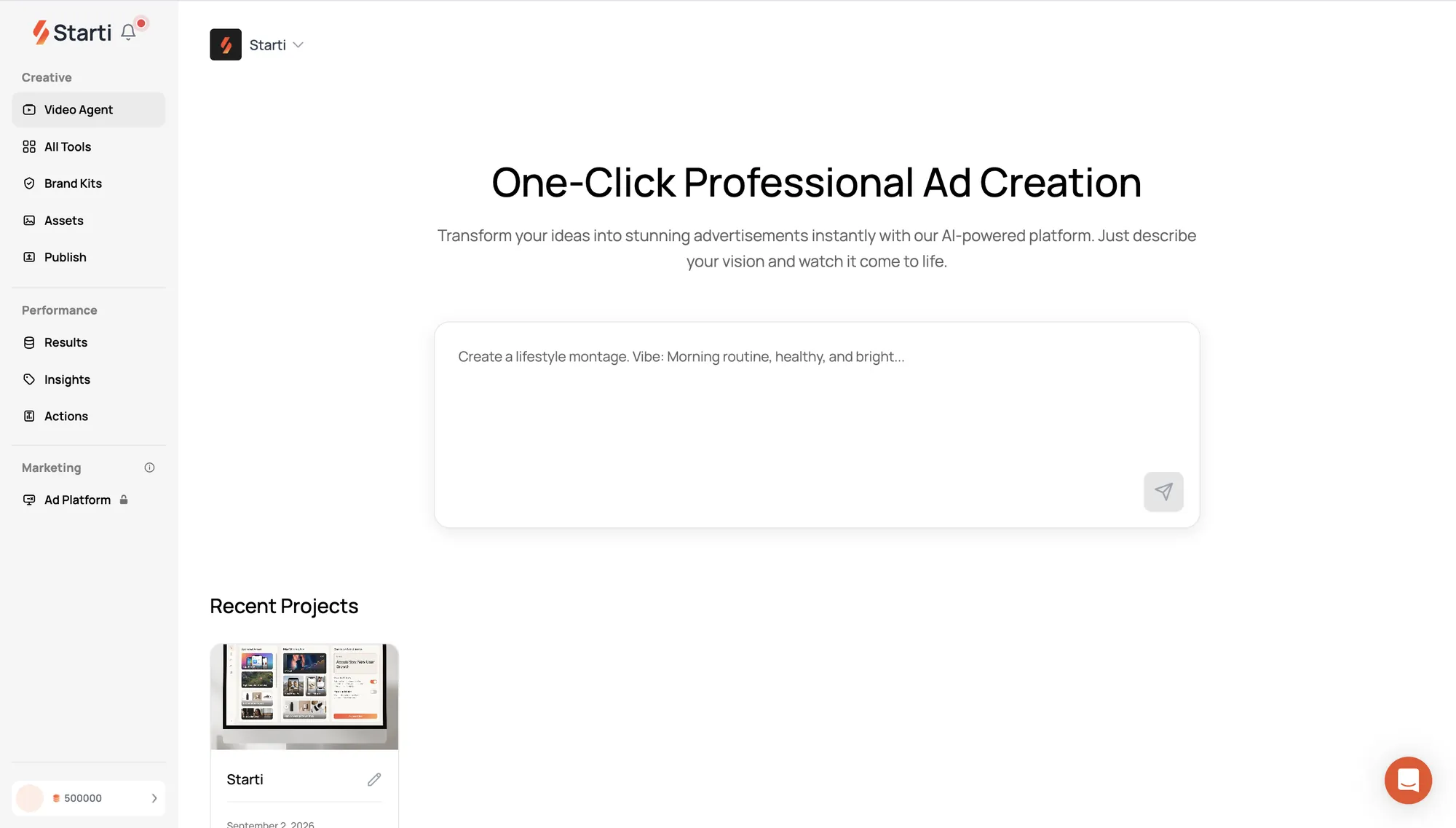
AI DASH is Starti's performance CTV platform. It connects audience discovery, premium inventory, real-time optimization, measurable outcomes, and delivery quality in one connected platform. For the audience step, SmartReach finds relevant audiences from product intelligence, first-party data, and campaign goals, and organizes audience intelligence across five categories and more than 500 tags. In flight, the Adaptive Performance Engine automatically adjusts bids and budgets across creatives and media as performance changes. Household Resonance extends CTV campaigns to eligible mobile, tablet, and desktop devices in the same household.
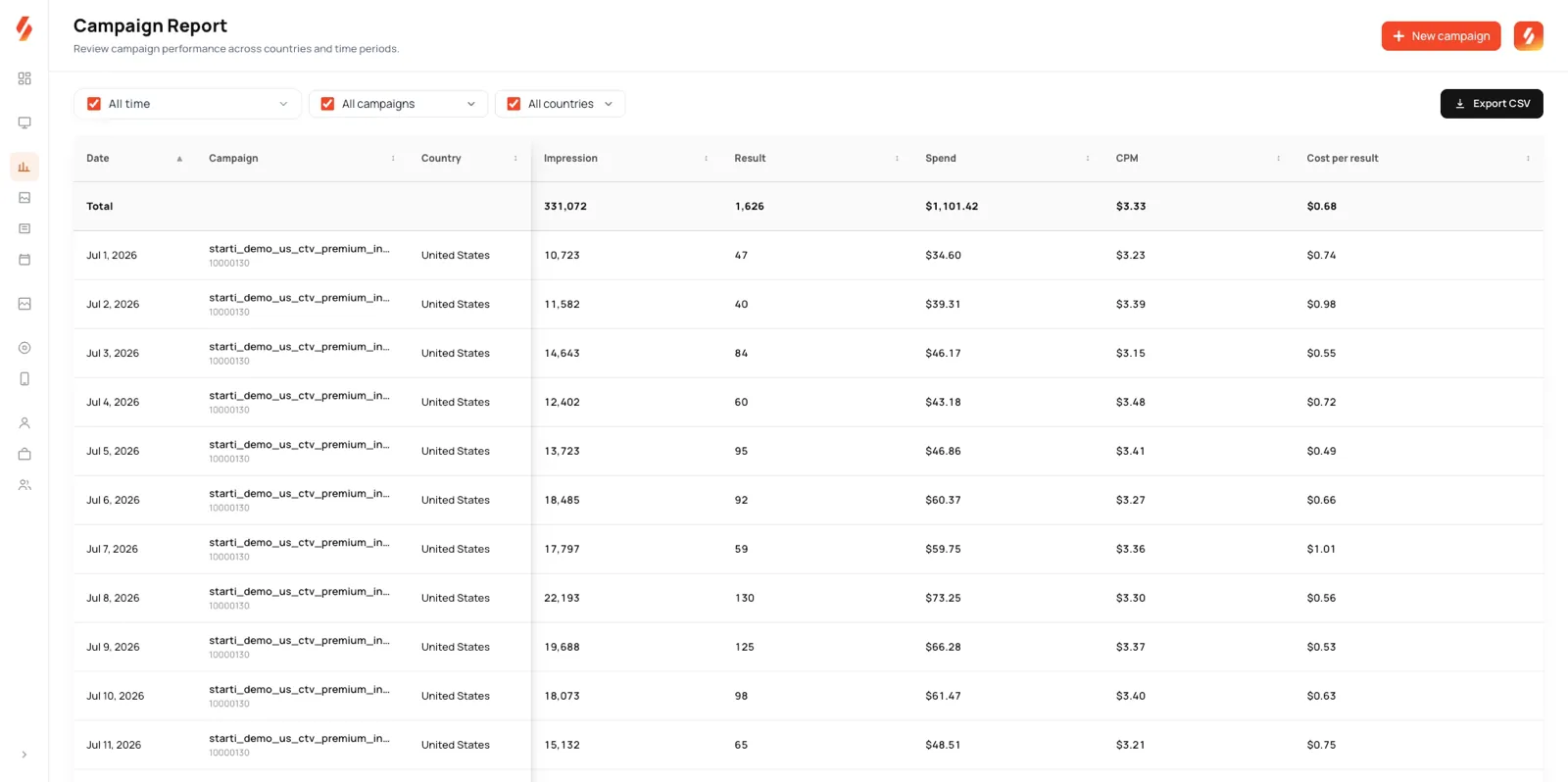
Reporting in AI DASH connects CTV exposure to supported visits, installs, registrations, purchases, and revenue through supported web pixels and mobile measurement partners.
Frequently asked questions
What is a CTV campaign?
A CTV campaign is a set of streaming TV ad buys toward one objective, planned, capped, and measured at the household level.
How do you advertise on streaming services?
Start with the primary KPI. It sets the supply path, the conversion events to map, and the size of the budget reserve. Household audiences, one ad ID per creative, campaign and partner caps, and event QA follow.
What is the difference between a branding and a performance CTV campaign?
A branding campaign sets an awareness KPI and leans toward premium programmatic guaranteed or direct deals. CIMM's cheat sheet for reach and frequency campaigns sets the budget reserve at 20 to 30%. A performance campaign sets a cost per outcome KPI such as cost per install and leans toward flexible deals, outcome-based buying, and agile private marketplaces. CIMM's outcome cheat sheet sets the reserve upwards of 50%, and conversion events go to the platform for automated bidding.
How does automated bidding work on CTV?
Bids and budget adjust toward the conversion events the platform receives through pixels, MMPs, or conversion APIs. The bidder works within the events, line items, and caps the team sets before launch.