
How Much Does a TV Commercial Cost in 2026?
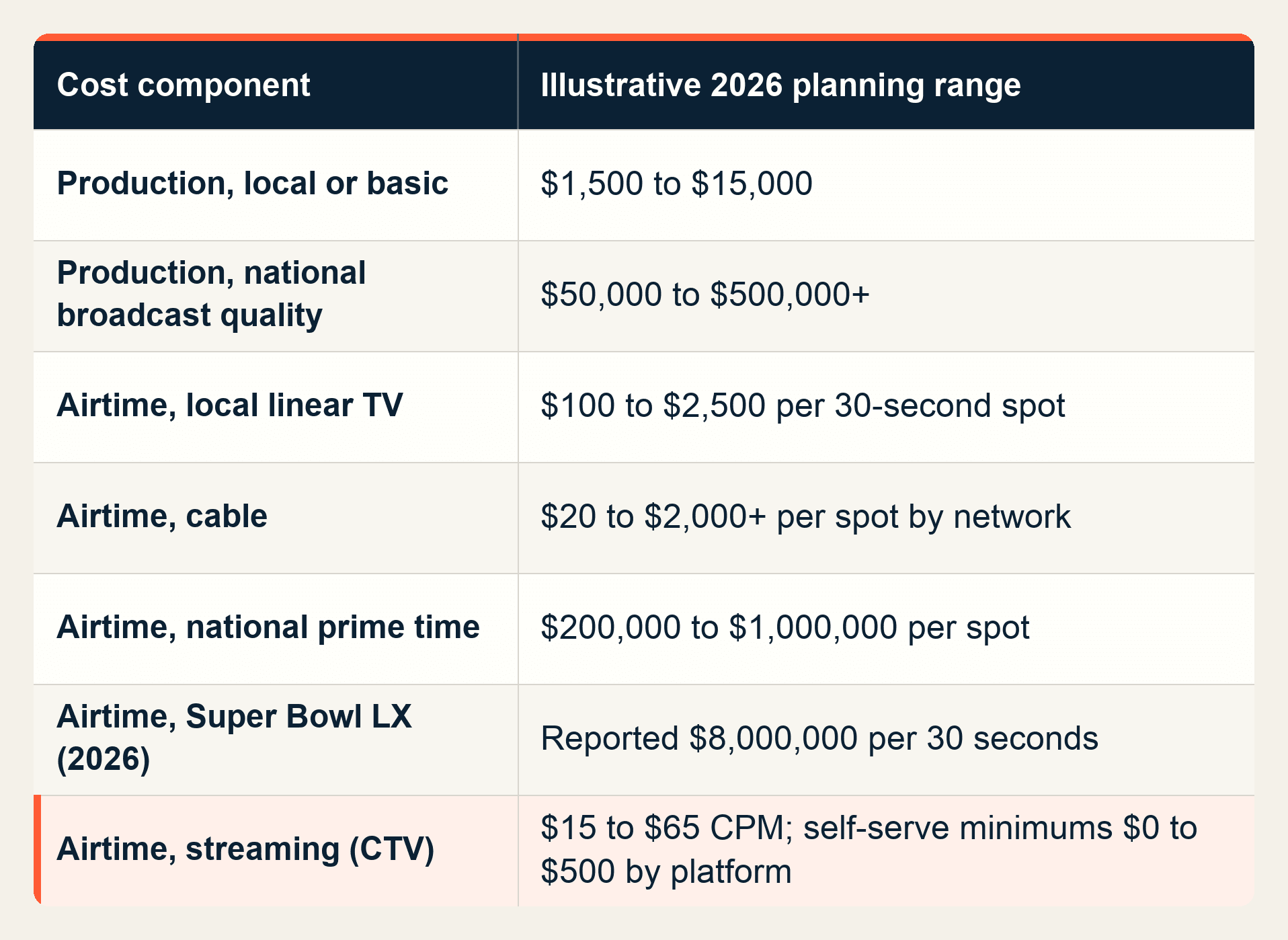
A TV commercial has two price tags: making the ad and airing it. In 2026, traditional production runs from about $1,500 for a simple local spot to $500,000 and beyond for national brand campaigns. Airtime starts near $100 for an off-peak local slot and climbs to the reported $8 million for 30 seconds of Super Bowl LX. Streaming TV rewrote the entry price: self-serve campaigns start anywhere from no minimum to $500 depending on the platform, priced at $15 to $65 per thousand impressions.
That range is so wide it is almost useless until you split it into its parts. Here is the whole picture in one table, then each number explained.
What TV commercial production costs
Production is the price of the ad itself, before it airs a single time.
At the low end, a local dealership-style spot shot in a day runs $1,500 to $5,000. A mid-tier commercial with professional talent, a small crew, and real post-production lands between $5,000 and $15,000. Agency-produced work for national brands starts around $50,000, commonly reaches $500,000, and passes $1 million once celebrity talent signs on. The catch is that cheap and broadcast-ready rarely overlap: a spot that looks fine in a phone feed looks out of place next to prime-time programming, and broadcast quality is where the price jumps.
Four line items do most of the damage. Shoot days bill per day for crew, equipment, and locations. On-camera talent bills union rates plus residuals every time the spot airs. Music licensing for a recognizable track can cost more than the shoot itself. And agency fees commonly add 15 to 30 percent on top of everything else.
One thing moved in 2026: the floor. Industry pricing guides now list AI production as its own tier below every traditional option, a line that did not exist in those tables until recently. The ceiling has not changed. The entry price has.
Airtime gets the headlines, but production is the quiet killer. In our experience it is the line item that keeps most brands off TV entirely, because it is due before the first impression is served.
Linear airtime: what broadcast and cable charge
Linear airtime is sold per spot, and geography sets the price.
A 30-second spot on local TV costs $100 to $500 off-peak and $500 to $2,500 in prime time, with top-ten markets running far higher. Cable is cheaper per airing: small cable networks sell spots for as little as $20, while a prime slot on a major cable network can pass $2,000. National broadcast is a different sport. Prime-time placements on the big networks run $200,000 to $1,000,000 per spot. At the very top, NBC sold Super Bowl LX spots for a reported $8 million per 30 seconds, and the inventory was gone by September 2025, five months before kickoff.
Two structural costs hide behind those rates. Buys usually go through an agency with monthly minimums in the tens of thousands. And measurement is panel-based: you pay for estimated reach, then wait to see whether sales moved. For a mass brand buying awareness at national scale, that trade can still be worth it. For anyone who needs to show cost per customer next quarter, it is a hard model to defend.
Streaming airtime: what CTV costs
Connected TV (CTV) means ads on streaming apps on the living-room screen, and it is priced like digital: by CPM, the cost per thousand impressions. The arithmetic is simple. At a $30 CPM, 100,000 impressions cost $3,000.
Our CTV advertising trends guide explains why budget is moving toward outcome pricing, delivery transparency, and privacy-aware measurement.
For planning purposes, this guide works with a $15 to $65 CPM range, split into three bands: free ad-supported streaming channels toward the bottom at $15 to $25, standard programmatic buys on premium services like Hulu, Peacock, and Tubi in the middle at $25 to $45, and direct deals on marquee content and live sports at the top at $45 to $65. Actual pricing varies by platform, audience, and buying method, and every new ad tier that launches adds supply that keeps rates competitive.
Entry budgets collapsed along with the rates, and each platform sets its own floor. Disney Campaign Manager takes Hulu and Disney+ campaigns from $500. Amazon's self-serve streaming TV ads run with no minimum budget at all, while the managed-service packages on Amazon's DSP list a $50,000 minimum: that spread, at a single publisher, is what self-serve changed. Targeting works like paid social (audience, geography, household attributes), and measurement is impression-level rather than panel-based, so a first campaign can report cost per site visit or install instead of estimated reach.
Most teams we talk to still assume TV starts at six figures. On the media side, that assumption is years stale. What remained expensive until recently was the ad itself.
The new math: AI production plus CTV
The reason TV budgets used to start at six figures is that both halves were priced for big advertisers: weeks of lead time and $50,000+ to produce a broadcast-quality spot, then a national buy on top. AI video production changed the first half. At Starti, broadcast-quality commercials are generated, revised, and versioned on a subscription starting at $899 per month, with media priced separately. On entry price alone, that is more than 95 percent below the $50,000 traditional production benchmark this guide uses.
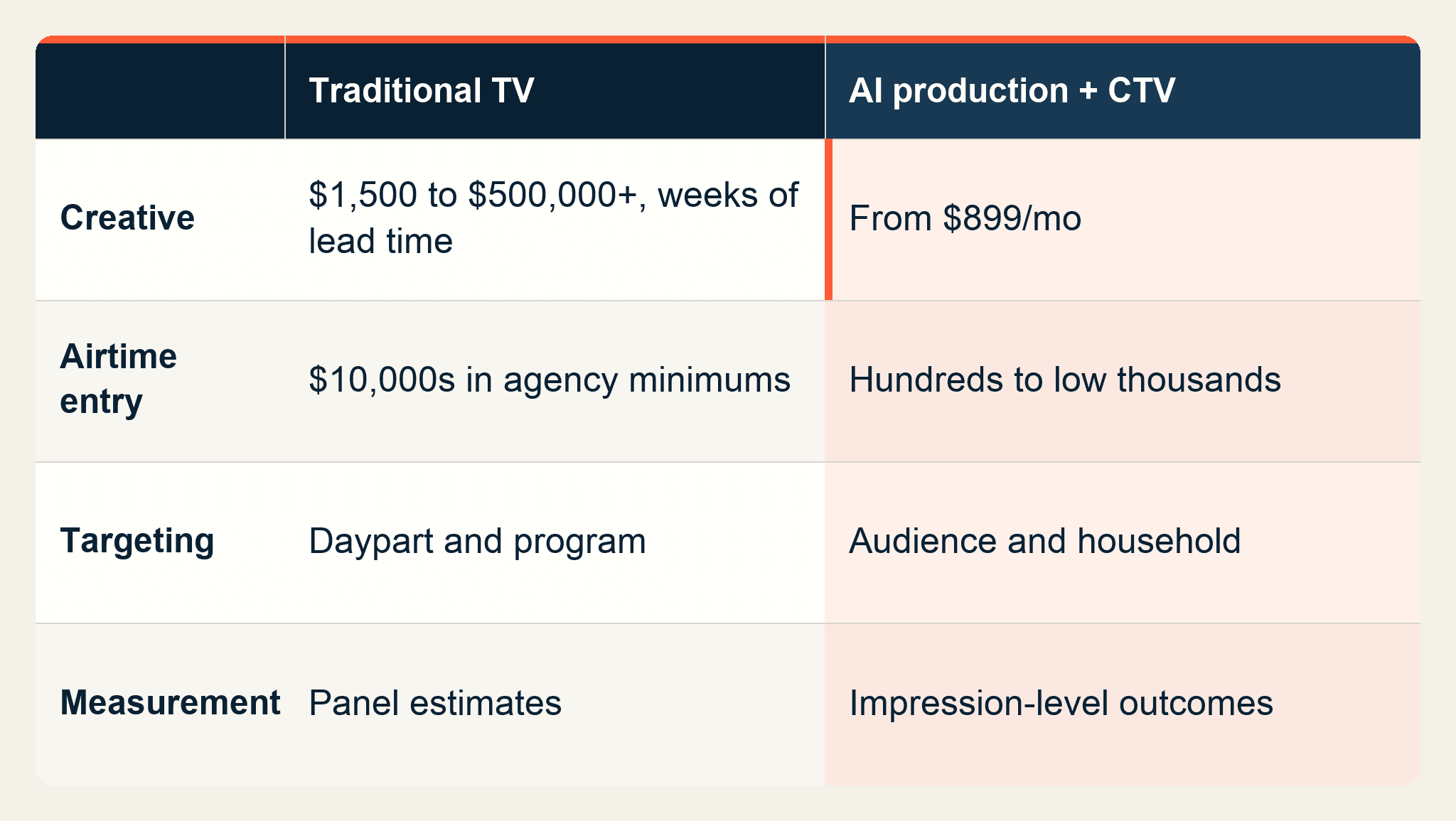
That removes the toll booth between a working ad budget and the living-room screen. The brands in our case studies drove through on performance budgets, not TV budgets: Strava lifted new-user registrations 28 percent against benchmark on CTV, and Vantage grew registrations 43 percent across its key markets.
FAQ
How much does a 30-second TV commercial cost?
Production runs $1,500 to $15,000 for local quality and $50,000 to $500,000 for national broadcast quality. Airtime adds $100 to $2,500 per local spot, $200,000 or more for national prime time, or $15 to $65 per thousand impressions on streaming.
How much does a Super Bowl commercial cost?
Super Bowl LX slots reportedly sold for $8 million per 30 seconds, and NBCUniversal confirmed the inventory sold out by September 2025. Production and celebrity fees come on top of the airtime.
Can a small business afford TV advertising?
On streaming, yes. Self-serve minimums run from zero to $500 depending on the platform, and a $2,000 to $5,000 test buys tens of thousands of impressions with full reporting. The historical blocker was producing a broadcast-quality ad, and AI production has substantially lowered that barrier.
How much does streaming TV (CTV) advertising cost?
Plan around $15 to $65: free ad-supported channels at $15 to $25, standard programmatic on premium services at $25 to $45, and direct deals on marquee content and live sports at $45 to $65. Actual rates vary by platform and targeting.
The bottom line
For fifty years, the honest answer to "how much does a TV commercial cost" was: more than you have. That answer is dead. Production that started at five figures now starts at a monthly subscription, and airtime that required a national buy now starts at the price of a search campaign. If you want the numbers for your specific case, book a demo and we will price a first campaign against your numbers, not against averages.